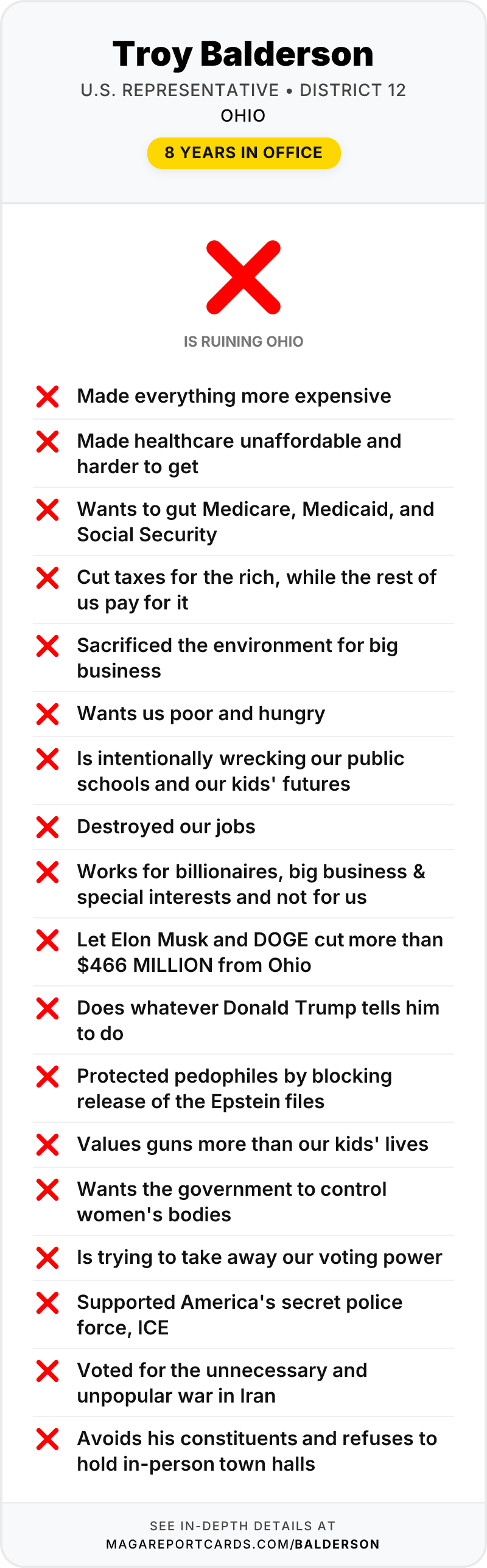
Most bills that help the fossil fuel industry do it the hard way — by repealing a rule, or funding a project, or blocking an agency.
Troy Balderson found a shorter route. On October 17, 2025, he introduced a bill that changes what the words mean.
H.R. 5765, the Affordable, Reliable, Clean Energy Security Act of 2025, does exactly one thing: it writes federal definitions of "affordable," "reliable" and "clean" energy into law, and then orders the Department of Energy, the Department of the Interior and the Environmental Protection Agency to go rewrite all of their "regulations, grants, guidance, and policies" on affordable, reliable and clean energy to match.
You can read the definitions yourself. They're three paragraphs long, and the rest of the bill is the order to use them.
"Clean" now includes burning hydrocarbons
Here is the bill's definition of clean energy, verbatim:
"The term 'clean' with respect to energy means any energy generated using — (A) an energy source listed in section 203(b) of the Energy Policy Act of 2005 (42 U.S.C. 15852(b)); (B) a nuclear reactor; or (C) the combustion of hydrocarbons, in accordance with the national ambient air quality standards under title I of the Clean Air Act (42 U.S.C. 7401, et seq.), including any such energy that is generated using natural gas."
Burning hydrocarbons would be clean, by statute, as long as the plant meets existing air standards. Not cleaner. Not lower-emission. Clean.
Every grant program at those three agencies that gives preference to "clean" energy would, within 180 days, have to treat a gas plant the same as a solar farm.
"Reliable" is written so wind and solar can't qualify
The other definition does the reverse. Under the bill, "reliable" energy must:
- have an Effective Load Carrying Capability of 60 percent or greater;
- not be "subject to intermittent availability"; and
- not be "subject to routine weather that impacts energy production."
Wind and solar cannot meet the second and third conditions. That isn't a side effect — it's the definition. As Spectrum News reported, energy policy experts said the bill addresses a real problem but that its definitions favor gas and nuclear over wind and solar, "in effect codifying Trump's energy policy."
Andrei Afanasev, a physics professor at George Washington University and a former senior adviser in the Energy Department's Office of Nuclear Energy during the Biden administration, told Spectrum:
"If you block a certain power source or a certain type of power in favor of others, that is a source of concern."
"My personal opinion is that you need to keep a fair balance between different energy sources, let markets speak and give a friendly hand to the industry if the industry needs it. It seems to me [the bill] is missing some necessary detail."
Balderson's own framing is narrower. "Grid reliability is the most important thing we have right now," he said, and the bill would merely undo what he described as the Biden administration's overemphasis on solar. "I feel that we're not advancing certain energies."
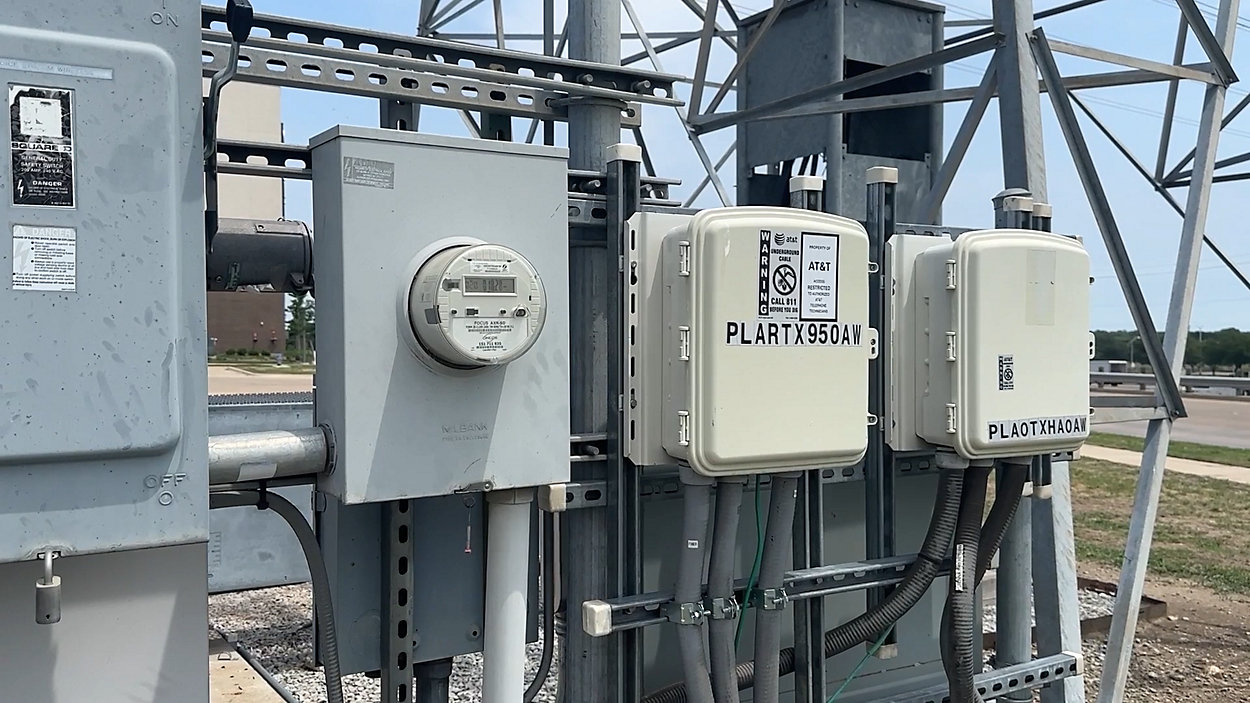
Nobody disputes that the grid is strained — power demand is climbing fast, driven partly by AI and data centers. The question is whether the fix is more capacity or a dictionary.
Follow the money
Balderson sits on the House Energy and Commerce Committee, which writes the rules for the electricity industry, and he chairs the House GOP Energy Action Team.
Two of his largest corporate PAC donors since 2020 are in exactly that industry:
- American Electric Power's PAC — $40,000. One of the largest electric utilities in the country, and one regulated by his own committee.
- Marathon Petroleum's PAC — $39,000. An oil refiner.
He ranks #297 out of 440 House members in grassroots funding — meaning almost all of his money comes from somewhere other than small donors. The full list is here.
And his record matches. The League of Conservation Voters gives him a 0% score for 2025 and 6% lifetime. Out of every environmental vote of his career, he has voted the right way roughly one time in seventeen.
This is his second run at it
The definitions bill isn't a one-off. It's the follow-up.
In December 2025, the House passed Balderson's earlier bill, the Reliable Power Act, which would force the EPA and other cabinet agencies — whenever the grid's reliability watchdog warns of a generation shortfall — to hand their pending power-plant rules to the Federal Energy Regulatory Commission, and bar them from finalizing those rules until FERC finds they won't threaten the power supply. All 218 Republicans on the floor voted yes; we wrote about the vote and the 188 of them with a report card here.
Put the two together and the strategy is clear:
- Reliable Power Act: give energy regulators a veto over clean-air rules.
- H.R. 5765: redefine the words those rules are written in.
One bill blocks the referee. The other rewrites the rulebook.
What Ohioans actually pay for
Balderson's district runs from suburban Columbus out into rural central and eastern Ohio — including Zanesville, Mount Vernon and Newark. The pollution from gas and coal plants doesn't stay at the plant. It lands in the air his constituents breathe, and it is the specific thing the EPA rules he's targeting exist to limit.
Ohio ranks 35th of 50 on the measures we track, and its Republicans in Congress voted to make health coverage, food aid and jobs worse. Balderson was among them.
He is not alone in Ohio on the energy-and-donors problem. Senator Jon Husted has taken $69,750 from the tech and utility companies at the center of Ohio's data center fight while promising to protect people's electric bills.
And he won't be asked about it at home
Constituents keep trying. Knox County organizers invited Balderson to an August 2025 town hall in Mount Vernon; he declined, and they scheduled it without him. The Columbus Dispatch ran a Knox County reader's letter under the headline "Rep. Troy Balderson is ducking and dodging us." In Athens County, residents got a meeting with his staff instead.
A bill that redefines "clean" so it covers combustion deserves to be defended out loud, in Ohio, to the people who breathe the result.
We deserve better.
Source
The bill text: H.R. 5765, the Affordable, Reliable, Clean Energy Security Act of 2025, introduced October 17, 2025. Reporting and quotes from Spectrum News 1, "Ohio lawmaker seeks to codify Trump's energy policies," November 5, 2025. Photo: Spectrum News 1.