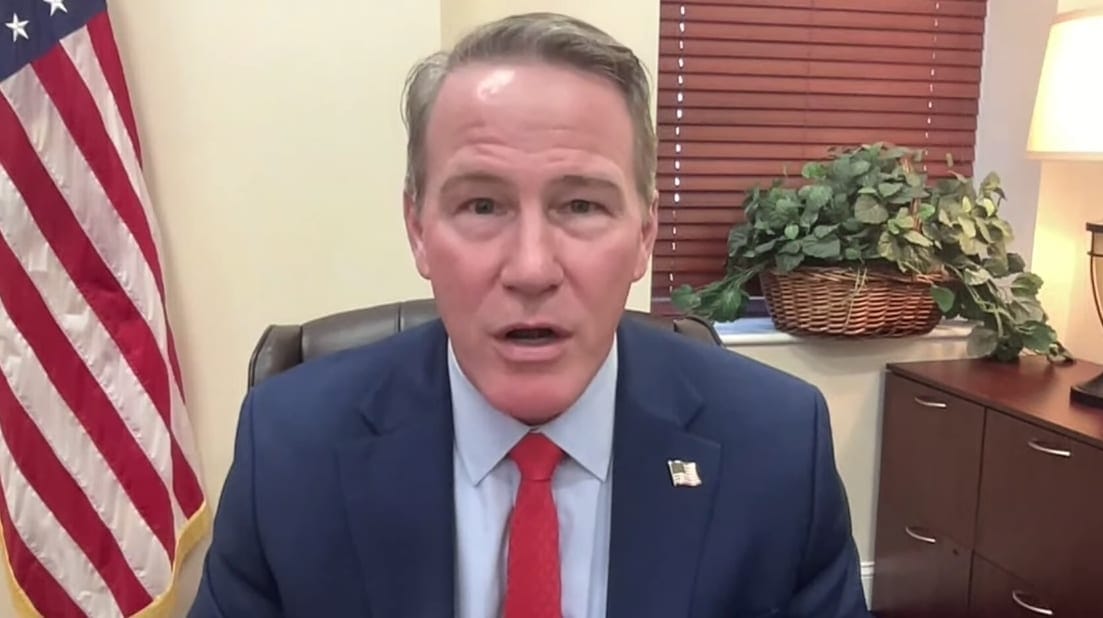
In 2021, the man in charge of Ohio's plan for its own workers got on a video call with the Darke County Chamber of Commerce and told them what he thought was coming.
"If you worked in something that had a repetitive nature to it, those kinds of jobs are going away," Jon Husted said. "They're going to be replaced by robots. I don't think that is a bad thing, because I don't think those are enriching — the enriching kinds of jobs that most people want to do."
The video resurfaced this month, and it matters because of the job Husted held when he said it. He was Ohio's lieutenant governor. He was also the director of the Governor's Office of Workforce Transformation — the state office whose whole purpose is building Ohio's workforce strategy, running job-training programs, and connecting employers with workers.
The person Ohio paid to protect its workers from exactly this told a room of employers it was fine.
"Not enriching" is a judgment about other people's work
Look closely at the reason he gave. Not "we'll retrain them." Not "we'll make sure nobody gets left behind." The reason was that those jobs aren't the "enriching kinds of jobs that most people want to do."
Husted was talking about work with a "repetitive nature." In Ohio that means assembly lines, warehouses, machine shops, packing plants, distribution centers. It means the jobs that built Dayton, Toledo, Lima and Youngstown.
Those jobs come with health insurance, a pension in some places, a union card in others, and enough money to pay a mortgage in a town where houses still cost something a family can carry. Whether or not a lieutenant governor finds them "enriching" is not the point. They pay.
And when one of them disappears, the person holding it does not get moved to something better. They get moved to something cheaper, or nothing.
What he did with the office after he said it
Husted's own office was running TechCred, a program that used state money to help employers pay for technology credentials for their workers — robotics, software, cybersecurity. In 2020 he framed it as preparation. "We must aggressively prepare Ohioans to compete," he said.
But preparation is what you do for a job that is changing. Husted told Darke County something different: these jobs "are going away." They don't need a credential. They need a replacement.
Then he spent his years as lieutenant governor bringing in the industry doing the replacing.
In 2019 he stood with Google executives to celebrate a $600 million data center in New Albany. The project was expected to create about 50 jobs within the next few years. Google got a 15-year property-tax break from New Albany and a 15-year state sales-tax exemption estimated at $43.5 million.
Husted defended it. "There's real benefits, to real people who live here and call central Ohio home," he said at the groundbreaking. He predicted the benefits would far outweigh the tax breaks, and that Columbus would become the "tech hub of the Midwest."
We've written before about who has been funding Husted while he defends those breaks: the tech and utility companies at the center of Ohio's data center fight have put at least $69,750 into his campaign.
Ohio has about 200 data centers now, and the consumer advocate says they create few permanent jobs
Ohio now hosts about 200 data centers — the fifth-highest count in the country, according to the Office of the Ohio Consumers' Counsel, which is the state's own advocate for utility customers. Companies plan as much as $40 billion more in Ohio data-center investment by 2030.
That same consumer advocate makes the point plainly: data centers create construction jobs while they're being built, and relatively few permanent jobs once they're running. A large AI facility can draw as much electricity as a small city while employing the population of a large restaurant.
This is the arithmetic Ohioans are living with. Their electric bills are up. The jobs are not. Husted's own party knows it — a leaked National Republican Senatorial Committee memo called his data center record an "anchor" around his campaign, and the state's data center tax break cost Ohio $1.57 billion last year, eleven times what was projected.
Ohio is not the only state where Republicans took utility money and then handed data centers the grid. We traced five of them across Texas, Florida, Ohio, Georgia and New Mexico.
In the Senate he is pushing the thing he said was fine
Husted is not a bystander to this anymore. He is a United States senator with a vote on how artificial intelligence gets regulated, and he has used the seat to push the industry forward.
At a White House roundtable in March on getting tech companies to fund their own data-center electricity, he called American dominance in AI a national priority: "If America wants economic and national security dominance, we must lead in technology and AI to stay ahead of adversaries like China."
In May he joined legislation to build a national research infrastructure for AI. In August he visited Path Robotics in Columbus, a company building AI-driven robotic welding systems. Husted said the company was helping Ohio manufacturers "overcome workforce challenges and increase their productivity."
"Overcome workforce challenges" is worth translating. A manufacturer's workforce challenge is that it needs people and people cost money. A robot overcomes it by removing the need for the person.
Husted said it more directly in 2021, before he had a Senate seat to protect: "They're going to be replaced by robots. I don't think that is a bad thing."
What the record shows
In 2021, while directing the Ohio office responsible for the state's workforce strategy and job training, Jon Husted told the Darke County Chamber of Commerce that repetitive jobs "are going away," would "be replaced by robots," and that this was "not a bad thing" because such work wasn't "enriching." He then helped bring a Google data center to New Albany that promised about 50 jobs in exchange for a 15-year local tax break and a state sales-tax exemption estimated at $43.5 million. Ohio now has about 200 data centers, the state's own consumer advocate says they produce few permanent jobs, and Husted is in the Senate promoting the industry.
Source
Reporting by Dave Miller for TiffinOhio.net, which credits MeidasTouch with surfacing the 2021 remarks.