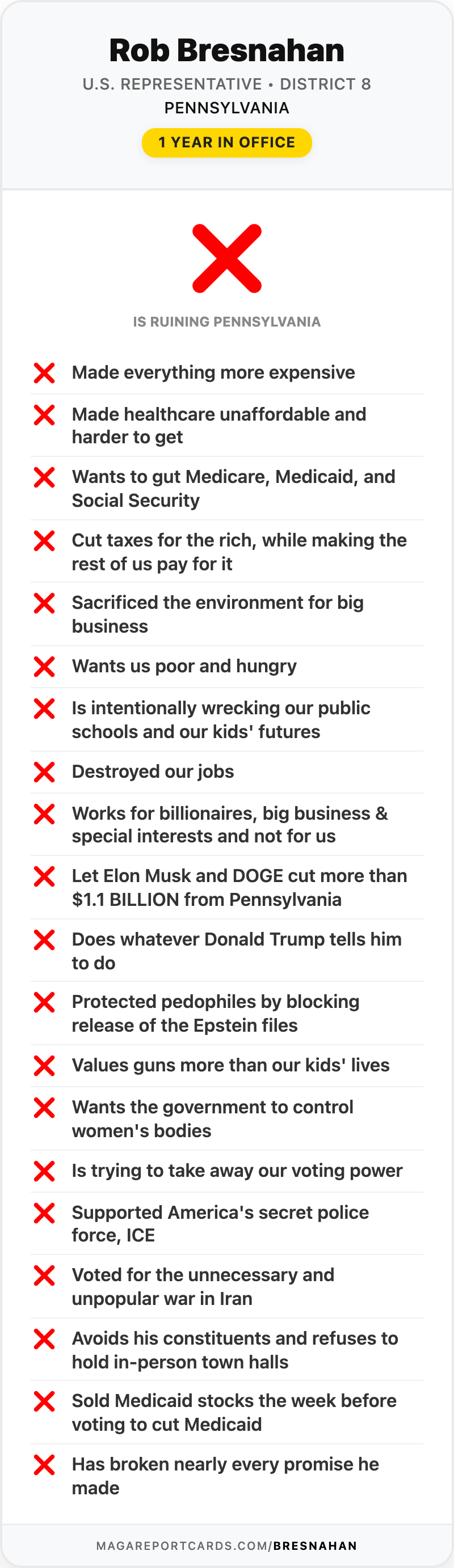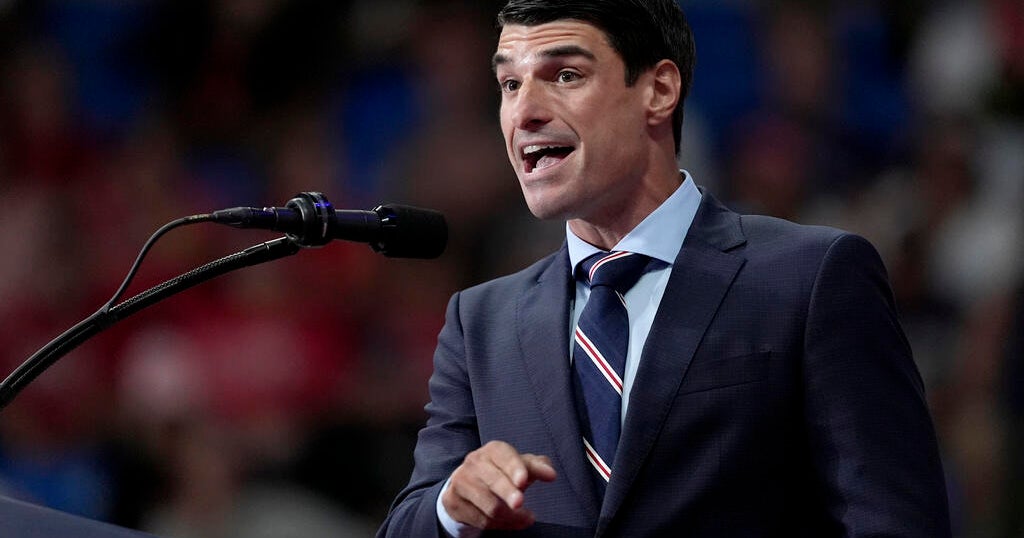
A television ad ran in Scranton and Wilkes-Barre on Wednesday and Thursday. In it, the congressman for Northeastern Pennsylvania makes a promise about who he is fighting.
"Northeastern Pennsylvania is our land and our home, but to big data, we're just land and dollar signs," Rob Bresnahan says. "I wrote the bill that makes data centers get local approval before construction and protects our communities when billion dollar corporations try to fight us."
CBS News looked at what Bresnahan owns. He owns big data.
The numbers in his own disclosure
Bresnahan filed a financial disclosure in August. Reporter Zak Hudak went through it and sorted the data center exposure into four groups.
- The companies that run data centers. Between roughly $19,005 and $110,000 in Equinix, Digital Realty Trust, Iron Mountain, and SBA Communications, whose SBA Edge subsidiary operates regional data centers and deploys modular ones.
- The companies that supply them. Between roughly $804,024 and $2.04 million in the chips, networking gear, semiconductor manufacturing tools and design software the industry runs on: NVIDIA, Advanced Micro Devices, Micron Technology, Arista Networks, Ciena, Applied Materials, Lam Research, Cadence Design Systems, Synopsys, Taiwan Semiconductor, Cisco, Broadcom and Credo Technology.
- The tech giants building and leasing the capacity. Between roughly $777,000 and $1.78 million in Amazon, Alphabet, Meta Platforms and Oracle.
- Blackstone. Between $15,001 and $50,000 in the investment firm that, in July 2025, announced data-center-related energy investments in Northeastern Pennsylvania — his own district's corner of the state.
Add the four disclosed ranges together and the exposure runs from about $1.6 million at the low end to roughly $3.98 million at the high end. Bresnahan's campaign did not answer CBS News' questions about the holdings.
Last year he was "pleased to hear" they were coming
The ad presents Bresnahan as someone who saw the data centers arrive and stood in the way. That is not what he said when they arrived.
In April 2025 he told the Wilkes-Barre Times Leader he was "pleased to hear that companies are looking to Northeastern Pennsylvania for their data centers, which can serve as catalysts for economic growth and technological innovation for our region as we work towards fostering a 22nd century workforce."
Fourteen months later, he introduced a bill to stop the industry suing towns that block them.
What changed in between was not the industry. It was the polling. An August 2026 Franklin & Marshall College poll found that nearly four in five Pennsylvania voters oppose having a data center built in their community. Regional economic development officials said earlier this year that roughly 29 data center projects were under consideration or in planning in Northeastern Pennsylvania alone.
His spokesperson, Samantha Bullock, told CBS News the bill "is consistent with his longstanding stance in favor of local control," and that "favoring local control over data center development does not make someone anti-investment. It shows that they support the will of the people."
That is the tell. "Support the will of the people" is a description of following a poll, not of holding a position.
Bullock's statement also notes it is "important and responsible to consider the blue-collar jobs and economic development that might benefit a region like Northeastern Pennsylvania when addressing and legislating this issue" — which is, in substance, the 2025 argument for the data centers, offered as part of the defense of the 2026 bill against them.
The bill he is running the ad about has not moved
Bresnahan introduced the local-control bill, H.R. 9262, on June 11. It would strip the federal courts of jurisdiction to hear a challenge to a town's decision to block a data center, and bar federal permits while a developer is suing over a zoning denial. It was referred to two committees the day it was introduced and has not moved since.
So the thing the ad credits him with — "I wrote the bill" — is accurate, and it is also the whole of it. He wrote it, it sat, and three months later he bought airtime to tell voters he wrote it.
"My advisers do it" is the answer he always gives
Bresnahan says financial advisers manage his portfolio and that he has no input in his trades. He has said this repeatedly.
He said a version of it before. In August we wrote about how, nine days after announcing a blind trust, he sold up to $130,000 in Medicaid company stock — and a week after that, voted to cut Medicaid. In July he voted for a trading ban that would not have stopped him, and then told voters he had fixed Congress.
During his 2024 campaign he pledged to back a ban on congressional stock trading, on the grounds that lawmakers should not buy and sell stocks while voting on laws affecting those companies. He introduced his own version after taking office. It has not advanced either.
Meanwhile his disclosed trades since entering office rank him seventh among all members of Congress, with more than 500 transactions reported, according to Capitol Trader.
His own constituents have noticed. Residents of Lackawanna and Luzerne counties gathered nearly double the signatures required to put an insider trading ban on their November ballot — a county charter provision that would list their congressman's own trades in an annual public report.
Northeastern Pennsylvania is not the only place this is happening
Somebody pays for the electricity these facilities draw, and it is generally the people who live nearby. We traced five Republicans across Texas, Florida, Ohio, Georgia and New Mexico who took utility industry money and then handed data centers the grid.
Bresnahan's version is narrower and stranger. He is not defending the build-out. He is running against it, in an ad, while holding the stock.
What the filings show
Rob Bresnahan's August 2026 financial disclosure lists between roughly $19,005 and $110,000 in four data center operators, between roughly $804,024 and $2.04 million in the chipmakers and equipment suppliers the industry depends on, between roughly $777,000 and $1.78 million in Amazon, Alphabet, Meta and Oracle, and between $15,001 and $50,000 in Blackstone, which announced data-center energy investments in his own region last year. In April 2025 he called data centers "catalysts for economic growth" for Northeastern Pennsylvania. In June 2026, after a poll found nearly four in five Pennsylvanians opposed one in their community, he introduced a bill to keep towns that block them out of federal court; it has not advanced. This week he paid for television ads telling voters that "to big data, we're just land and dollar signs." His campaign would not answer questions about the holdings.
Source
Zak Hudak, GOP Rep. Rob Bresnahan campaigns on data center limits while investing in industry, CBS News, September 11, 2026. Photo: Associated Press.