On September 2, 2026, the House voted on a change to the United States Constitution. Not a bill. Not a spending fight. An amendment to the founding document itself — one that would have written a single sentence into it: "The Supreme Court of the United States shall be composed of nine justices consisting of one chief justice and eight associate justices."
It failed, 212 to 206. Amendments need two-thirds of the House, and it did not come close. But 211 Republicans voted for it, and 188 of them have a report card on this site.
The number nine is not in the Constitution
That is the part worth sitting with. The founders wrote Article III and left the size of the Supreme Court blank on purpose. As the federal courts' own historians put it, the Constitution "leaves for Congress to determine the size and responsibilities of the Court."
And Congress has determined it, over and over. The Judiciary Act of 1789 created a Court of six. A seventh justice was added in 1807. An eighth and a ninth in 1837. A tenth in 1863. In 1866 Congress shrank it back to seven. In 1869 Congress settled on nine, and there it has stayed ever since.
Five changes. Every one of them made by ordinary law, by the elected representatives of the people, exactly as the founders designed it.
What they were actually voting on
The amendment would not have frozen the justices themselves. Justices still die. Justices still retire. Seats still come open, and whoever is president when that happens still fills them. That much stays the same.
What the amendment would have frozen is the number — and, more to the point, it would have taken that number out of Congress's hands and put it somewhere Congress cannot reach. An ordinary law can be changed by the next Congress. A constitutional amendment can only be undone by another constitutional amendment: two-thirds of the House, two-thirds of the Senate, and ratification by the legislatures of three-fourths of the states. Thirty-eight of them.
So the question is not really about the number nine. It is about who gets to decide, and when they decided to stop deciding.
The timing
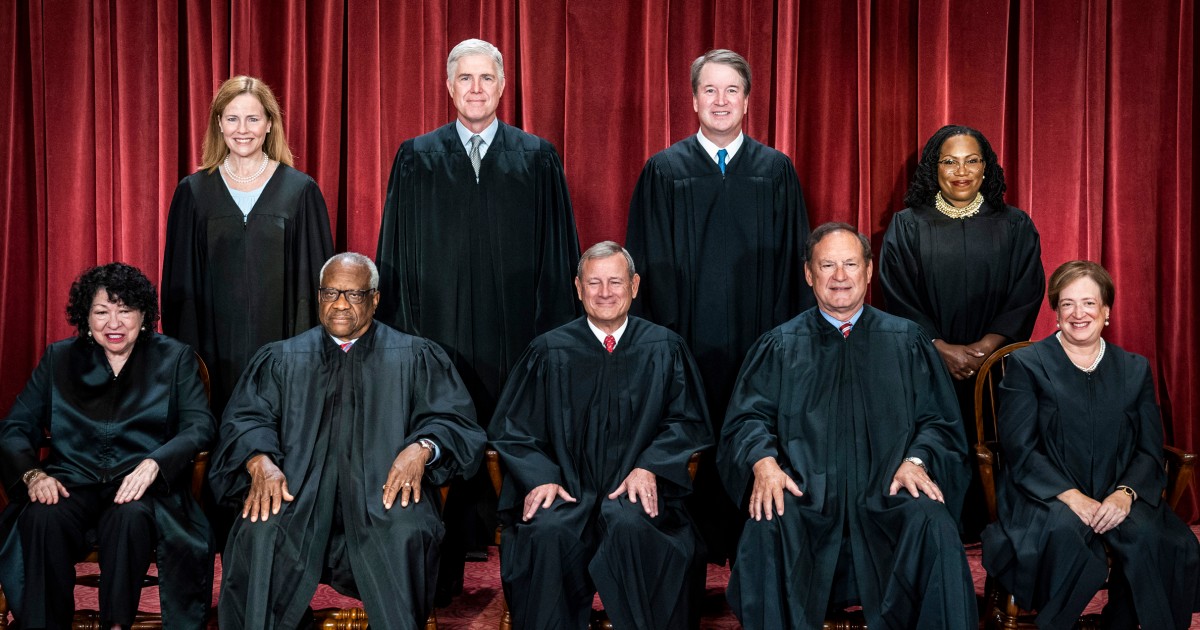
Six of the nine sitting justices were appointed by Republican presidents: Chief Justice John Roberts and Justices Clarence Thomas, Samuel Alito, Neil Gorsuch, Brett Kavanaugh and Amy Coney Barrett. Three of those six — Gorsuch, Kavanaugh and Barrett — were put there by Donald Trump. The other three justices, Sonia Sotomayor, Elena Kagan and Ketanji Brown Jackson, were appointed by Democrats.
That six-to-three majority is not an abstraction. It is the majority that overturned Roe v. Wade in 2022, ending the constitutional right to an abortion in this country and handing the question to state legislatures. Six of them ruled for Mississippi. Five of the six voted to throw out Roe itself — Alito, Thomas, Gorsuch, Kavanaugh and Barrett. Chief Justice Roberts would not go that far, writing that he would "take a more measured course."
Republicans chose this moment — with that Court seated and that record on the books — to try to bolt the door shut behind it.
Rep. Mary Gay Scanlon of Pennsylvania said on the floor that the amendment would "lock in for a generation or more a right-wing majority." Rep. Jamie Raskin of Maryland, the top Democrat on the Judiciary Committee, called it "another partisan power grab." The office of House Minority Whip Katherine Clark told members it would "strip Congress of yet another constitutional authority that is meant to be controlled by the American people's representatives."
Who pushed it
The amendment was written by Arizona's Andy Biggs, who is now running for governor of his state. He introduced it on the first day of this Congress and picked up exactly two cosponsors along the way: Georgia's Rick Allen and Kansas's Derek Schmidt. The House Judiciary Committee sent it to the floor on a 15-to-8 vote in June, and Speaker Mike Johnson brought it up for a vote on September 2.
Biggs argued the change was about fairness across administrations. "If a sitting majority can change the size of the Supreme Court the moment it dislikes rulings, what happens the next time the other side is in power?" he asked. In a statement after the committee vote, he said special interests were "threatening to pack this iconic American institution to ensure favorable outcomes for their causes," and that his amendment would "protect the Court's legitimacy."
North Carolina's Mark Harris said the push from the left was meant "to consolidate power and intimidate the court."
Here is the trouble with that argument. There is exactly one bill in this Congress to add seats to the Supreme Court. Texas Democrat Al Green introduced it on May 4, 2026, it would raise the number from nine to thirteen, and it has picked up zero cosponsors. It was referred to the House Judiciary Committee — the committee Republicans run — and it has not moved since. No hearing. No markup. No vote.
So nothing was being stopped on September 2. What was on the floor was a permanent change to the Constitution, offered by the side that currently holds the advantage, at the exact moment it holds it. If the principle really is that the rules should be the same no matter who is in power, the year to write it down is not the year your own appointees hold six of the nine seats.
Only one Democrat, Rep. Don Davis of North Carolina, voted yes.
Who voted to freeze the Court
188 Republicans with a report card on this site voted for the amendment. Here they are, grouped by state:
Alabama: Barry Moore, Dale Strong, Gary Palmer, Mike Rogers, Robert Aderholt
Alaska: Nick Begich
Arizona: Abraham Hamadeh, Andy Biggs, David Schweikert, Eli Crane, Juan Ciscomani, Paul Gosar
Arkansas: Bruce Westerman, French Hill, Rick Crawford, Steve Womack
California: David Valadao, James Gallagher, Ken Calvert, Tom McClintock, Vince Fong, Young Kim
Colorado: Gabe Evans, Jeff Crank, Jeff Hurd, Lauren Boebert
Florida: Aaron Bean, Anna Paulina Luna, Brian Mast, Carlos Gimenez, Greg Steube, Gus Bilirakis, Jimmy Patronis, John Rutherford, Kat Cammack, Laurel Lee, Maria Elvira Salazar, Mario Diaz-Balart, Mike Haridopolos, Randy Fine, Scott Franklin
Georgia: Andrew Clyde, Austin Scott, Brian Jack, Clay Fuller, Mike Collins, Rich McCormick, Rick Allen
Idaho: Mike Simpson, Russ Fulcher
Illinois: Darin LaHood, Mike Bost
Indiana: Erin Houchin, Jefferson Shreve, Jim Baird, Mark Messmer, Marlin Stutzman, Rudy Yakym, Victoria Spartz
Iowa: Ashley Hinson, Mariannette Miller-Meeks, Zach Nunn
Kansas: Derek Schmidt, Ron Estes, Tracey Mann
Kentucky: Andy Barr, Brett Guthrie, Hal Rogers, James Comer
Louisiana: Clay Higgins, Julia Letlow, Mike Johnson, Steve Scalise
Maryland: Andy Harris
Michigan: Bill Huizenga, Jack Bergman, John James, John Moolenaar, Lisa McClain, Tim Walberg, Tom Barrett
Minnesota: Brad Finstad, Michelle Fischbach, Pete Stauber, Tom Emmer
Mississippi: Michael Guest, Mike Ezell, Trent Kelly
Missouri: Ann Wagner, Bob Onder, Eric Burlison, Jason Smith, Mark Alford
Montana: Troy Downing
Nebraska: Adrian Smith, Mike Flood
New Jersey: Chris Smith, Jeff Van Drew
New York: Andrew Garbarino, Claudia Tenney, Mike Lawler, Nick LaLota, Nick Langworthy, Nicole Malliotakis
North Carolina: Brad Knott, Chuck Edwards, David Rouzer, Greg Murphy, Mark Harris, Pat Harrigan, Richard Hudson, Tim Moore, Virginia Foxx
North Dakota: Julie Fedorchak
Ohio: Bob Latta, David Joyce, David Taylor, Jim Jordan, Max Miller, Michael Rulli, Mike Carey, Mike Turner, Troy Balderson, Warren Davidson
Oklahoma: Frank Lucas, Josh Brecheen, Kevin Hern, Stephanie Bice, Tom Cole
Oregon: Cliff Bentz
Pennsylvania: Brian Fitzpatrick, Dan Meuser, Glenn Thompson, Guy Reschenthaler, John Joyce, Lloyd Smucker, Mike Kelly, Rob Bresnahan, Ryan Mackenzie, Scott Perry
South Carolina: Joe Wilson, Ralph Norman, Russell Fry, Sheri Biggs, William Timmons
Tennessee: Andy Ogles, Chuck Fleischmann, David Kustoff, Diana Harshbarger, John Rose, Matt Van Epps, Scott DesJarlais, Tim Burchett
Texas: August Pfluger, Beth Van Duyne, Brandon Gill, Brian Babin, Craig Goldman, Jake Ellzey, John Carter, Keith Self, Lance Gooden, Michael Cloud, Monica De La Cruz, Nathaniel Moran, Pat Fallon, Pete Sessions, Randy Weber, Roger Williams, Ronny Jackson
Utah: Blake Moore, Celeste Maloy, Mike Kennedy
Virginia: Ben Cline, Jen Kiggans, John McGuire, Morgan Griffith, Rob Wittman
Washington: Michael Baumgartner
West Virginia: Carol Miller, Riley Moore
Wisconsin: Bryan Steil, Derrick Van Orden, Glenn Grothman, Scott Fitzgerald, Tom Tiffany, Tony Wied
Wyoming: Harriet Hageman