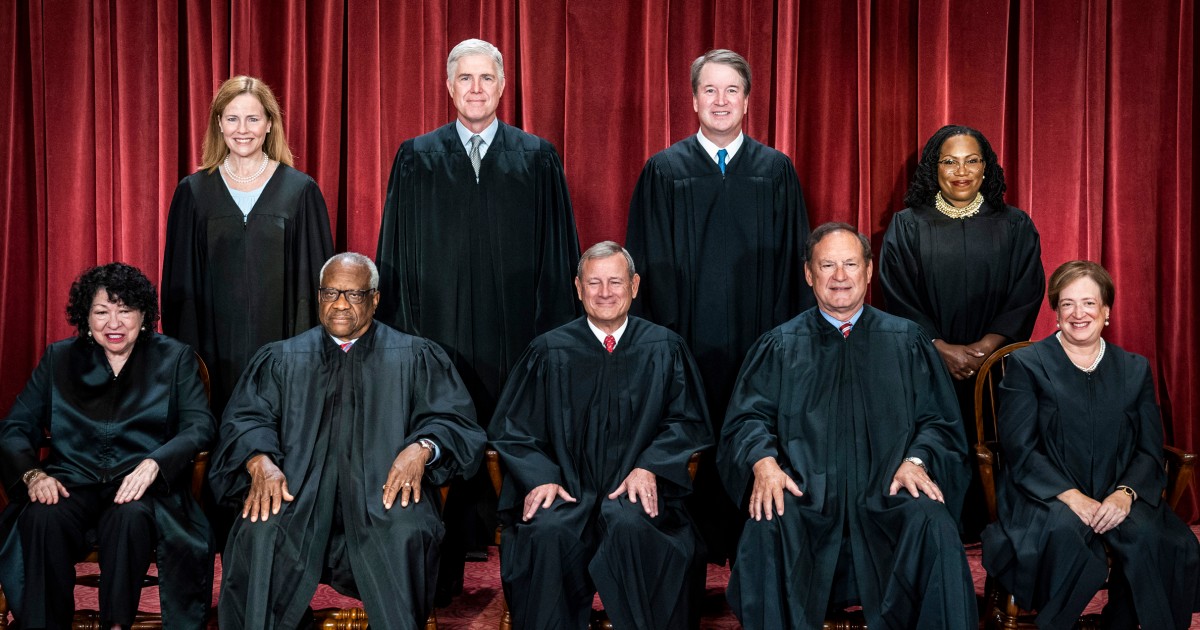
For four years, Republicans have told us the same thing about abortion: it's up to the states now. That's what the Supreme Court said in 2022 when it overturned Roe v. Wade. Every state gets to decide for itself. No national ban. Just let the people vote.
That was never the plan.
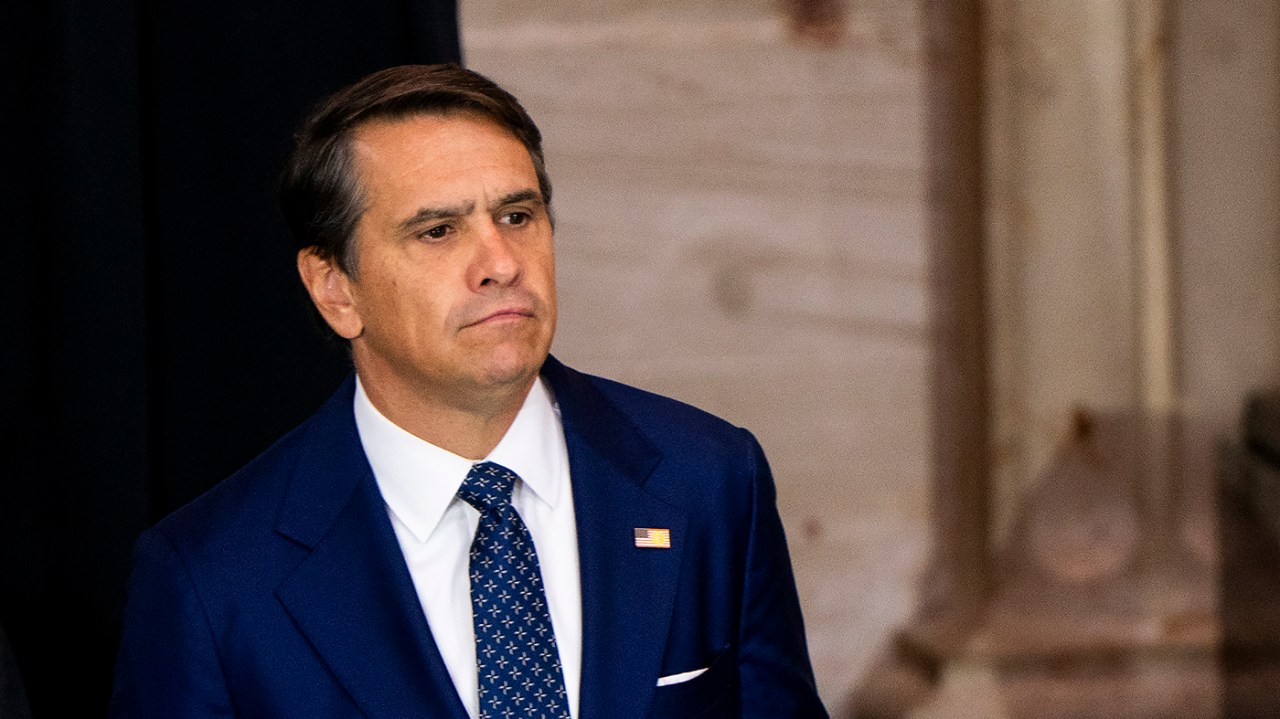
On a private call hosted by the White House Faith Office, acting Attorney General Todd Blanche told the religious group Intercessors for America that the Justice Department is "working hand-in-hand" with federal health agencies, the White House and President Trump's team "to get permanent solutions so the Dobbs decision becomes permanent in every single state."
Every single state. Not just the ones with bans. All of them.
Blanche admitted the work is "taking longer than we want." But he promised it's coming.
"We don't have complete victory yet, but we will have victory, and victory will be soon, and it will be permanent."
The group posted the recording on YouTube. Politico found it. The Hill confirmed it on August 4, 2026 — the same day Senate Republicans voted to make Blanche the permanent attorney general of the United States.
What "permanent in every single state" actually means
Since Roe fell, abortion hasn't gone away. It's gone in the mail.
Most abortions in America now use pills, not a clinic — 63% of them by 2023, up from 53% in 2020. In 2023, the Biden administration ended the rule that made women pick up mifepristone in person. Blue states passed "shield laws" that protect doctors from being prosecuted for prescribing to patients in states with bans. Put those two things together and a woman in a banned state can still get care.
That's what Blanche says he's going to stop.
"If states have said, 'We are going to protect the unborn and we're going to protect every life from the moment of conception,' we're putting practices and policies in place so that other states and other organizations can't attack that. They can't do things like they're doing with mailing in mail-order drugs."
Read that again. The "other states" he wants to stop aren't breaking any law. They passed their own laws, in their own legislatures, to protect their own doctors. Blanche is saying the federal government will override them.
The tool for that is a law from 1873. The Comstock Act was an anti-obscenity law written before women could vote, and it bans mailing "every article or thing designed, adapted, or intended for producing abortion." In 2022, the Justice Department concluded it doesn't apply to mailing abortion pills unless the sender knows they'll be used illegally. A different Justice Department can simply write a different opinion — and then start prosecuting. It would hit every state, including the ones where abortion is legal.
Blanche wouldn't say whether that's his plan. But he didn't say it wasn't.
What he said under oath vs. what he said in private
At his confirmation hearing on July 15, Blanche was careful. He told senators he'd make mifepristone a priority but wouldn't give specifics. He said the administration opposed the Biden-era mail-order rule and that the DOJ "could review it." He said the FDA was taking "a real look" at whether the pills are safe.
"We are not in any way defending what Biden and what his administration did," he said.
That's hedging. On the prayer call, there was no hedging at all — just a promise of total, permanent victory in all 50 states.
When The Hill asked about it, the Justice Department said the comments "have been mischaracterized and need to be understood in their full context, which was with respect to mail order abortion drugs, not a broader expansion of federal control over states."
But blocking one state from mailing pills into another state is federal control over states. That's the whole idea.
Ashley Moody voted to hand him the job
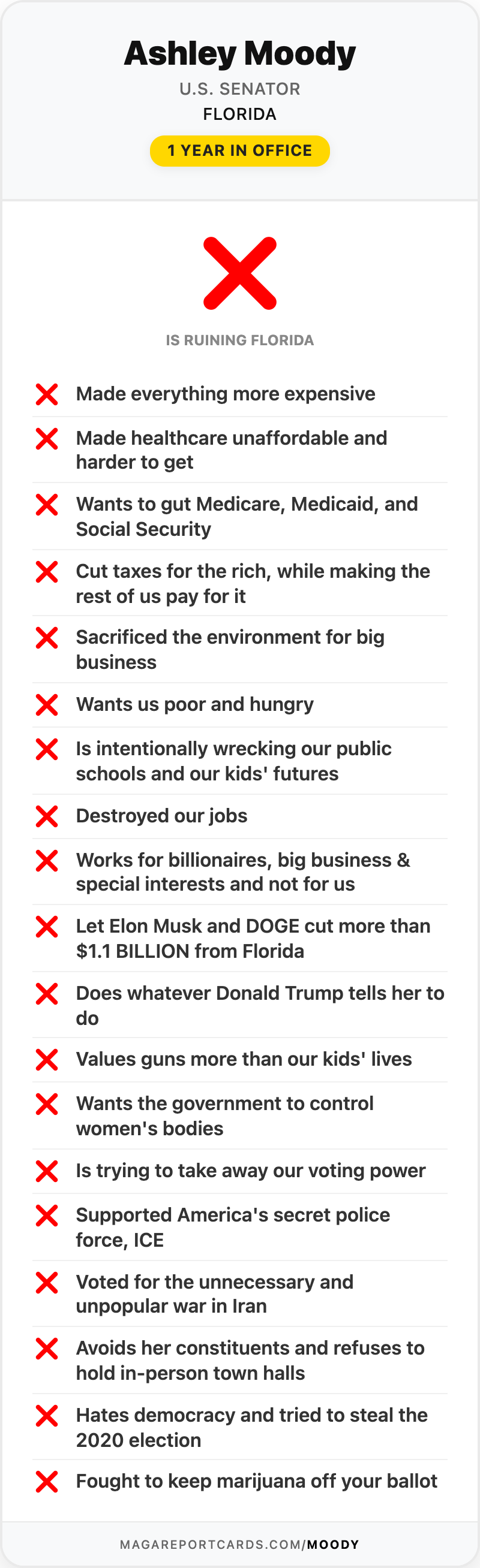
Ashley Moody sits on the Senate Judiciary Committee. On August 4, that committee voted 12–10, straight down party lines, to send Blanche's nomination to the Senate floor. Every Republican on the panel voted yes. Moody is one of the twelve Republicans on that committee.
She didn't just vote for him. She campaigned for him. Moody publicly endorsed Blanche, calling him "an excellent attorney, a former federal prosecutor, and a dedicated public servant" and saying she looked forward to "our continued work together." The anti-abortion group Americans United for Life backed him too.
None of this is out of character. Before DeSantis appointed her to the Senate, Moody spent six years as Florida's attorney general, and she used that job to try to keep Floridians from ever voting on abortion at all. In 2023 she filed a 39-page brief asking the Florida Supreme Court to strip the abortion-rights amendment off the 2024 ballot, calling it an attempt to "hoodwink" voters.
The court let it on the ballot anyway. And then something remarkable happened: 57.17% of Floridians voted yes. A clear majority. It still failed, because Florida requires 60% to amend the constitution.
So Florida is still enforcing a six-week ban. Nearly six in ten Floridians voted to change that. Moody fought to keep them from getting the chance, and now she's voted to confirm the man who says he'll make that ban permanent.
Susan Collins says no — four years too late
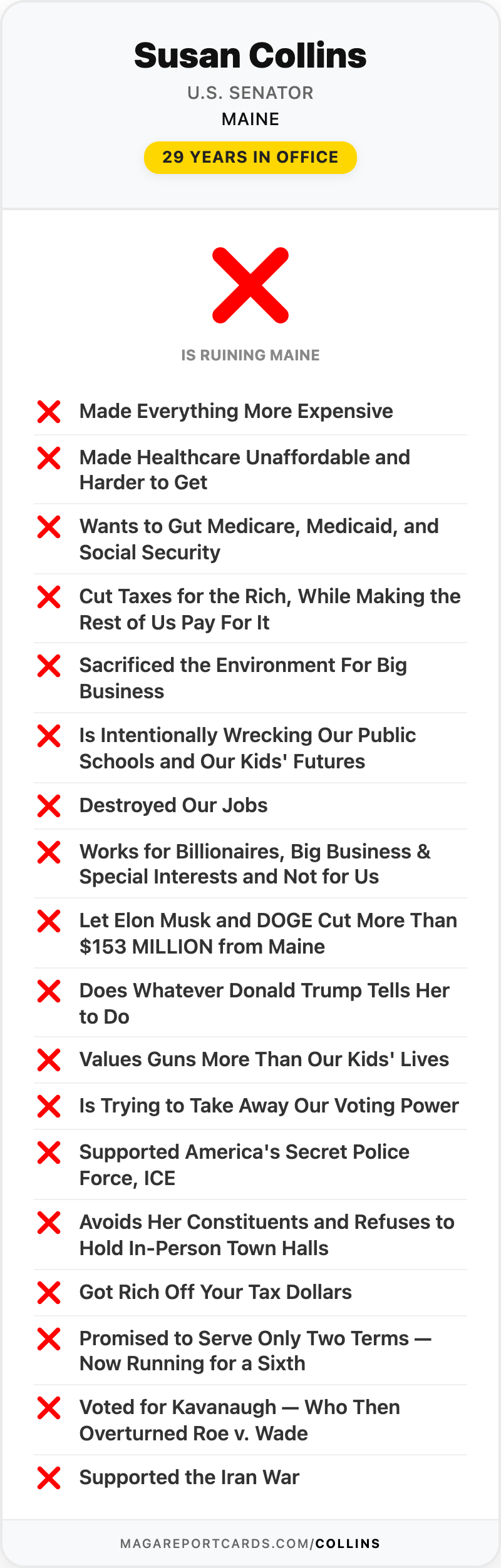
Hours after the committee vote, Susan Collins announced she'd oppose Blanche on the floor. Her reason wasn't abortion. "While I believe Mr. Blanche is a capable lawyer, the Department of Justice has become increasingly political," she said. "Mr. Blanche has taken several actions that have further eroded the Department's independence."
Collins is the Senate's most famous self-described pro-choice Republican. She also put the fifth vote to overturn Roe on the Supreme Court.
In 2018, she voted to confirm Brett Kavanaugh, who was seated 50–48. She told Mainers he had assured her privately that Roe was "settled law" and an important precedent. Four years later Kavanaugh wrote that Roe was "wrongly decided" and "should be overruled." Collins called the ruling a "sudden and radical jolt to the country."
She has never taken it back. This June, asked on Fox News whether the Kavanaugh vote is a problem for her reelection, she claimed it didn't matter: "Whether Justice Kavanaugh were confirmed or not, Roe v. Wade would have been overturned, given the 6-3 vote."
That's not what happened. The 6-3 part of Dobbs upheld Mississippi's 15-week ban. The part that threw out Roe entirely was 5-4 — and Kavanaugh was in that five. Her own spokesperson later acknowledged she misspoke.
Here's why it lands so hard right now. Maine has a shield law, in effect since August 2024, that protects Maine doctors who provide reproductive care from out-of-state investigations. Maine providers are exactly the "other states and other organizations" Blanche says he's building policies to stop. The protections Collins points to when she calls herself pro-choice are the next target.
A "no" vote this week doesn't undo a "yes" vote in 2018.
What happens next
Blanche's nomination is on the Senate floor. Republicans hold 53 seats. With Mitch McConnell still absent and Collins a no, Blanche can lose exactly one more Republican and still be confirmed. He is expected to get there.
If he does, the man who privately promised to make the Dobbs decision "permanent in every single state" will run the Justice Department, control the Comstock Act, and decide who gets prosecuted for putting a pill in the mail.
They told us it would be left to the states. It was a talking point with an expiration date.
We deserve better.
Source
FactPost on X, reporting on Blanche pledges to make Dobbs decision 'permanent' in every state by Nathaniel Weixel, The Hill, August 4, 2026. Photo: The Hill.