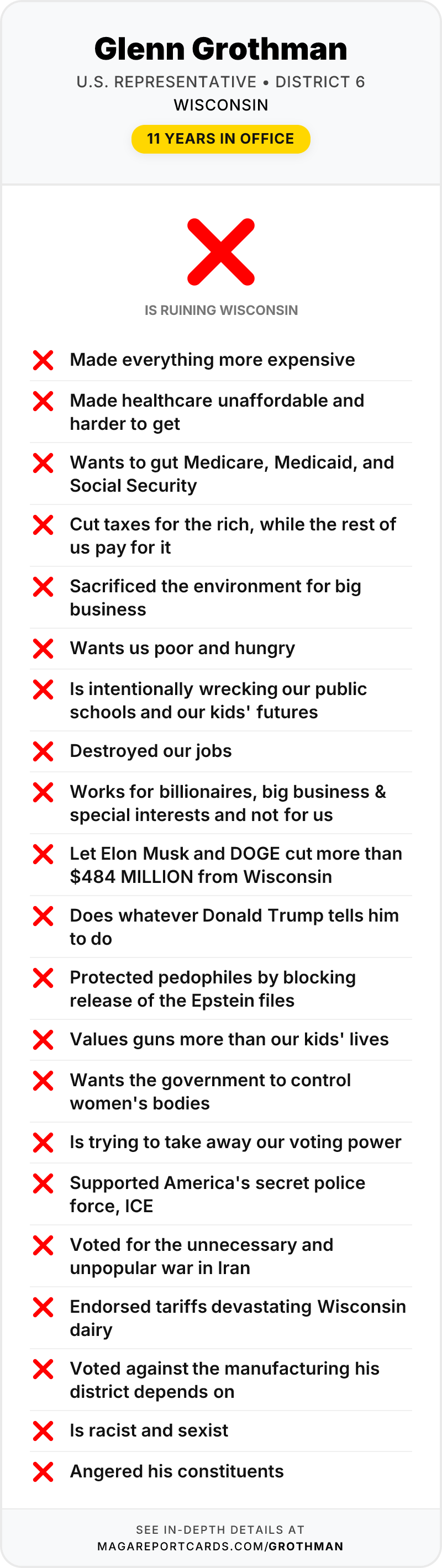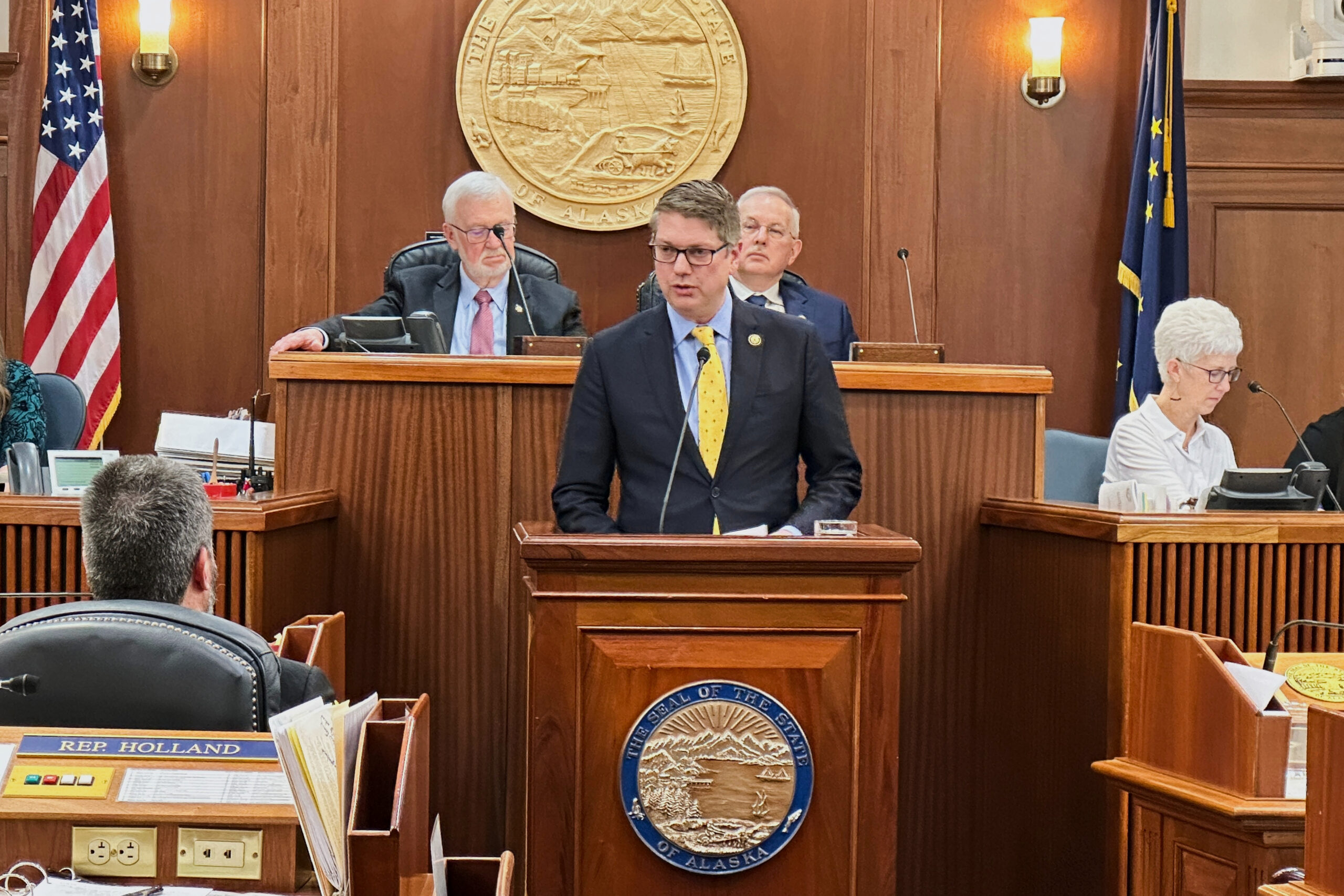
On October 3, 2025, three days into a government shutdown, Glenn Grothman went on Wisconsin Public Radio and said out loud what most of his colleagues were careful not to.
He wanted people fired — and said the shutdown had nothing to do with it: "whether or not there's a shutdown is irrelevant."
"I would certainly hope that President Trump would step up and let go — certainly in the Department of Defense, probably other departments, as well — find (100,000) or 200,000 jobs that are not necessary," he told WPR's "Wisconsin Today."
Then he explained why he thought that was fine:
"A lot of these people are not working very hard at all. To keep hiring people, many with over six-figure salaries when they aren't working that hard, that's just irresponsible."
His evidence, offered in the same interview: "There is a lot of anecdotal evidence out there that these people aren't working that hard."
Anecdotal evidence. That is the entire case for firing up to 200,000 people.
A week later, it happened
Grothman was not talking into the void. On Friday, October 10, 2025 — seven days after that interview — the administration sent reduction-in-force notices to more than 4,000 federal employees at at least seven agencies. KPBS reported the targets included the IRS, the Substance Abuse and Mental Health Services Administration, HUD's Office of Fair Housing and Equal Opportunity, the Department of Energy's Office of Energy Efficiency and Renewable Energy, and the Department of Education's Office of Special Education and Rehabilitative Services.
The CDC alone got 1,300 notices. More than half of those were reversed over the weekend — and HHS admitted to the court that nearly 800 of its notices had gone out in error, because of "data discrepancies and processing errors."
On October 15, U.S. District Judge Susan Illston paused the whole thing. From the bench she asked the government's lawyers: "This hatchet is falling on the heads of employees all across the nation and you're not even prepared to address whether that's legal?" She described the administration's approach as "very much 'ready, fire, aim'" and said the human cost of that "cannot be tolerated."
Her order stopped the layoffs already underway and blocked new ones at more than 30 agencies. Then Congress itself shut the door. The spending bill that ended the shutdown barred the use of any federal funds "to initiate, carry out, implement, or otherwise notice a reduction in force" anywhere in the federal government between October 1, 2025 and January 30, 2026.
So the plan Grothman publicly asked for got carried out, got called a hatchet job by a federal judge, got partially reversed by the agencies themselves within days, and then got banned by a bipartisan act of Congress. He has not, as far as we can find, revisited the idea.
The 2019 vote almost nobody else cast
Here is the part of Grothman's record that explains everything else.
In January 2019, in the middle of a five-week shutdown, Congress passed the Government Employee Fair Treatment Act. It is a short bill. It guarantees that federal workers who go unpaid during a shutdown get their back pay when it ends — including the ones who were required to keep working without a paycheck.
It passed the House 411 to 7.
Grothman was one of the seven. The full list of Nays: Justin Amash, Andy Biggs, Paul Gosar, Glenn Grothman, Thomas Massie, Chip Roy, and Ted Yoho.
Four hundred and eleven members of Congress — including virtually every Republican — thought people who are forced to work without pay should eventually be paid. Grothman was in the seven who did not.
And in that same 2025 WPR interview, he told listeners exactly how he still feels about it:
"I felt they changed the rule a couple of years ago where, if you are not working, say you don't work for a month, you get paid for that month anyway. So there are a lot of federal employees (who are) going to come out ahead of the game."
The rule "they changed … a couple of years ago" is the law he voted against. He is still annoyed it exists. He thinks furloughed workers who get paid for weeks the government wouldn't let them work are coming out "ahead of the game."
About 18,000 Wisconsinites work for the federal government
This is not an abstraction in his state. WPR reported that roughly 18,000 civilian federal workers live and work in Wisconsin. VA hospital staff. Social Security claims processors. Food safety inspectors. Air traffic controllers. National Guard technicians.
Grothman also told WPR that a shutdown wouldn't matter much: "I don't think it's going to be as big an impact as people say. All the big federal programs, Social Security, Medicare, Medicaid, they all continue on as before. There are people who are going to get a delayed paycheck but they're still going to get their paycheck."
A "delayed paycheck" is the phrase you use when you have never had to make rent on one.
He sits on the committee that oversees the federal workforce
Grothman is a member of the Committee on Oversight and Government Reform, per the House Clerk's official member roster — the committee whose actual job is oversight of how the federal government is staffed and run.
That means he had every tool available to make the case with evidence. Hearings. Subpoenas. GAO requests. Inspector general referrals. Data.
Instead, he went on the radio and said there's "a lot of anecdotal evidence."
This is the same pattern we documented with Gary Palmer, who claimed DOGE did better oversight in six weeks than Congress managed in forty years — right up until the GAO reported that DOGE wouldn't even answer the auditors' questions. And it's the same pattern that ran through DOGE's entire short life: enormous claims, no receipts, and nobody willing to own the wreckage afterward.
What it adds up to
Grothman's position on federal workers has been consistent for seven years, and it is simple:
- 2019: one of seven members to vote against guaranteeing back pay to workers forced to work through a shutdown.
- 2025: publicly asked the president to cut 100,000 to 200,000 jobs, based on "anecdotal evidence."
- 2025: called the back-pay rule "a little ridiculous" and said furloughed workers would "come out ahead of the game."
He did not name a single unnecessary job. He just knows, somehow, that a lot of these people aren't working very hard.
About 18,000 of them are his constituents' neighbors.
Source
- Wisconsin GOP Rep. Glenn Grothman: Lay off 100K to 200K federal workers — Wisconsin Public Radio, October 3, 2025. Photo: WPR.