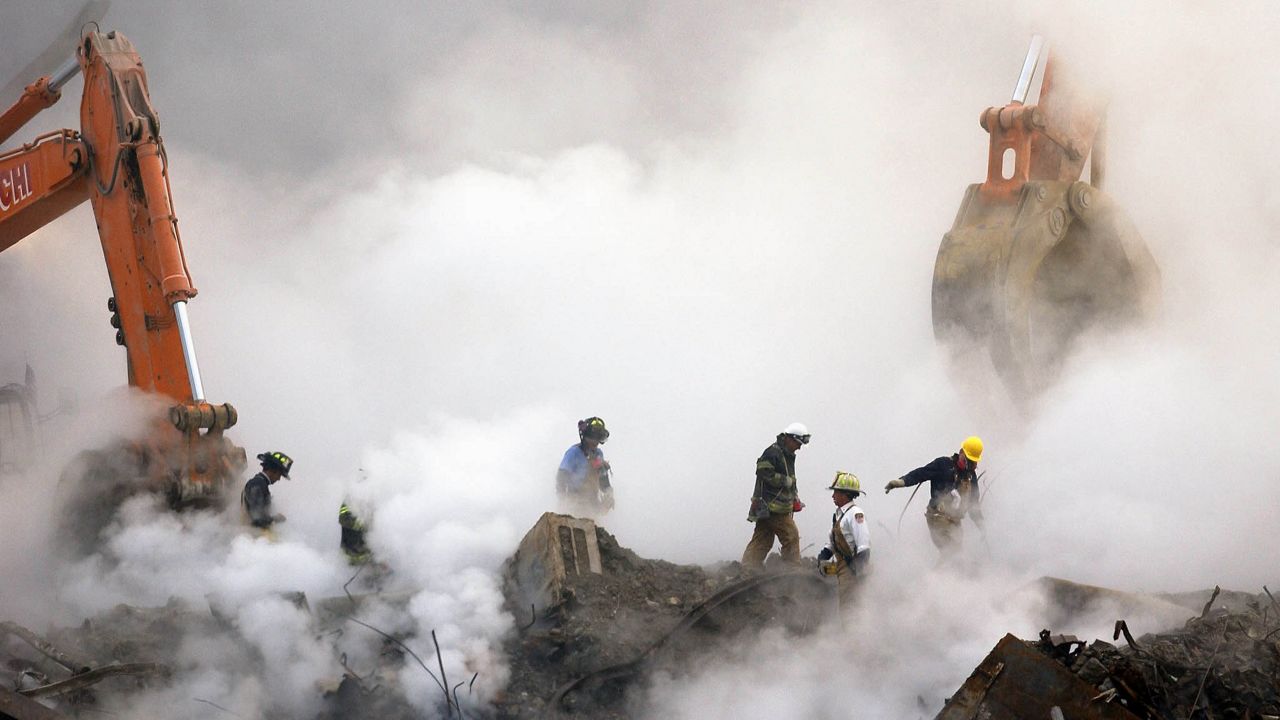
Andrew Garbarino has done real work for the people who ran toward the towers on September 11, 2001. That should be said first, because it's true, and because it's what makes the rest of this so hard to explain.
Starting in February 2025, the Trump administration and Elon Musk's DOGE took a wrecking ball to the World Trade Center Health Program — the federal program that treats the firefighters, cops, construction workers, and neighborhood residents who got sick from the dust at Ground Zero. It happened four separate times in under three months. Each time, Garbarino organized his colleagues — a letter to the president, joint statements, conversations with the administration — and got some part of it undone.
And on June 12, 2025 — right in the middle of all of it — he walked onto the House floor and voted to make DOGE's cuts to other programs permanent federal law.
What DOGE did to the 9/11 program
The Citizens for the Extension of the James Zadroga Act has kept a running record of it. It reads like a chart of a patient crashing over and over.
February 14, 2025 — the day after Robert F. Kennedy Jr. was confirmed as Health and Human Services Secretary — HHS fired thousands of probationary employees and pushed thousands more into buyouts. The 9/11 program lost more than 20% of its staff, dropping from 93 filled positions to fewer than 73. That included 16 fired probationary workers and five who took the buyout. The program lost its medical benefits team leader and its Director of Research. DOGE also killed two cancer research grants — one studying disease rates among FDNY firefighters, one at Long Island's Feinstein Institute comparing cancer rates among lower Manhattan workers to a control group in Westchester.
This was a program that had just been planning to grow to 138 staff, because it had added more than 10,000 new members the year before.
April 1, 2025 — a second, bigger round. HHS fired nearly all the staff of the National Institute for Occupational Safety and Health, including Dr. John Howard, who ran both NIOSH and the 9/11 program. Sixteen more program staff got termination notices. The cuts also wiped out the National Firefighter Cancer Registry, the program that investigates firefighter deaths, the office that certifies the respirators every firefighter and nurse in America wears, and the black lung research program for coal miners.
April 28–29, 2025 — the part that actually hurt patients. Garbarino and his New York colleagues had announced on April 5 that Dr. Howard was reinstated. HHS had told them so. It wasn't true — Howard was never properly restored as administrator of the 9/11 program, and because nobody had the legal authority to sign, the program stopped certifying new cancers and stopped enrolling new members. Three FDNY responders with cancer couldn't get certified for treatment; one of them had pancreatic cancer, and his doctor was told even an expedited request could not be approved. Roughly 1,200 monthly certifications went unprocessed. As many as 800 people waiting to enroll were stuck.
May 2, 2025 — the 16 staff were formally fired, effective immediately, notified after they'd already left for the day. Four days later, after another public uproar, the firings were rescinded.
May 14, 2025 — Kennedy admitted to the Senate that it had been a "mistake," restored 313 NIOSH positions, and confirmed Dr. Howard and the 15 remaining program staff were back.
Garbarino was in the middle of every one of those fights. The advocates thanked him by name.
Then came June 12
Four weeks after Kennedy's admission, the House voted on the Rescissions Act of 2025 — a bill that took $9.4 billion Congress had already approved and cancelled it, locking in DOGE's cuts to foreign aid and public broadcasting as permanent law.
It passed 214 to 212.
Garbarino voted yes.
Two votes. If he had voted the other way, the bill would have failed.
Think about what he knew by then. He had spent four months watching DOGE fire the people who process a cancer patient's paperwork, and then watching cancer patients not get treated. He had learned, in the most concrete way available to a member of Congress, that "cutting bureaucracy" is a thing that happens to specific human beings with specific diseases.
He took that lesson and applied it to exactly one program: his own.
His Long Island neighbor Nick LaLota was in the same room that day. Speaker Mike Johnson pulled LaLota aside on the floor and he switched his vote to yes, and $1.1 billion for public broadcasting died by two.
It never actually got fixed
Here's the part that makes the June vote worse rather than better. The 9/11 program didn't get put right. The pressure just moved to a slower setting.
After the staff were restored, Kennedy kept a "temporary" communications pause in place that stopped the program from talking to the 9/11 community at all. He kept a hiring freeze on. He froze the research grant process. And he stalled the decisions on whether to add cardiac conditions, autoimmune conditions, and dementia to the list of illnesses the program covers — decisions that had been due in March 2025.
Senators Schumer and Gillibrand wrote about it in August 2025. Sen. Andy Kim and five colleagues wrote again in September 2025. LaLota led another letter in March 2026. Garbarino signed that one.
April 15, 2026 — more than a year after the first firings — Kennedy finally let the program fill its 37 vacancies. That's a 30% vacancy rate it had been carrying the whole time.
July 9, 2026 — Garbarino and Sen. Kirsten Gillibrand led 26 bipartisan colleagues in a letter begging Kennedy to reappoint Dr. Howard, whose term was running out. The same day, it came out that of those 37 authorized positions, HHS had actually posted four.
That's the state of play eighteen months in: letters, and four job postings.
The thing a chairman could do
Garbarino is not a backbencher writing letters into the void. Since July 2025 he has been Chair of the House Committee on Homeland Security — one of the most powerful gavels in Congress. He sits on Financial Services. He sits on the Ethics Committee.
A committee chairman in the majority has tools a letter-writer doesn't. He can hold a hearing. He can put a cabinet secretary under oath. He can subpoena documents.
What the record shows for the 9/11 program is letters — good letters, bipartisan letters, letters that sometimes worked. But the pattern over eighteen months is that the administration cuts, Garbarino objects, the administration partly backs off, and then does it again a different way. That cycle has now run four times on the firings and is running a fifth time on the hiring freeze.
Meanwhile, when the administration asked him to vote for its cuts, he voted for its cuts.
What this looks like from Long Island
Garbarino sells himself as the Republican who breaks with his party. He voted for the January 6 commission. He voted for the infrastructure law. He voted for the Respect for Marriage Act. He voted against Jim Jordan for Speaker three times.
Those are real votes and they cost him something.
But the pattern on money is the opposite. He held Trump's budget bill hostage for months over the state and local tax deduction, won a bigger deduction, and then slept through the vote and had to explain himself to the Speaker. He voted for that budget bill when it came back. He voted for the rescissions bill by two votes. The Joint Economic Committee's House minority staff estimates that the Medicaid and Affordable Care Act cuts will cost nearly 34,000 people in his district their insurance — 30,657 of them on Medicaid.
He knows what these cuts do. He watched them do it to sick firefighters from his own island, in real time, for four straight months.
Then he voted for more of them.
Source
The timeline of cuts to the World Trade Center Health Program is documented by Citizens for the Extension of the James Zadroga Act, which has tracked each round of firings, reversals, and restrictions since February 2025. Photo: AP, via NY1. Vote totals from the Office of the Clerk of the U.S. House of Representatives.