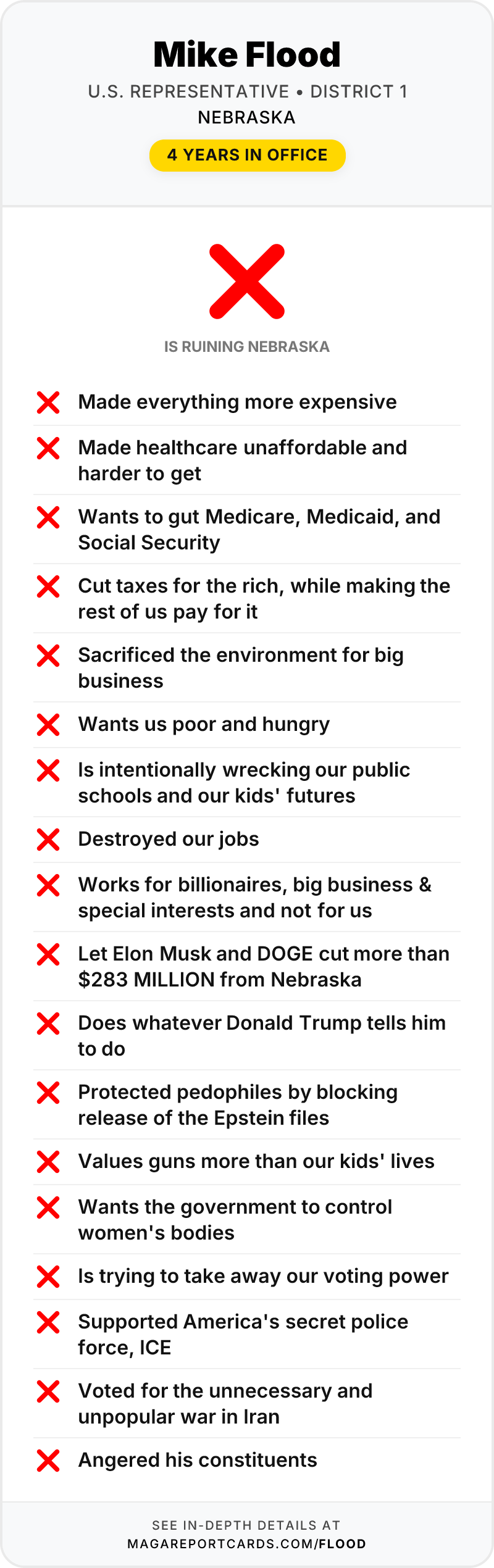
On May 22, 2025, the House passed Trump's budget bill by a single vote, 215 to 214. Mike Flood voted yes.
Five days later he stood in front of a room of constituents in Seward, Nebraska, and the very first question was about a provision buried on page 500-something of the 1,100-page bill he had just voted for.
His answer, as KMTV reported:
"I'm not going to hide the truth, this provision was unknown to me when I voted for that bill."
What was in the part he didn't read
Section 70302 of H.R. 1 was one sentence long. Here is the version the House actually passed, in full:
"No court of the United States may enforce a contempt citation for failure to comply with an injunction or temporary restraining order if no security was given when the injunction or order was issued pursuant to Federal Rule of Civil Procedure 65(c), whether issued prior to, on, or subsequent to the date of enactment of this section."
That is broader than the version reported out of committee two days earlier, which barred courts only from using "appropriated funds" to enforce contempt. The Congressional Research Service notes the change: the funding language "was removed in an amendment to the bill and does not appear in the engrossed version." What Flood voted for was the flat bar.
Strip out the legal language and here is what it does.
When a federal judge orders the government to stop doing something, the only thing that makes that order real is contempt — the judge's power to punish officials who ignore it. Section 70302 would have taken away the courts' power to enforce contempt in a huge category of cases, and it would have done it retroactively: every injunction and restraining order already sitting on the Trump administration would have become a piece of paper with no teeth.
A court order nobody has to obey is not a court order. It's a suggestion.
This is not an abstract worry. It's already happening in the cases where courts do still have teeth — a federal judge had to order the EPA a second time after the agency read a ruling voiding its grant terminations and concluded it had to do nothing. Section 70302 was designed to make that the permanent default.
"Unknown to me"
This was not a secret. Two days before the vote — on May 20, 2025 — Rep. Laura Friedman and 20 members of Congress sent a letter warning that the provision "would block courts from enforcing contempt rulings" and demanding it be struck.
Flood's own Nebraska colleague, Rep. Don Bacon, told KMTV flatly:
"I knew about this provision and I'm totally fine if the Senate strips it out."
So the information was available. Bacon read it. Nebraska's Adrian Smith not only read it, he defended it, telling the station the provision "reinforces those existing requirements" and that he supported its inclusion.
Flood — a lawyer, and a former speaker of the Nebraska Legislature — did not read it, and voted for it anyway.
The crowd in Seward reacted about how you'd expect. One constituent:
"You say, oh I care about the rule of law but you voted for a bill that contains a provision that guts the checks the judicial branch has and you didn't even read it? It's ridiculous."
Colleen Nygern, the constituent who asked the question, walked out of the town hall rather than listen to the rest of his answers.
What he promised, and who actually did it
Flood told the room he'd fix it:
"When I return to Washington I am going to very clearly tell the people in my conference that we cannot support undermining our court system and we must allow our courts to operate and issue injunctions."
Section 70302 did come out of the bill. Flood didn't do it.
The Senate wrote its own version of the attack on the courts — a bond requirement that would have blocked judges from issuing an injunction against the government unless the plaintiff put up security "in an amount proper to pay the costs and damages" the government sustained — and on June 23, 2025, Senate Parliamentarian Elizabeth MacDonough ruled that language violated the Byrd rule, the Senate procedure that keeps non-budget policy out of a fast-track budget bill. The House's contempt language was, as NBC News put it that day, "a different version of the provision" — and it did not survive into the Senate's rewrite either. Neither one is in the law Trump signed; the words "contempt citation" appear nowhere in it. A Senate referee and a Senate rewrite saved the enforceability of federal court orders. Not the lawyer from Nebraska who voted for the thing.
Then, on July 3, 2025, the final bill came back to the House and Flood voted for it again.
The other 1,095 pages
Here's the part that should actually worry Nebraskans. Section 70302 got caught because one constituent in Seward read the bill herself and stood in line to ask about it.
Nobody caught the rest on Flood's behalf. And the rest is what's hitting his district right now:
- Nebraska stands to lose up to $4 billion in federal Medicaid funds over the next decade, with up to 55,000 Nebraskans projected to lose health coverage.
- About 18,000 Nebraskans have stopped participating in food assistance over the past year — an 11% drop, per the state's own DHHS data, which Nebraska Appleseed attributes to the new law.
Flood has been asked about that too. Confronted at a town hall over the SNAP cuts, his answer was "we do not have unlimited money in the United States." The room booed him.
He didn't say that provision was unknown to him.
Why "I didn't read it" is not an excuse
Reading the bill is the job. It is close to the whole job. A member of Congress has one vote and a staff whose entire purpose is to tell them what's in the thing they're voting on.
The May 22 vote passed 215–214. Flood's yes was not a formality; a single member changing their mind would have stopped that version of the bill in its tracks. One Republican, Brian Fitzpatrick, later voted against the final version while staying quiet about the May 22 vote that kept it alive. Flood voted yes both times.
To his credit, Flood keeps holding real, in-person town halls — which is more than most of his colleagues will do, and it's how Nebraskans found this out at all. But the point of a town hall is that constituents get to hold him to something. He told them he'd go fight the provision. What actually killed it was the Senate — a rewrite, and a parliamentarian ruling ten days before he voted for the bill one more time.
Source
Congressman Mike Flood tells crowd he didn't read portions of the Big Beautiful bill before voting to pass it — Max Williams, KMTV 3 News Now, May 28, 2025.