In 2022, Congress passed a law whose entire job was to make sure that if the Supreme Court ever reversed itself on marriage, the marriages already made would still count.
It's called the Respect for Marriage Act. It repealed the Defense of Marriage Act and required the federal government and every state to recognize marriages — same-sex and interracial — that were legally performed somewhere else.
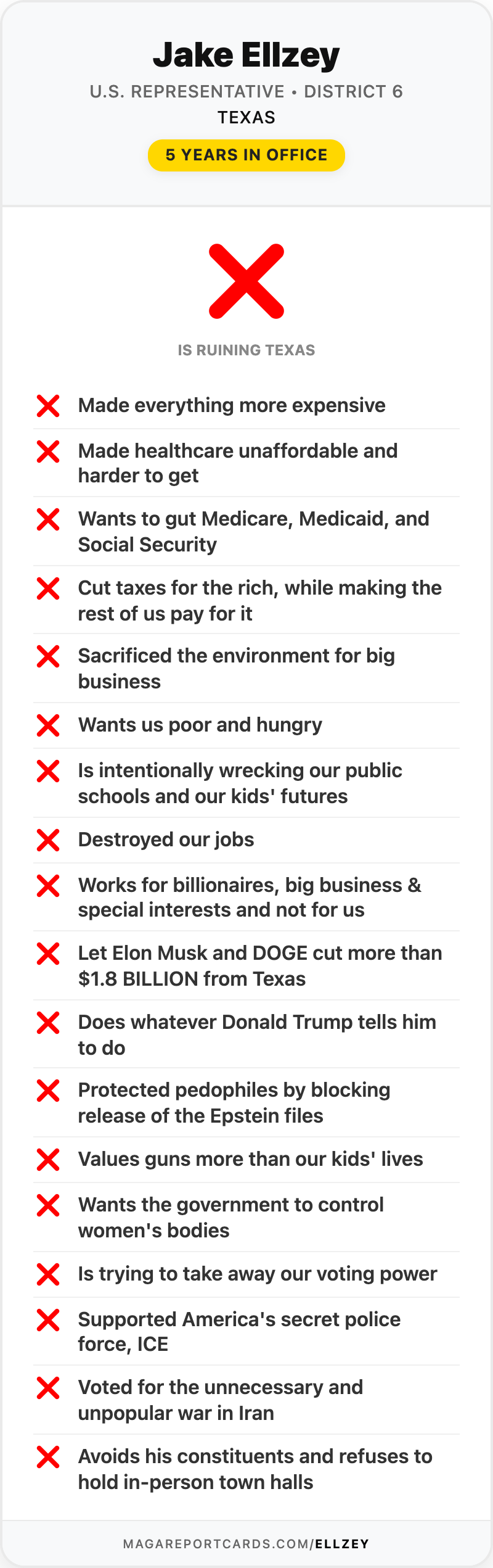
Jake Ellzey voted no. Then he voted no again.
The two votes
July 19, 2022. The House passed it 267–157. Forty-seven Republicans voted yes. Ellzey voted Nay.
December 8, 2022. The Senate had spent five months rewriting the bill, adding explicit protections for religious organizations — churches wouldn't have to perform ceremonies, faith-based nonprofits wouldn't lose their tax status. The House passed that final version 258–169. Thirty-nine Republicans voted yes. Ellzey voted Nay again.
Five months and a bipartisan rewrite designed to answer exactly the objection most Republicans raised. It didn't move him.
Why this is not an old, symbolic vote in Texas
Texas never repealed its ban.
Article I, Section 32 of the Texas Constitution — approved by voters in 2005 — still reads that marriage "shall consist only of the union of one man and one woman." A matching statute sits in the Texas Family Code. Both are dormant, unenforceable only because Obergefell v. Hodges says so. Texas is one of 32 states where the bans could snap back if that ruling fell.
And the pressure on that ruling in Texas is not hypothetical. Two things happened in a single autumn:
October 24, 2025. The Texas Supreme Court amended the state's judicial conduct code so that a judge who declines to perform a wedding over a "sincerely held religious belief" isn't violating the impartiality rules. In plain terms: a Texas justice of the peace can perform opposite-sex weddings only, and face no sanction for it.
December 19, 2025. Dianne Hensley, the Waco justice of the peace whose refusals prompted that fight, went to federal court asking the judiciary to overturn Obergefell. Her attorney, Jonathan Mitchell, argued that "the federal judiciary has no authority to recognize or invent 'fundamental' constitutional rights" and that "there is nothing in the language of the Constitution that even remotely suggests that homosexual marriage is a constitutional right."
The goal is stated plainly: send marriage back to the states, the way Dobbs sent abortion back to the states.
If that ever happens, the Respect for Marriage Act is the thing standing between a Texas couple and a marriage their own state stops recognizing.
Ellzey voted against it. Twice.
What the law actually does — and doesn't
Worth being precise, because the bill was widely misdescribed at the time.
The Respect for Marriage Act does not force any state to issue a marriage license. What it does is require recognition: a marriage lawfully performed in one state has to be honored by the federal government and by every other state. And the enacted text says in so many words that nothing in it requires a religious organization to provide services or facilities for a marriage, or denies a nonprofit its tax-exempt status over marriage.
That's the protection. It's narrow, it's defensive, and it's the exact thing Texas's dormant constitutional ban would otherwise override.
It also covers interracial marriage, which Loving v. Virginia protects on the same legal footing marriage equality does. Justice Clarence Thomas, concurring in Dobbs, wrote that "in future cases, we should reconsider all of this Court's substantive due process precedents, including Griswold, Lawrence, and Obergefell" — the footing itself, though he did not name Loving.
Forty-seven, then thirty-nine
The reason this is Ellzey's vote and not just his party's is that a meaningful number of House Republicans went the other way — 47 in July, 39 in December. Among Texas Republicans, Tony Gonzales voted yes both times.
Ellzey's public brand is the reasonable one. His own office highlights 20 years in the Navy, five combat tours, and a stint as Air Boss aboard the USS Ronald Reagan, and his House website carries a standing link to the bipartisan For Country Caucus.
On the vote where the bipartisan option was actually on the table, twice, he took a pass.
We've written about the identical two-vote record for Ohio's Troy Balderson, and about Dan Meuser, who voted yes in July and then flipped to no in December — after the bill got more religious protections, not fewer.
What it comes down to
There are Texans in Ellis and Navarro and Cherokee counties who got married under a Supreme Court ruling that a Waco judge is currently asking a federal court to erase, in a state whose constitution still says their marriage doesn't count.
Their congressman had two chances to make sure that marriage keeps being recognized no matter what the Court does.
He said no both times.
Sources
House roll call votes 373 and 513 of 2022, Office of the Clerk, U.S. House of Representatives; "Waco judge asks federal courts to overturn same-sex marriage," The Texas Tribune, December 19, 2025.