The Supreme Court case that made same-sex marriage legal across the country started in Ohio.
Jim Obergefell, an Ohio native, sued because the state refused to list him as the surviving spouse on his husband John Arthur's death certificate. The other name in Obergefell v. Hodges is Richard Hodges — Ohio's director of health. It is an Ohio case with an Ohio plaintiff about an Ohio law.
In 2022, Congress voted on whether to protect that right in federal statute, in case the Supreme Court changed its mind.
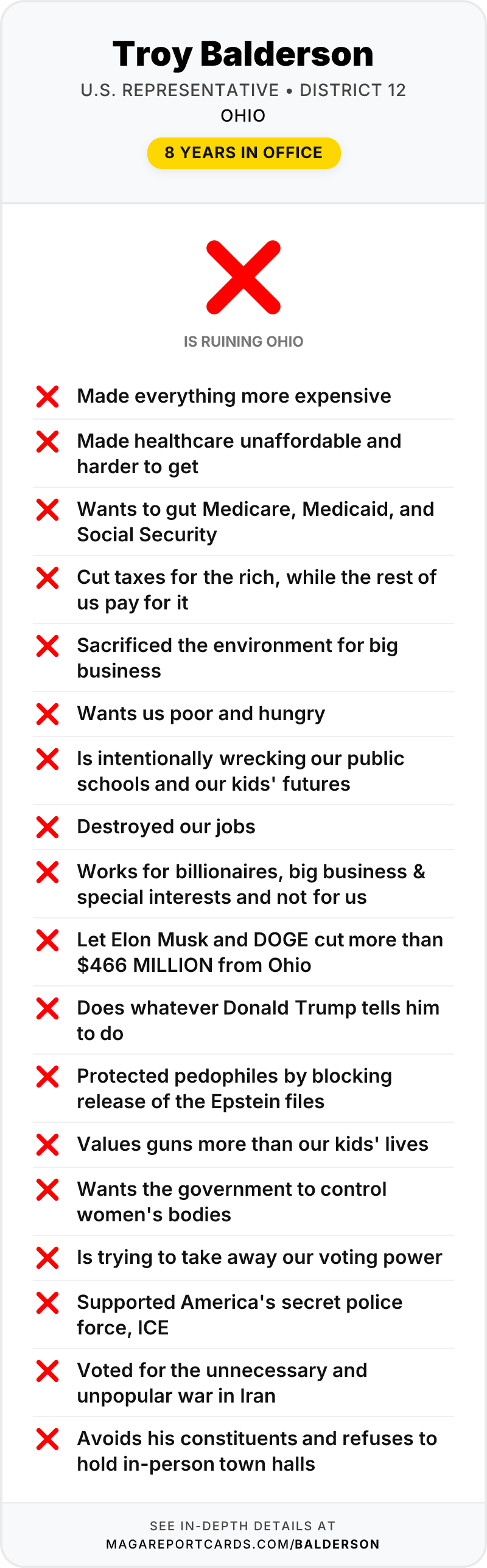
Troy Balderson voted no. Then he voted no again.
The two votes
The Respect for Marriage Act repealed the Defense of Marriage Act and required the federal government and every state to recognize marriages — same-sex and interracial — that were validly performed elsewhere.
July 19, 2022. The House passed it 267-157. Forty-seven Republicans voted yes. Balderson voted Nay.
December 8, 2022. After the Senate amended it, the House passed the final version 258-169. Thirty-nine Republicans voted yes. Balderson voted Nay again.
He had nearly five months and a bipartisan Senate rewrite to change his mind. He didn't.
Four of his Ohio colleagues voted yes
This is the part that makes it his choice rather than his party's.
On both votes, four Ohio Republicans in the House voted for the Respect for Marriage Act: Mike Carey, David Joyce, Mike Turner, and Anthony Gonzalez. Balderson voted with the other faction.
That matters because of how Balderson positions himself. He belongs to the Republican Governance Group, which says it "supports the governing wing of the House Republican Conference," and the Republican Main Street Partnership, which advertises "the good governance and pragmatic solutions our Members are known for." The Republican Governance Group's Tuesday Group PAC is one of his larger donors, at $37,000 since 2020.
On a bill where 47 Republicans, including four from his own state, found a way to yes, the self-styled pragmatist from central Ohio did not.
Why this is not a symbolic old vote
Ohio's 2004 ban is still sitting in the state constitution.
The language reads that "only a union between one man and one woman may be a marriage valid in or recognized by this state." There's a matching 2004 statute. Both are dormant — Obergefell overrides them — and both would take effect again the moment Obergefell doesn't.
Bennett Guess, executive director of the ACLU of Ohio, told NBC4 in Columbus that if Obergefell were overturned, Ohio's ban would automatically snap back into effect:
"The only way to take that constitutional amendment out of the constitution is for the voters of Ohio to be given the opportunity to vote again to remove that."
Justice Clarence Thomas, concurring in the 2022 decision that overturned federal abortion rights, wrote that the Court should reconsider several precedents — marriage equality among them.
And here is where Balderson's vote lands. NBC4 spells out exactly what the law he opposed would and wouldn't do for Ohio:
"While a federal law passed in 2022, the Respect for Marriage Act, would require Ohio to recognize same-sex marriages performed in other states, it would not require the state to issue new marriage licenses if Obergefell was reversed and Ohio's ban reinstated."
So the Respect for Marriage Act is the floor. It is the one thing standing between Ohio couples and a state that doesn't recognize their marriage at all. Balderson voted against the floor. Twice.
Ohioans are now trying to fix it themselves
Because Congress didn't fully solve it and the state legislature hasn't, Ohioans are doing it by petition.
Ohio Equal Rights is gathering signatures for a "Right to Marry" amendment that would strike the 2004 ban from the state constitution, plus a companion "Equal Rights" amendment barring discrimination based on sexual orientation and gender identity. Organizers need more than 442,000 valid signatures for each to reach the November 2026 ballot.
Jim Obergefell himself endorsed the campaign:
"If our nation's Constitution becomes a mere suggestion of what rights every person enjoys, then Ohioans must propose and pass laws and amendments to protect those rights."
Ohio voters have done this before. In 2023 they passed a constitutional amendment on abortion rights and a law legalizing marijuana — both over the objections of Republican Gov. Mike DeWine.
He isn't around to explain it
When Knox County organizers invited him to a town hall in August 2025, he declined, so they scheduled it without him and promised to videotape it and send him the questions the audience would have asked. The group's founder, Meg Galipault, wrote in the Columbus Dispatch that Balderson "has eschewed such opportunities, leading us to wonder who he represents."
Somewhere in Ohio's 12th District there is a married couple whose marriage exists because a man from their state sued over a death certificate. Their congressman voted twice against writing that into law, and won't take the question.
We deserve better.
Source
Roll call votes from the Office of the Clerk of the U.S. House — RC 373 (July 19, 2022) and RC 513 (December 8, 2022) on H.R. 8404. Ohio ballot-measure reporting and quotes from NBC4/WCMH Columbus, "What could happen to Ohio same-sex marriage rights in 2026." Photo: Congressman Troy Balderson sworn into office, via Wikimedia Commons.