Every state in the country gets to decide how much a lender is allowed to charge you. Ohio has decided. Under Ohio law, a two-year $2,000 loan is capped at 37% a year. That is the ceiling. It exists, as the National Consumer Law Center puts it, "to protect its residents from predatory lending."
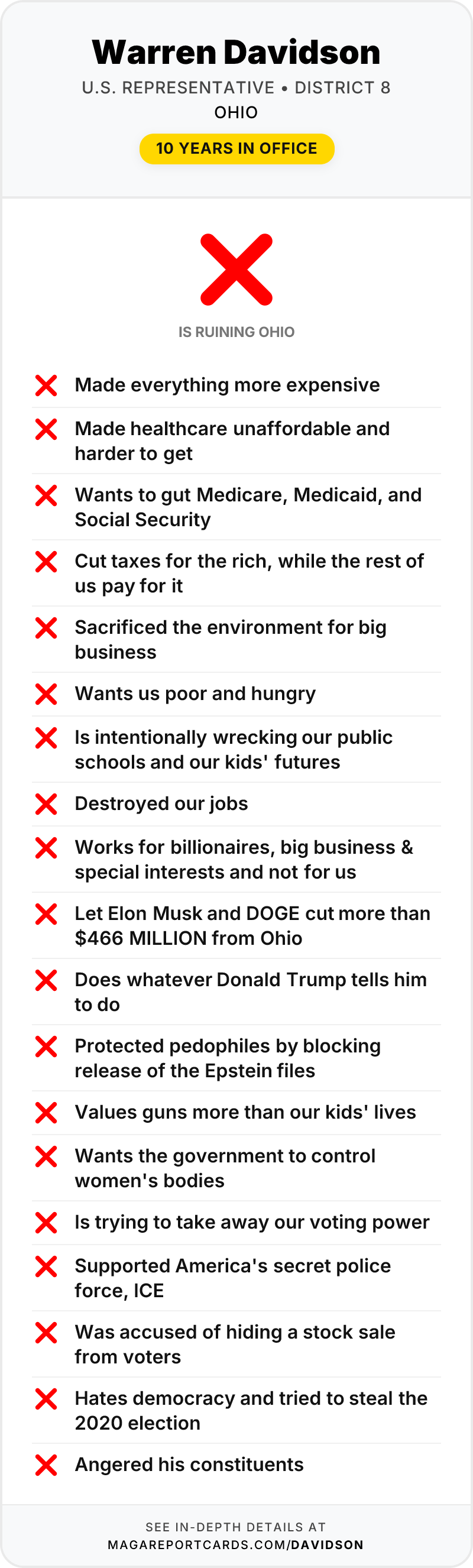
Warren Davidson has written a bill that would take a large piece of that power away — not just from Ohio, but from every state.
It's called the American Lending Fairness Act. Davidson introduced the House version, H.R. 7866, on March 9, 2026. His fellow Ohio Republican, Sen. Bernie Moreno, introduced the Senate companion on February 12.
Here is what 103 consumer, civil rights, and community organizations told Congress the bill would do, in a letter sent on May 7, 2026:
"S. 3889 would eliminate states' ability to stop exploitative, unaffordable predatory lending through rent-a-bank schemes."
What a "rent-a-bank" loan actually is
This part is simple once you see it, and the whole bill turns on it.
Banks are exempt from state interest-rate caps. Ordinary lenders — the storefront on the corner, the online installment lender — are not. So high-cost lenders found a workaround: they partner with a small bank chartered in a state with no cap at all, put the bank's name on the paperwork, and then claim that state's law applies to a loan made to somebody in Ohio.
The lender does the advertising, the underwriting, and the collecting. The bank rents out its charter. That's the whole trick, and it has a name: rent-a-bank.
The National Consumer Law Center documented six of these operations running in Ohio in a 2022 factsheet on the state, among them:
- EasyPay Finance, through TAB Bank — loans at 130% to 189%, sold through pet stores, auto mechanics and furniture stores
- OppLoans, through FinWise Bank, First Electronic Bank or CC Bank — $500 to $4,000 at 160%
- Personify Financial, through First Electronic Bank — up to 189%
- Axcess Financial, which runs the Check 'n Go stores, through Capital Community Bank — its Xact loan runs 145% to 225%
Ohio's own ceiling, again, is 37%. As NCLC put it: "a few rogue banks are helping predatory lenders disguise their loans as bank loans so they can charge triple-digit interest rates."
Congress has been on the other side of this before. In 2021, on a bipartisan basis, it overturned a Trump-era regulation that would have protected these arrangements.
The one lever states still have
A 1980 law called DIDMCA is what lets a state-chartered bank export its home state's interest rate to borrowers everywhere else. But Congress wrote an escape hatch into it — Section 525 — that lets a state opt out and say: loans made to our residents follow our rules.
Iowa, Colorado, and recently Oregon have used it, and other states are considering it. Colorado opted out in 2023, the lending industry sued, and in 2025 the Tenth Circuit sided with Colorado — ruling that out-of-state banks lending to Coloradans have to obey Colorado's limits.
Davidson's bill is the answer to that ruling. It would limit a state's rate caps to banks chartered inside that state, so an out-of-state bank could keep exporting whatever rate its home state allows. One legal summary of the bill notes it repeals Section 525 outright — the opt-out provision itself.
The coalition letter spells out the stakes plainly: lenders using these arrangements charge 100% to 200% a year, rates that are illegal for many nonbank installment loans in 45 states.
Here is how Davidson described his own bill:
"Federal law should not pick winners and losers based on a bank's charter. The American Lending Fairness Act restores decades-long precedent, protects consumers' right to shop for interest rates across state lines, and ensures they benefit from real competition."
"Consumers' right to shop for interest rates across state lines." Nobody in Ohio is shopping across state lines for a 189% loan at the furniture store. The shopping is being done by the lender, and what it is shopping for is a state with no cap.
Look at who lined up behind it
Moreno's announcement listed the groups supporting the bill. It is a wall of finance: the American Bankers Association, America's Credit Unions, the Consumer Bankers Association, the American Financial Services Association, the Online Lenders Alliance, the American Fintech Council, the Financial Technology Association, the Delaware, Nevada and Utah bankers associations — and two banks by name, WebBank and Cross River.
Two of the endorsers are from Ohio: the Ohio Bankers League and the Ohio Credit Union League.
On July 17, 2026, eleven industry groups, nine of them from that list, wrote jointly to the leaders of both banking committees urging Congress to pass it.
Now look at who pays for Davidson's campaigns. According to federal campaign filings:
- American Bankers Association PAC — $35,000. An endorser of his bill.
- America's Credit Unions PAC — $34,000. An endorser of his bill.
- UBS — $35,000. Wells Fargo — $35,000.
- Mortgage Bankers Association — $32,500. Huntington Bancshares — $25,500.
Davidson sits on the House Financial Services Committee, which is the committee that writes the rules for all of them — and the committee his bill was referred to.
The magazine Jacobin, which covered the bill in February, reported that Davidson and Moreno together have taken nearly $5 million in financial-sector donations, and noted that states have moved to shield residents from out-of-state banks charging rates "as high as 199 percent on credit cards and loans."
Of the $3.66 million Davidson has raised since 2020, about $161,000 — roughly 4% — came from small grassroots donors.
This is a pattern, not a one-off
Davidson's committee has spent this Congress dismantling the rules that sit between ordinary people and the financial industry. The same committee voted to gut the law requiring companies to say who really owns them — a bill Davidson himself wrote. Its chairman personally authored the House resolution to kill a $5 cap on overdraft fees, keeping about $5 billion a year in bank revenue that would have stayed in customers' accounts.
And the federal agency that would otherwise police high-cost lending is being taken apart. At a hearing last month, House Republicans asked how to make the gutting of the Consumer Financial Protection Bureau permanent.
Strip the disclosure rules, kill the fee caps, defang the cop — and then take away the states' authority to fill the gap. That last piece is Davidson's contribution.
What it costs an Ohio family
A $2,000 loan at Ohio's 37% ceiling is expensive. A $2,000 loan at 189% is a different kind of thing entirely: the interest alone can exceed the amount borrowed inside a year. That is the gap between what Ohio law allows and what a rent-a-bank loan charges, and Davidson's bill is aimed squarely at making sure states can't close it.
The coalition letter names three states that have pulled the opt-out lever — Iowa, Colorado and Oregon — and says others are considering it. This bill isn't only about those three. It takes the option off the table for every state, permanently, right as more of them start reaching for it.
Exactly one Ohio organization signed the letter opposing it: Advocates for Basic Legal Equality, the legal-aid group that represents low-income Ohioans in court. On the other side: the Ohio Bankers League and the Ohio Credit Union League.
Davidson picked a side. It wasn't the borrowers'.
We deserve better.
Source
Freddy Brewster, "Wall Street–Backed Lawmakers Want to Help Banks Gouge You," Jacobin, February 20, 2026.