If you have ever had $12 in your checking account, bought groceries for $40, and gotten hit with a $35 fee for the privilege, you already understand this story.
That fee is called an overdraft charge. Roughly 23 million American households pay them. For the households that get hit, the National Consumer Law Center estimated that killing the rule would cost them an average of $225 each a year — money taken from people precisely at the moment they have the least of it. Wells Fargo and JPMorgan Chase each pull in roughly a billion dollars a year from overdraft and related fees.
In December 2024, the Consumer Financial Protection Bureau finished a rule that would have capped that fee at $5 at the country's biggest banks — those holding more than $10 billion in assets. A bank could charge more if it could show the higher fee actually covered its costs, or if it treated the overdraft like the short-term loan it functionally is and disclosed the interest rate. The rule would have kept about $5 billion a year in ordinary people's bank accounts.
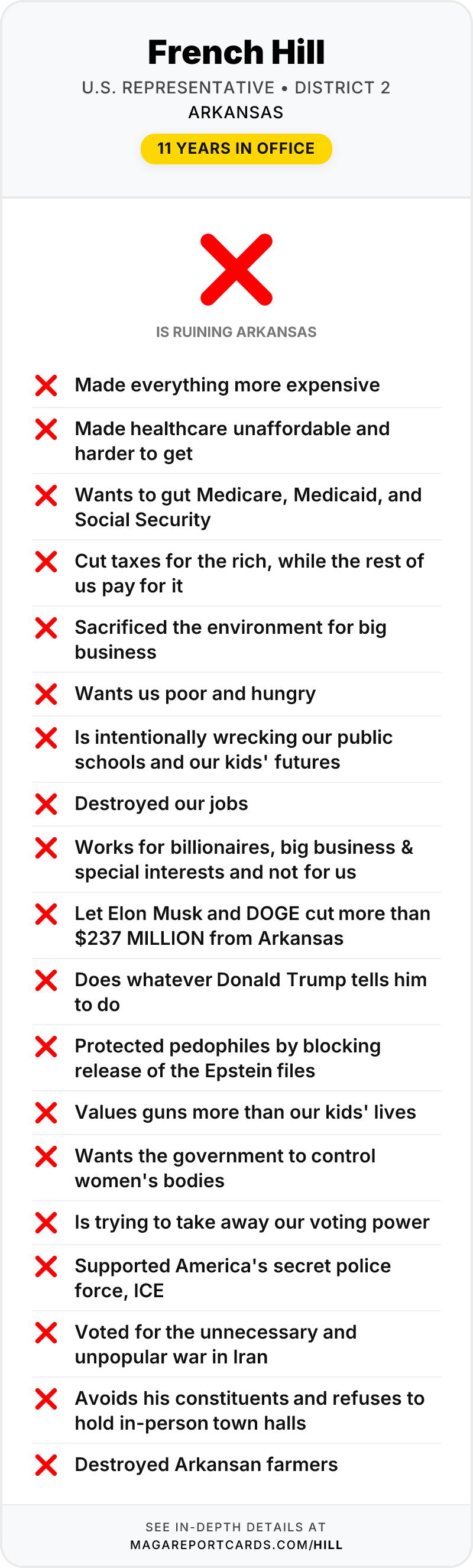
It never took effect. French Hill killed it.
He didn't just vote for it. He wrote it.
On February 13, 2025, Hill — the Arkansas Republican who chairs the House Financial Services Committee — introduced the resolution to wipe the rule off the books, alongside Senate Banking Chairman Tim Scott.
This is a distinction worth sitting with. Hundreds of Republicans cast a vote on this. One of them put his name at the top of it.
Here is how Hill explained himself in his own press release:
"The CFPB's actions on overdraft is another form of government price controls that hurt consumers who deserve financial protections and greater choice."
A $5 cap on a $35 fee "hurts consumers." That is the argument.
On March 5, 2025, his committee advanced it 30-19. What reached the House floor, though, was Scott's identical Senate twin. The Senate passed S.J.Res. 18 on March 27, and on April 9, 2025, the House passed it 217 to 211 — a six-vote margin, with Hill voting yes. Trump signed it on May 9.
Hill's own resolution never got a floor vote of its own; it is still sitting on the Union Calendar. It didn't need one. Congress.gov's note on it reads: "The text of H.J.Res.59 is contained in the text of S.J.Res.18, which became Public Law 119-10."
The rule had been set to take effect on October 1, 2025. It never got there. Not one American ever paid a $5 overdraft fee under it.
Six votes. If three members had gone the other way, the tally would have been 214-214, the resolution would have failed, and 23 million households would have kept that money.
The people who thanked him by name are the people who pay him
Hill's own press release announcing the resolution came stacked with praise from the banking industry. The Consumer Bankers Association thanked him for "standing up for consumers." The American Bankers Association "welcome[d] Chairman Hill and Chairman Scott's leadership." The Independent Community Bankers of America said it "strongly supports" the effort.
Now look at who funds him. Since 2020, according to Who Bought My Rep, the American Bankers Association's PAC has given Hill $40,000 and the Independent Community Bankers of America's $39,500. Two of the three trade groups quoted praising his resolution in his own press release are among his largest PAC donors.
That's not an inference about influence. It's the same names, in the same document, on both sides of the transaction.
And it isn't a one-off. Hill takes eleven times what the average House member takes from the finance, insurance and real estate sector — $1,620,940 against an average of $146,176 — and that sector accounts for 77% of all the PAC money he raises. Only 2% of his money comes from small grassroots donors.
He also spent thirty years in the industry he now regulates. Before Congress, Hill was founder, chairman, and chief executive of Delta Trust & Banking Corporation in Little Rock, from 1999 until he sold it to Simmons Bank in 2014. He went from running a bank to writing the rules for banks.
What "greater choice" actually means
Hill's defense — and the bank lobby's — is that overdraft is a service people want. Cap the fee and banks will stop offering it, and consumers will be pushed toward payday lenders and worse.
Notice what the rule actually did, though. It didn't ban overdraft. It gave banks three options: charge $5, charge whatever your costs justify and show your math, or call it a loan and tell the customer the interest rate. Every one of those options leaves overdraft available. What none of them leaves available is charging $35 for a service that costs the bank almost nothing, and not explaining why.
The National Consumer Law Center's Carla Sanchez-Adams put the effect plainly: overturning the rule "takes money out of the pockets of hard-working families to boost the balance sheets at the largest banks." Her colleague Lauren Saunders was blunter — that Republican leadership was "siding with Wells Fargo and other big banks over working families hurt by abusive overdraft fee practices."
Nobody has $35 overdraft fees because they're wealthy. The fee is, by design, a charge for being short on money. Hill's committee decided that charge should stay right where it was.
This is the pattern, not the exception
Killing the overdraft cap wasn't a stray vote — it's the job as Hill has defined it.
When Trump's budget director came before Hill's panel in July 2026 to answer for the dismantling of the CFPB, the Republicans on the committee didn't push back — they asked how to make it permanent.
The CFPB exists because in 2008 the financial industry blew up the economy and ordinary people paid for it. It has returned billions of dollars to Americans who got cheated. The overdraft rule is exactly the kind of thing it was built to do: find a fee that takes $5 billion a year from people who can least afford it, and make it stop.
A former bank CEO, funded overwhelmingly by banks, chairing the committee that oversees banks, wrote the resolution that stopped it.
What it means in Arkansas
Arkansas already ranks 49th of 50 states across the measures we track — health, income, hunger, and the rest. Hill's own district runs through Little Rock and North Little Rock.
The people in it who get hit with overdraft fees are not the ones with $1,620,940 to hand a congressman. They're the ones whose paycheck lands on Friday and whose rent clears on Thursday.
Hill has represented them since 2015. Given the chance to save them $225 a year, he introduced the resolution to take it back.
We deserve better.
Sources
Hill, Scott Lead Effort to Roll Back Biden-Era CFPB Overdraft Rule — U.S. House Committee on Financial Services, February 13, 2025.
Bill to Overturn CFPB Overdraft Fee Rule Would Hurt Families, Allow Big Banks to Keep $5 Billion in Excessive Fees — National Consumer Law Center.