In February, the Supreme Court ruled that President Trump didn't have the power to impose his "emergency" tariffs on his own. Alabama Sen. Katie Britt was not happy about it. She went on social media to say that "What the media won't tell you is that President Trump's tariffs work," and that the country was not going back to "cheap junk from foreign adversaries."
Here's what Katie Britt didn't tell you. Ten months before she wrote that, her office was quietly asking the Trump administration to go easy on four Alabama companies that were getting hurt by those same tariffs.
We know because the Wall Street Journal's editorial board got the email through a public records request and published it on September 14. Its verdict: "Tariffs for thee, exemptions for me."
The email
On April 15, 2025, less than two weeks after Trump's "Liberation Day" tariffs, Britt's legislative director emailed the U.S. Trade Representative's office. The subject line was "Sen. Britt Alabama Trade Priorities." It asked for help for "specific Alabama manufacturers."
The email opened by saying Britt "is supportive" of rebalancing trade. Then it laid out "four pressing issues," and each one was a request for a company:
- TNT Fireworks, based in Florence. The email said there is no American fireworks maker and that "over 99% of firework products are produced in China." It also noted the company was getting ready for America's 250th birthday.
- Novelis, an aluminum company building what the email called a "$4.1 billion recycling and rolling plant" in Alabama that would "create 1,000 new direct jobs." While it was being built, the company relied on imports from Canada, South Korea and Brazil, and the tariffs were causing "cash flow problems."
- Kronospan, a wood panel maker in the middle of a $600 million expansion in Oxford. It needed "highly specialized equipment that is not available from domestic manufacturers." The Journal put the extra tariff bill at about $60 million.
- Airbus, which was building a third final assembly line in Mobile. "We've recently learned that this expansion has been suspended indefinitely," the email said. "Trade policy has made the project financially unviable."
Read those again. Britt's own office was writing, in April 2025, that the tariffs were putting a $600 million expansion at risk, squeezing a $4.1 billion plant, and had put a jobs project in Mobile on hold indefinitely.
As the Journal put it, the point isn't that Britt made bad arguments against these four tariffs. It's that she made good ones. She made them in private, for four companies, while telling everyone else the tariffs work.
Then she voted to keep the tariffs — four times
Asking for a break for a few companies is one thing. Voting to keep the tariffs on everyone else is another. Britt did both.
Fifteen days after that email, the Senate voted on whether to end the emergency Trump used to put tariffs on goods from nearly every country. The resolution failed on a 49–49 tie. Britt voted no.
In October 2025, the Senate took three more votes to end Trump's tariff emergencies. All three passed. Britt voted no every time:
- October 28 — the tariffs on Brazil. Passed 52–48. Britt: no.
- October 29 — the tariffs on Canada. Passed 50–46. Britt: no.
- October 30 — the global tariffs. Passed 51–47. Britt: no.
Those are the same three votes Jon Husted cast to keep the tariffs squeezing Ohio farmers.
Who speaks for the little guy?
The Journal asked the right question. Big company CEOs know how to get a U.S. senator to plead their case. "But who speaks for the little guy being walloped?"
Not the tariffs Britt voted to keep. The Tax Foundation estimates Trump's tariffs raised taxes by an average of $1,000 per American household in 2025, and will cost another $820 per household in 2026. Families in Alabama don't have a legislative director emailing the trade office about their grocery bill.
It's the same thing we saw after the Supreme Court threw the tariffs out. The refunds are going to Apple, Ford, Nike and Amazon — not the families who paid higher prices at the register. Big companies get relief. Everyone else gets the bill.
What Britt did in public
Asked about the email, Britt's office pointed to Senate hearings where she raised these matters. "It wasn't a hard press," the board wrote.
In one, Britt asked Commerce Secretary Howard Lutnick if he would "consider the production needs" of Airbus. He said yes. Britt's answer: "Yes. OK, great. This is a lot easier than I thought. Excellent. Thank you so much."
That's not a senator fighting a policy her own office said had put an Alabama jobs project on hold. That's a senator asking nicely, then thanking the man in charge of it.
What happened next
The email doesn't show whether the trade office did anything. An assistant U.S. trade representative replied that her concerns would be passed along. The administration told the Journal that it "does not have an exemption process at this time."
Novelis told the Alabama Daily News it "has not received tariff relief," but its plant is on schedule. An Airbus spokesperson said the third Mobile line opened in October 2025. Britt's office said the administration dropped tariffs on Airbus planes and parts in September 2025.
So by her office's own account, the tariffs on Airbus's planes and parts are gone. Alabama families got no such break — the Tax Foundation's $820 is for this year.
Britt's defense
Britt told the Alabama Daily News that she supports Trump "getting us on a level playing field," but that "in the interim, you have to make sure that you are going eyes wide open to what's happening in our state."
"I feel like that's my absolute job," she said.
She's right that it's her job to look out for Alabama. But the email shows her office knew what the tariffs were doing to Alabama companies — and she still voted four times to keep them, and still told the public they work.
She's not the first. The Journal notes that in Trump's first term, Sen. Josh Hawley lobbied for a break on saw blades, Rep. Mark Meadows on furniture wood, and Rep. Andy Biggs on patio screens. And cheering the tariffs in public while the damage piles up is a habit across the party: Erin Houchin wrote an op-ed saying they were "reviving American manufacturing."
What the record shows
On April 15, 2025, Katie Britt's office privately asked Trump's trade office to help four Alabama companies — Airbus, Novelis, Kronospan and TNT Fireworks — writing that the tariffs had made an Airbus jobs project in Mobile "financially unviable." Fifteen days later she voted to keep the global tariffs, and she voted three more times in October 2025 to keep the tariffs on Brazil, on Canada and on the rest of the world. In February 2026 she told the public "President Trump's tariffs work," while the Tax Foundation estimates those tariffs cost the average household $1,000 in 2025.
Source
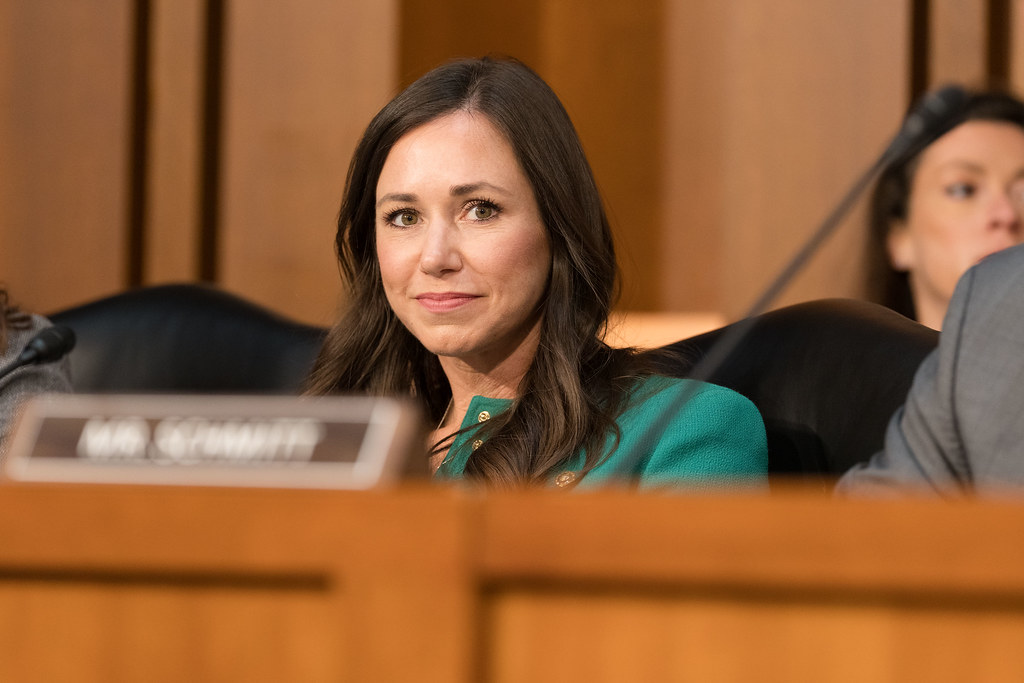
The Wall Street Journal Editorial Board, "One Senator's Plea for Tariff Breaks," September 14, 2026 (archived copy). Photo: Official U.S. Senate photo by Rosa Pineda, via Alabama Daily News.