There is a law that lets the government collect the emails, texts, and phone calls of foreign targets overseas. It's called Section 702 of the Foreign Intelligence Surveillance Act, and almost nobody disputes that it's useful.
The fight is over what happens when an American is on the other end of one of those conversations. Those messages land in a government database. And right now the FBI can go into that database, search for an American by name, and read what's there — without a warrant, without probable cause, without a judge.
Critics call it the backdoor search. In 2026 Congress had a chance to close it.
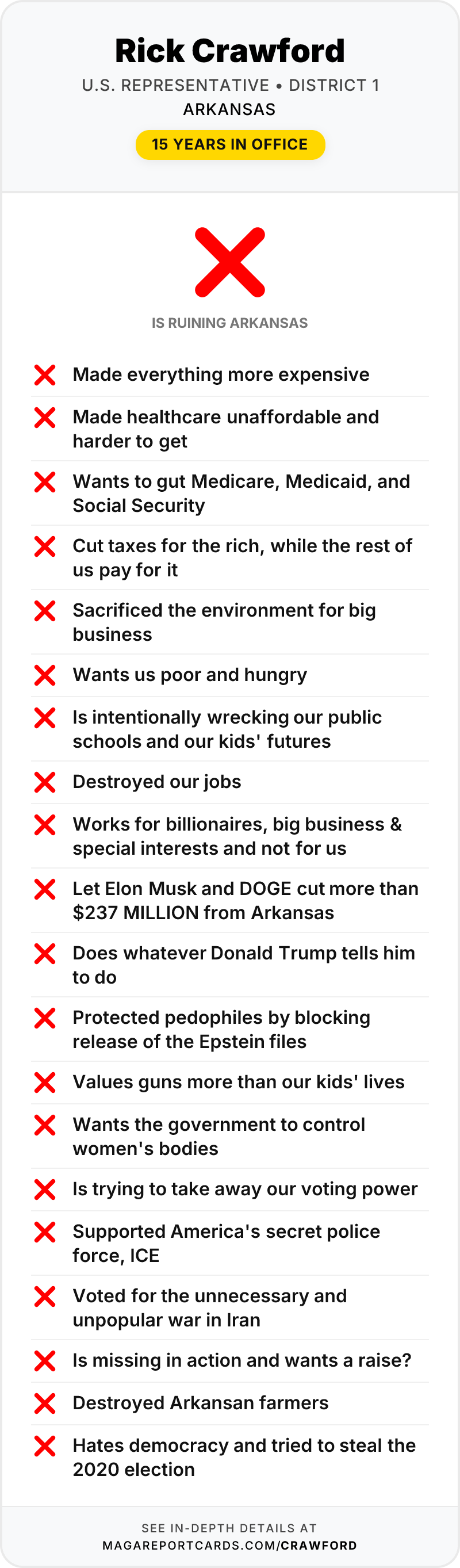
Rick Crawford, who chairs the House Intelligence Committee, spent the year making sure it stayed open.
What he pushed for
In March 2026, with the authority set to expire, Crawford's plan was what Washington calls a "clean" reauthorization — 18 more months of Section 702 with no changes at all. Roll Call reported that a clean extension was what the Trump administration and Speaker Mike Johnson wanted too, and that it meant no warrant requirement for searching Americans' communications.
"I'm doing everything I can to try to advance the 18-month clean" reauthorization. — Rep. Rick Crawford
The resistance wasn't partisan. Republican Andrew Clyde of Georgia said he would probably not support a clean extension, though he had not made a final call. Republican Andy Harris of Maryland said his decision turned on the length, and that 18 months would probably be off the table for him. Democrats objected too — Jamie Raskin said of the administration, "It's an administration which has set itself against the privacy rights of the people and against civil liberties."
The 9/11 argument
When Crawford went home to Arkansas television to sell it, he reached for the biggest thing he had. On April 24, 2026, he told KATV:
"If we had had 702 prior to 9/11 very good likelihood and all probability would not—9/11 would not have happened."
And:
"What we don't want to do is let that go dark and run the risk of another type of 9/11."
Notice the sleight of hand. The reform on the table was not to let it go dark. The reformers wanted to keep the foreign collection and require a warrant before the FBI reads an American's side of it. Crawford answered a question about Americans' Fourth Amendment rights by invoking the worst terrorist attack in American history.
He also claimed his revised bill had solved the privacy problem — "We've been able to clean that up to satisfy, you know, both sides Being able to walk and chew gum at the same time, we absolutely want to protect every American citizen's civil liberties."
The ACLU's Kia Hamadanchy, quoted in the same KATV story, disagreed:
"Quite insidious because it doesn't have to provide any new protections. All it essentially does is restate existing law."
That's the whole argument in one line. Crawford's "reform" added review paperwork and restated rules already on the books. What it did not add was the one thing that actually protects you: a judge.
What the reformers were asking for
The Electronic Frontier Foundation laid out the ask in June 2026: Section 702 "should require a warrant before the Federal Bureau of Investigation can look at digital communications collected from Americans." If Congress wouldn't do that, EFF said, let the authority lapse.
Today, as EFF describes it, the FBI can "query and even read the U.S. side of that communication without a warrant." A warrant requirement would mean an agent has to convince a judge there's probable cause first. That's it. That's the reform Crawford spent months resisting.
Why it matters right now, specifically
EFF pointed at something more immediate than principle: who would be holding this power.
When EFF wrote that in June, the man about to take over the intelligence community was Bill Pulte, who had already "accused several of the President's political foes and targets… of mortgage fraud based on private data held by his agency." That is not a hypothetical about abuse. That is a federal official using private government records against the president's political enemies, before ever getting the keys. He went on to run the office on an interim basis until the Senate confirmed Jay Clayton to replace him on July 28.
Crawford's answer was to hand that administration eighteen more months of warrantless access to Americans' communications.
We've documented what this looks like in practice: ICE is paying contractors to scan social media around the clock and then subpoenaing platforms to unmask Americans who criticize the agency. And in the Senate, Tom Cotton has been asking the Justice Department to open investigations into American protest groups. Arkansas's two most powerful members of Congress on intelligence are both pushing in the same direction — more surveillance power, aimed inward, with fewer people allowed to say no.
How it ended
Crawford didn't get his clean bill. On April 29, 2026, the House passed a reauthorization, 235 to 191 — Crawford put out a statement celebrating it — and then both chambers fell back to a stopgap that carried the authority to June 12 while negotiators kept fighting over the warrant question.
They never resolved it. The Senate never took up the House bill, one more extension failed on the House floor on June 11 by 198 to 218, and Section 702 lapsed the next day.
So the chairman who insisted the sky would fall without an immediate clean renewal ended up presiding over the lapse he warned about — because he would not accept the one reform that could have gotten the votes. He had a Republican-controlled House and members of his own party telling him what they needed. He chose the version the administration wanted instead.
The bottom line
Rick Crawford has represented eastern Arkansas since 2011. The last in-person town hall his own office announced was a joint appearance with Tom Cotton in Heber Springs on March 4, 2017.
So no constituent got to stand up and ask the chairman of the House Intelligence Committee the simple version of this question:
If the government wants to read my email, why shouldn't it have to ask a judge first?
For everyone else in America, that answer is in the Fourth Amendment. Crawford spent a year arguing it shouldn't apply here.
Source
Roll Call, "Uncertainty shrouds key surveillance authority renewal in House", March 18, 2026, and KATV, "Rep. Crawford warns FISA 702 surveillance law must be renewed to prevent 'another 9/11'", April 24, 2026. Photo: KATV.