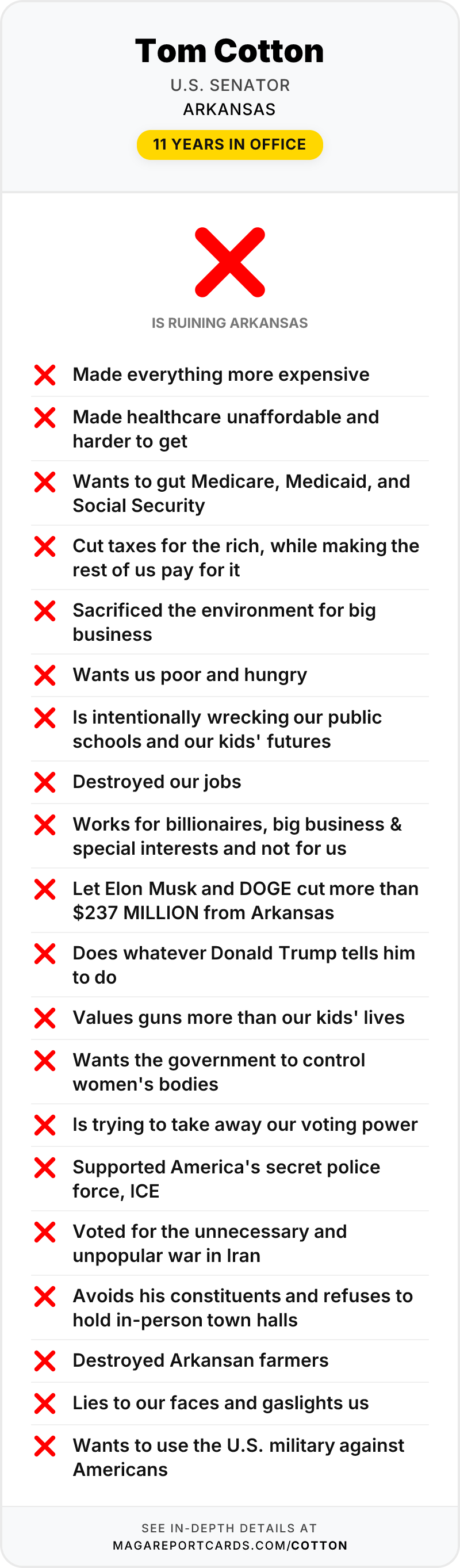
On June 10, 2026, Tom Cotton sent a letter to Acting Attorney General Todd Blanche asking the Justice Department to open an investigation into the people organizing against data centers in America.
Not the companies building them. The people objecting to them.
The letter runs to two pages. And buried in the middle of the first one is a sentence that gives the whole game away:
"Americans certainly have valid concerns about potential rising energy costs and strains on natural resources related to data centers, and we should implement common sense regulations and legislation to protect communities from adverse effects."
He agrees with them. He says so in writing. And then he asks the federal government's top law enforcement agency to investigate them anyway.
What he actually asked for
Cotton's letter to Blanche opens by asking DOJ to "investigate foreign influence efforts targeting the buildout of American AI infrastructure." His claim is that the opposition isn't real — that it's foreign:
"Alarming reports indicate that a network of foreign actors, led by the Chinese Communist Party (CCP), is attempting to manipulate U.S. policy and public opinion on data centers."
The specific ask, as Fox News reported, is an investigation under the Foreign Agents Registration Act — the law that requires people working on behalf of foreign governments to register with the Justice Department. Cotton points out in the letter that nobody in the network he describes has ever been charged under it.
His evidence is thin. The letter names one alleged actor — Neville Roy Singham, an American businessman living in Shanghai — and says his network of U.S. nonprofits produces content opposing American AI infrastructure. It asserts that entities tied to the campaign have "reportedly funneled more than $2 billion into U.S. advocacy organizations" without naming a single one of them. And it reaches for guilt by association: at a 75-minute AI event hosted by Senator Bernie Sanders, the letter says, two of the four panelists were Chinese government affiliates, one of them a professor from Tsinghua University. Two footnotes carry the whole thing — a Bitcoin Policy Institute report and a 2023 New York Times story about Singham.
Here's what the letter does not mention: the actual people in actual American towns fighting actual data centers over their actual water and their actual electric bills. There are a lot of them, and they aren't taking orders from Beijing. In Missouri, hundreds of Eric Burlison's constituents opposed a data center in their county and their congressman wrote a letter supporting it anyway. Cotton's letter would sweep all of that into a federal foreign-agent probe.
This is a habit, not a one-off
The Blanche letter isn't the first time Tom Cotton has asked a federal agency to go after a group he doesn't like.
November 2025 — the Justice Department. Cotton asked Attorney General Pam Bondi to investigate CodePink, the anti-war group, for possible violations of the same foreign-agent law and for "material support" to foreign terrorist organizations. Material support of a terrorist organization is a serious federal felony. He wanted it looked at because of the group's funding and its positions on China and Palestine.
March 2025 — from the chairman's seat. Cotton chairs the Senate Intelligence Committee. During a hearing on March 25, 2025, an activist named Tighe Barry was removed from the room, and Cotton called him a "CODEPINK lunatic funded by Communist China." The group filed a Senate ethics complaint three days later, asking Cotton to publicly recant and apologize. It says its money comes from small donors in the United States.
April 2019 — the IRS. Cotton wrote to the IRS commissioner asking the agency to investigate whether the Southern Poverty Law Center should keep its nonprofit status. He called the organization "a racist and sexist slush fund devoted to defamation" and urged the IRS to "take immediate action."
Different agencies, different targets, one move: when a group organizes against something Cotton supports, Cotton asks the federal government to open a file on them.
That's worth sitting with for a second. The senator who chairs the committee that oversees America's spy agencies keeps asking the executive branch to investigate Americans for the content of their politics. The job of that committee is supposed to be the opposite — keeping the surveillance state pointed outward and inside the law.
Meanwhile, back in Little Rock
Two months before Cotton wrote to Washington about foreign influence, some of his own constituents were standing outside his Little Rock office.
On April 13, 2026, members of Arkansas Community Organizations hand-delivered a letter to Cotton's office asking him to cut ties with Palantir Technologies. Organizer Nathan Huffmister said the group delivered a letter "asking him to sever his support for the company, which is being used by ICE and the Trump administration to violate Americans' right to privacy."
Norma Huffman, president of the group's Southwest Little Rock chapter, put it plainly:
"People that are being taken away from their families … Palantir is no good, and I cannot support a senator that gets funding from this type of organization."
These are Arkansans. They came to his office. They wrote it down and handed it to his staff. There is no record of Cotton responding.
The funding she was talking about
Huffman's line about "funding from this type of organization" is not a guess. It's in the Federal Election Commission's own records.
There is a super PAC called America One, registered in Alexandria, Virginia. Federal filings show it has spent $665,400 supporting Tom Cotton this election cycle. And on March 26, 2025, America One received $125,000 from Alexander C. Karp — listed with the employer "Palantir Technologies Inc." Karp is Palantir's chief executive.
What does Palantir do with the government? According to the ACLU, the company builds the software backbone of the deportation machine. Its case-management contract with ICE has grown past $145 million since 2014. In April 2025 it took a $30 million contract to build "ImmigrationOS," a system for identifying people to remove and tracking them through the process, running through September 2027. The systems pull records from Health and Human Services, the FBI, student visa databases, and commercial data brokers. ICE has said in writing that "Palantir remains the sole provider capable of meeting the specific needs and requirements of ICE."
So the picture is this. The chief executive of a company profiting from mass deportation puts money behind Cotton. Arkansans show up at his office to object. He ignores them — and writes to the Justice Department asking it to investigate people who protest.
This is the same pattern we documented when ICE started paying contractors to scan social media and then subpoenaing the platforms to unmask Americans who criticize the agency. Nobody gets charged. That isn't a bug. Being investigated is the punishment.
It's also the same money pattern that Marsha Blackburn's data-center donations followed in Tennessee: praise the industry in public, collect from it in private.
What this costs Arkansans
Cotton's own letter concedes the point his constituents are making. Data centers use enormous amounts of electricity and water. When they arrive, ordinary ratepayers can end up covering the cost of the new power lines and generation built to serve them. He wrote that Americans have "valid concerns" about "rising energy costs and strains on natural resources," and that Congress "should implement common sense regulations and legislation to protect communities from adverse effects."
He wrote that in June. He has not passed that legislation. What he did instead, in the very next paragraph, was ask the Justice Department to investigate the organizing.
You can believe both of the things Cotton wrote in that letter, or you can believe one. If the concerns are valid, the people raising them are neighbors, not foreign agents. If they're foreign agents, the concerns aren't valid. Cotton wants it both ways, because the one thing he clearly won't do is take the side of the people who have to pay the electric bill.
The bottom line
Tom Cotton has spent seven years asking federal agencies to investigate organizations that oppose him — the SPLC at the IRS, CodePink at the DOJ, and now the groups he says are driving the campaign against data centers, also at the DOJ.
In the same period, his own constituents came to his Little Rock office to ask him one thing about one company, and got nothing.
He is up for reelection this November. We deserve a senator who answers letters from Arkansans instead of writing letters about them.
Source
Sen. Tom Cotton, "Cotton to DOJ: Investigate Communist China Influence on Data Center Development", June 10, 2026. Photo: KATV.