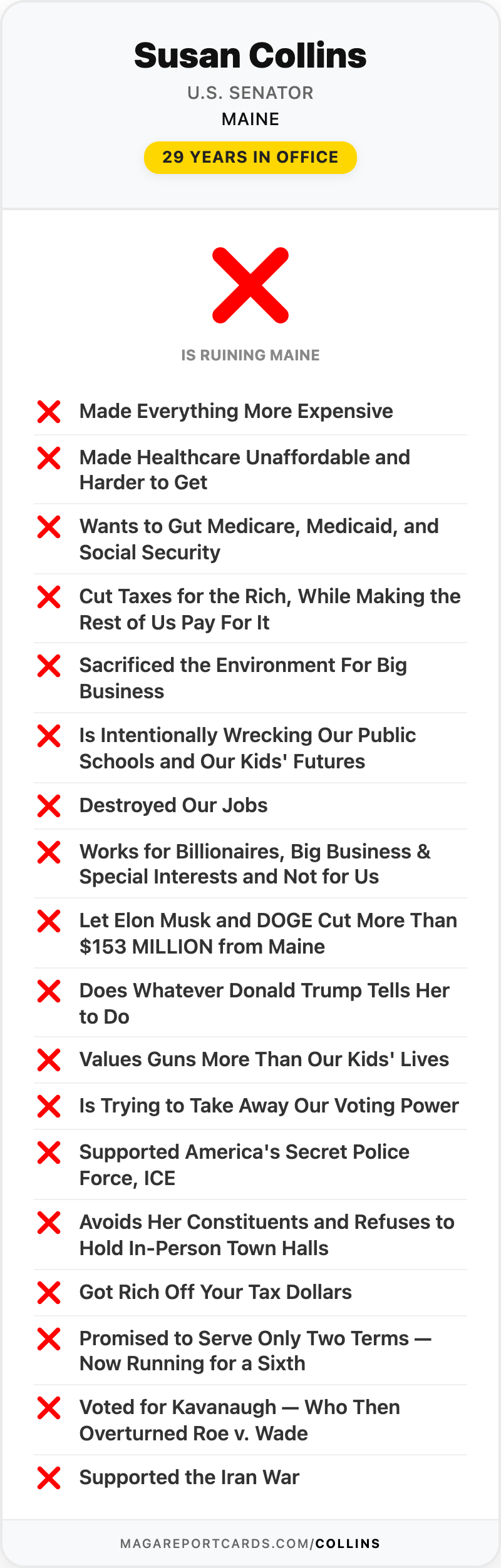
Susan Collins has spent years telling Maine voters she supports abortion rights. When the Supreme Court overturned Roe v. Wade in 2022, she called it an "ill-considered action."
On Monday, September 14, seven weeks before Election Day, she helped a Trump judicial nominee with a long anti-abortion record get past his last real hurdle.
The vote
Matthew R. Byrne is Trump's pick for a lifetime seat as a federal judge in the Southern District of Ohio.
On September 14, the Senate voted 47 to 46 to cut off debate on his nomination, the step that clears the way for a final vote. Every yes vote came from a Republican. Six Republicans didn't vote.
Collins voted yes. The margin was one vote. If she had voted no, it would have been 46 to 47, and the motion would have failed.
The next morning, the Senate confirmed Byrne 52 to 45. Collins voted yes again. The New Republic called it a "major anti-abortion vote."
Who Matthew Byrne is
This is not a nominee whose views on abortion anyone had to guess at. He wrote them down.
In a 2020 judicial candidate survey from Ohio Right to Life's political action committee, Byrne was asked whether he agreed that an unborn child should not die by abortion "for any reason other than to preserve the life of the mother." According to the questions senators sent him this summer, he checked "Yes" and added:
"I strongly agree. However, I believe the 'life of the mother' should be strictly defined so as to avoid creating loopholes."
No exception for rape. No exception for incest. And even the one exception he allowed, he wanted kept narrow.
In the same survey he wrote: "My family was always committed to the pro-life cause... I have remained involved in pro-life efforts throughout my career." And then: "In other words, my pro-life credentials cannot be questioned."
He also wrote in a Cincinnati Right to Life survey that "there is no reference to a 'right to privacy' in the Constitution," a right the Supreme Court has relied on in cases about birth control and same-sex relationships.
He wouldn't explain himself
Senators on the Judiciary Committee asked Byrne in writing why he opposes abortion with no exceptions for rape or incest, and what "loopholes" he wanted to avoid when a mother's life is at risk.
His answer to both, in the written responses he filed: as a federal judicial nominee, "it would be inappropriate for me to opine" on "a matter of political controversy."
Asked whether statements like "my pro-life credentials cannot be questioned" create at least the appearance that he's not impartial on abortion cases, he answered: "In general, no."
He's already ruled on it
Byrne has already sat on an abortion case.
In 2023 he was appointed as a visiting justice on the Ohio Supreme Court to hear a challenge to Ohio's six-week abortion ban. That November, Ohio voters passed an amendment putting abortion rights in the state constitution. The court dismissed the case in December. Byrne dissented.
He didn't step aside from the case, even though, according to the senators' questions, he'd written in his 2020 survey that he had "helped arrange for some testimony in support of the Ohio Heartbeat Bill," the very law being challenged. Byrne told senators it was just an informal, brief conversation answering someone's question about how to testify.
Collins has done this before
Collins' defense on abortion has always rested on the judges she votes for. In 2018 she voted to confirm Brett Kavanaugh, saying she was assured Roe was settled law. He voted to overturn it. She has since said she'd vote for him again.
The Bangor Daily News went through her record and found that when Collins casts a deciding vote, it usually goes to Republicans.
Byrne won't sit on the Supreme Court. But he will hear federal cases in Ohio for the rest of his career, and Collins helped put him there after he told an anti-abortion group his credentials "cannot be questioned."
What the roll call shows
On September 14, 2026, the Senate cut off debate on Matthew Byrne's nomination to a lifetime federal judgeship by 47 to 46, and Susan Collins was one of the 47. Had she voted no, the motion would have failed. The next day she voted to confirm him. Byrne wrote in a 2020 survey for an anti-abortion group that he opposes abortion except to save the mother's life, with that exception "strictly defined," and that his "pro-life credentials cannot be questioned." When senators asked him why he opposes exceptions for rape or incest, he declined to answer.
Source
- The New Republic: Susan Collins Casts Major Anti-Abortion Vote 6 Weeks Out From Election
- U.S. Senate: Cloture vote on the Byrne nomination (47–46) and confirmation vote (52–45)
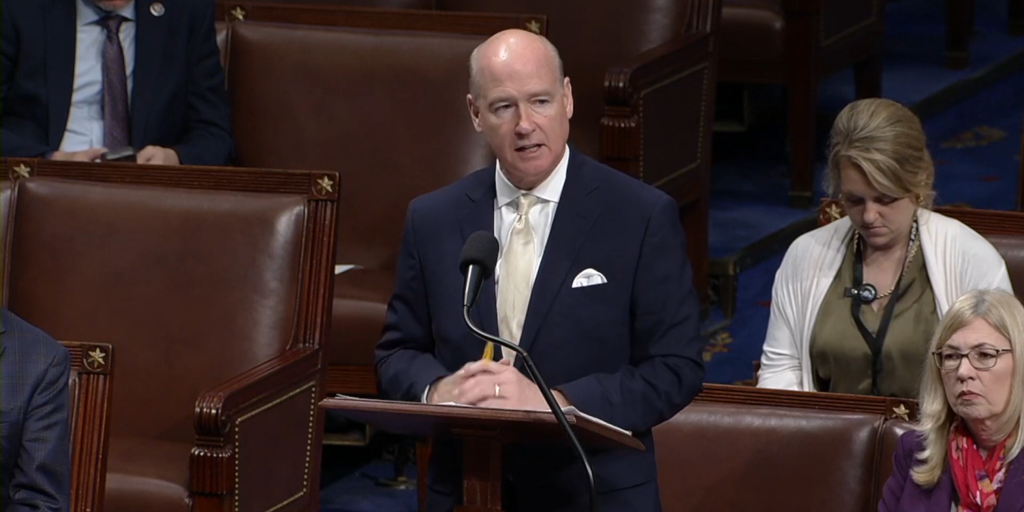
Photo: Bill Clark/CQ-Roll Call, Inc/Getty Images, via The New Republic.