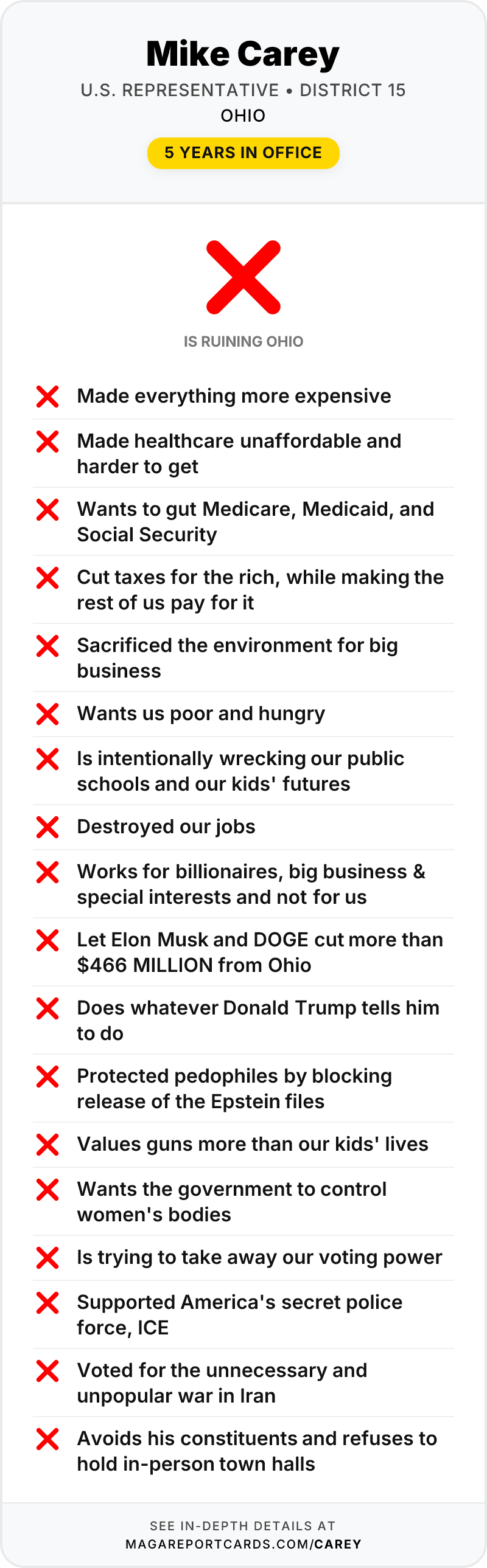
Giving back a tainted campaign check is easy. It costs $3,500 and buys a headline that says you did the right thing.
Voting to release the files is hard. It costs you a fight with your own leadership.
Mike Carey did the first one. Let's talk about the second.
February 2026: the deposition
On Wednesday, February 18, 2026, the House Oversight Committee deposed Les Wexner — the founder of L Brands, Ohio's wealthiest man, and for twenty years Jeffrey Epstein's client — about his relationship with Epstein.
Epstein was Wexner's personal financial adviser from 1987 to 2007, a period in which Epstein reportedly misappropriated millions of dollars from him. Wexner is listed as an alleged co-conspirator of Epstein in a 2019 FBI document, the Ohio Capital Journal reported. A legal representative for Wexner told the outlet that "the Assistant U.S. Attorney told Mr. Wexner's legal counsel in 2019 that Mr. Wexner was neither a co-conspirator nor target in any respect," and that Wexner "cooperated fully by providing background information on Epstein and was never contacted again."
Wexner has written checks to Ohio politicians for more than forty years. When the Epstein files started coming out and the subpoena landed, a scramble began.
"It's a big political problem for anybody that's been getting Les Wexner money over the years," University of Akron political scientist David Cohen told the Capital Journal. "This scandal is not going away. It's just going to get bigger and bigger and bigger."
What Carey did — and credit where it's due
Wexner donated $3,500 to Mike Carey for Congress on June 30, 2025.
Over the weekend before the deposition, Carey said he had donated all of Wexner's contributions to organizations that fight human trafficking and help survivors.
"Epstein was a profoundly evil man whose crimes destroyed countless innocent lives," Carey said in a statement.
That is the correct thing to say and the correct thing to do, and he should get credit for both. Plenty of Ohio politicians didn't. Columbus Mayor Andrew Ginther has declined to give up more than $91,000 in Wexner money. Sen. Bernie Moreno, who took $3,500 in June, and the National Republican Senatorial Committee, which took $250,000 from Wexner at the end of October, didn't respond to the Capital Journal's questions at all.
So this post isn't about the $3,500. It's about what Carey was doing in the months between cashing that check and returning it.
July 2025: the vote that actually mattered
On July 15, 2025 — fifteen days after that donation — the House took the routine procedural vote that opens debate on a rule, the motion to order the previous question. What hung on it was the Epstein files. As The Hill reported, defeating that motion "would have triggered a vote on Rep. Ro Khanna's (D-Calif.) amendment requiring Attorney General Pam Bondi to preserve, compile and publish the Epstein files."
Republicans held together to make sure it wouldn't. The previous question was ordered 211–210, on a straight party-line vote.
Two hundred eleven to two hundred ten. One vote.
Mike Carey voted Yea.
There is no version of that math where his vote didn't matter. In a one-vote margin, every member who voted yes is the deciding vote. He could have flipped it by himself.
That's the moment. Not the check. In July 2025, releasing the Epstein files was a live question that a single member of the House could have changed, and Carey chose the side that kept them sealed. The reporting at the time was explicit that House Republicans were blocking Democrats from forcing a vote on the files.
November 2025: the vote after it stopped costing anything
Four months later, after a discharge petition had gathered 218 signatures and after Donald Trump publicly relented, the House finally voted on the Epstein Files Transparency Act.
It passed 427 to 1.
Carey voted Aye.
Of course he did. By November 18, 2025, voting yes was free. Four hundred twenty-seven members voted yes. There was no leadership to defy, no Trump to irritate, no risk of any kind.
Put the two votes next to each other and the pattern is unmistakable:
- When his vote could have forced a floor vote on releasing the files (211–210, July): he voted to shut that door.
- When his vote changed nothing (427–1, November): he voted to release them.
That is not a change of heart. That is a man who waited to see what was safe.
And then the files came out
The Justice Department began releasing the Epstein files in December 2025, and the full release landed on January 30, 2026: more than 3 million pages, 2,000 videos and 180,000 images.
Independent human rights experts working under mandates from the UN Human Rights Council said the material contained "disturbing and credible evidence" of what may amount to a global criminal enterprise, and said some of the conduct could meet the threshold for crimes against humanity — including sexual slavery, torture and enforced disappearance.
That is what was inside the files Carey voted, in July, not to release.
Just over two weeks after that release, he gave back $3,500.
Why the gesture rings hollow
Robert Alexander, a political science professor at Bowling Green State University, framed the donation-return wave for the Capital Journal this way: there's an assumption that people don't give money just to give money, and "if that individual appears to be tainted, then there's going to be some suspicion that they were able to get some kind of favor or influence for the money that they contributed."
He added: "when you are dealing with things that are as sordid as those that are contained in the Epstein files, it would be hard to imagine politicians not wanting to divorce themselves from that situation."
That's the honest read on all of this — including Carey's. Returning the money was the easy, obvious, self-protective move once the files were public and the cameras were pointed at Ohio. Nobody had to be brave to make it.
Being brave was July 15.
The rest of the pattern
None of this is out of character. Carey has spent his time in Congress being reliably unavailable when it counts.
He won't hold an open in-person town hall — his telephone town hall came with call-in information his office promised to post and never did, and WOSU has tried to interview him 17 times without success. Before Congress he was a coal lobbyist who was a registered lobbyist on House Bill 6, the law at the heart of Ohio's largest bribery scandal, whose coal subsidies and the charges that preceded them took more than $683 million from Ohio ratepayers.
He is on the ballot again this year. If you want to ask him why he voted to block a floor vote on the Epstein files in a 211–210 vote, you'll have to catch him — and that is the one thing he's very good at preventing.
Source
Megan Henry, "Ohio billionaire political funder Les Wexner to be deposed by members of Congress in Epstein probe," Ohio Capital Journal, February 18, 2026.