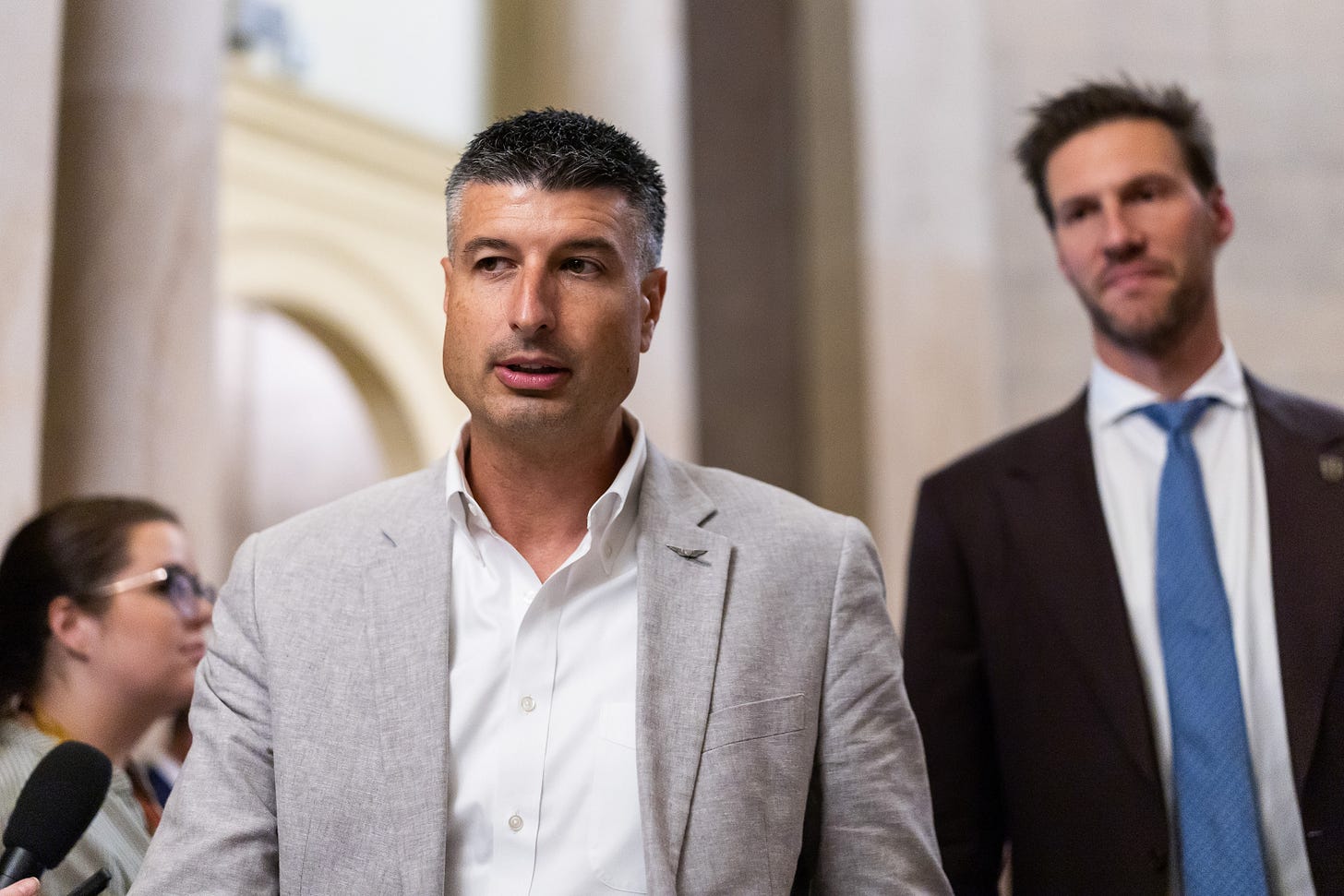
Tom Barrett wants voters in Michigan's 7th District to see him as the Republican who stood up to Trump's war with Iran. The people who build the weapons for that war have been paying for his campaign the whole time.
On October 2, Drop Site News reported that defense industry PACs and executives have given more than $58,000 to Barrett's reelection campaign. About $38,000 of it came from defense contractors, Drop Site reported. Much of the rest came from the men who run some of the biggest weapons companies in America.
Barrett's spokesman, Jason Roe, told Drop Site there was nothing to see: "One has nothing to do with the other."
The timeline says otherwise.
The vote that kept the war going
The war with Iran started in February. Congress never voted to approve it.
On April 16, 2026, the House voted on a resolution telling the president to pull U.S. troops out of the fighting. It failed 213 to 214. Tom Barrett voted no.
Read that tally again. One vote. If Barrett had voted yes, the resolution would have passed. We've written about how the House came within one vote of ending the war — twice; on that first day, Barrett was one of the votes that made the difference.
Six days before that vote, on April 10, the PAC of SpaceX — Elon Musk's rocket company, which sells missile tracking, launches and satellite communications to the military — wrote a $102,000 check to Grow the Majority, a joint fundraising committee that splits its money among several House Republicans. Barrett's campaign filings record $7,000 of it as his share.
Then he changed his tune
Three weeks after that vote, Barrett started sounding like a different person.
On May 7, he introduced his own war authorization and put out a statement:
"Two things have been clear from the very beginning: Iran cannot be allowed to develop a nuclear weapon and the United States of America cannot be dragged into another endless war."
"From the very beginning" is doing a lot of work there. Three weeks earlier, he'd cast a vote that kept the war going.
Look at what his bill actually did, too. It would have given Trump 90 more days of congressional authority to fight Iran and its proxies. That's not a plan to end the war. It's a permission slip with a deadline on it.
Starting May 14, Barrett voted yes on every resolution to end the war — on May 14, June 3, July 23 and September 15. Those votes are real, and we've counted them every time. But by then the war had been running for three months, and the April vote that could have put the House on record against it was already lost.
The checks kept coming
Here's what the defense industry gave Barrett's campaign, according to his FEC filings:
- Oshkosh Corporation's PAC — $10,000, on June 30, 2026. Oshkosh makes military vehicles and systems.
- SpaceX's PAC — $7,000, his share of a $102,000 check the PAC wrote to a joint fundraising committee on April 10, 2026.
- General Dynamics' PAC — $3,500, in 2025.
- Lockheed Martin's PAC — $3,000 across three checks, the latest on May 24, 2026.
- Booz Allen Hamilton's PAC — $2,000, in July 2025.
- Oracle's PAC — $1,000, on June 16, 2026.
And from the executives themselves:
- Shyam Sankar, the chief technology officer of Palantir — $7,000.
- Palmer Luckey, the founder of the defense company Anduril — $5,500.
- Neal Blue, the CEO of the defense contractor General Atomics — about $4,996.
Notice the dates. The Oshkosh, Lockheed, and Oracle checks all arrived after Barrett started telling voters he was against an "endless war." As Drop Site put it, he kept taking defense money "as recently as the last week of June, after a number of these comments were made and votes were cast."
None of this is illegal. That's the point. A congressman can tell voters he's worried about the war while the companies selling the war's hardware help pay for his campaign, and nobody has to break a single rule.
Why this matters in Michigan's 7th
Barrett is an Army veteran. In that same May 7 statement, he said: "I've lost too many friends on the battlefield." We believe him. That's exactly why the money matters.
This war isn't free. The Congressional Budget Office put its direct cost at $38.1 billion through August 1, and gas prices climbed after the war started. Every month the war runs is another month of contracts for the companies on that list.
Barrett isn't the only Republican on this site tangled up in the war's money. In North Carolina, Senate candidate Michael Whatley urged Trump to "stay the course" while owning up to $2.1 million in oil and defense stocks. And it's not the first time Barrett's donor list has undercut his campaign message: his own ad claimed he'd sent health insurers their money back, but he kept checks from UnitedHealth and Centene.
Voters can decide for themselves whether "one has nothing to do with the other." They should have the whole record when they do.
What the record shows
On April 16, Tom Barrett voted against a resolution to end the Iran war, and it failed by a single vote. He has run as a critic of the war since May, but defense PACs and executives have given his campaign more than $58,000, including $10,000 from military-vehicle maker Oshkosh at the end of June, after he had started calling it an "endless war."