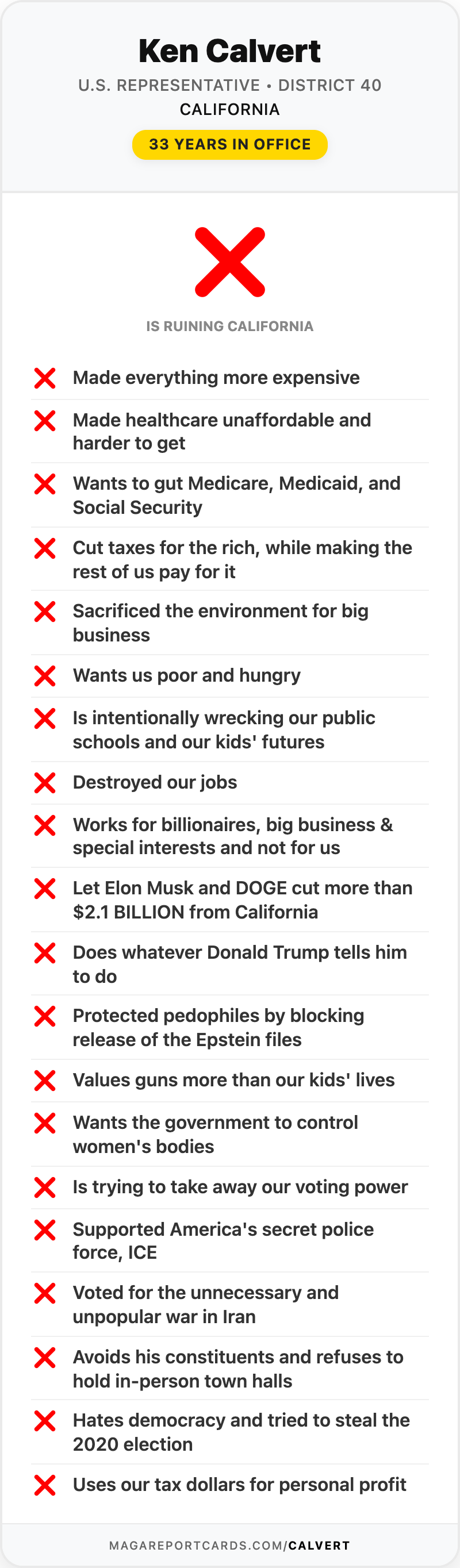
There is one member of the House of Representatives who holds the pen on the Pentagon's budget. He decides which line items live and which ones die. He decides which contractors get paid.
His name is Ken Calvert, and he has represented part of Riverside County since 1993.
On May 1, 2026, the news outlet NOTUS published an analysis of hundreds of Federal Election Commission filings covering the first three months of the year — January 1 through March 31, the exact stretch when American troops were fighting and dying in Trump's war with Iran. It found that the defense industry poured money into the campaign accounts of the people who decide how much the defense industry gets paid.
Calvert was near the top of the list.
"Rep. Ken Calvert chairs the House Defense Appropriations Subcommittee, which is charged with drafting the Defense Department's budget. The Republican is running in a competitive race after California Democrats gerrymandered his district, and his campaign committee received more than $200,000 during the first three months of 2026 from defense contractor PACs and direct contributions from top defense executives, according to FEC records."
More than $200,000. In three months. From the industry whose budget he writes.
The checks arrived while the shooting was going on
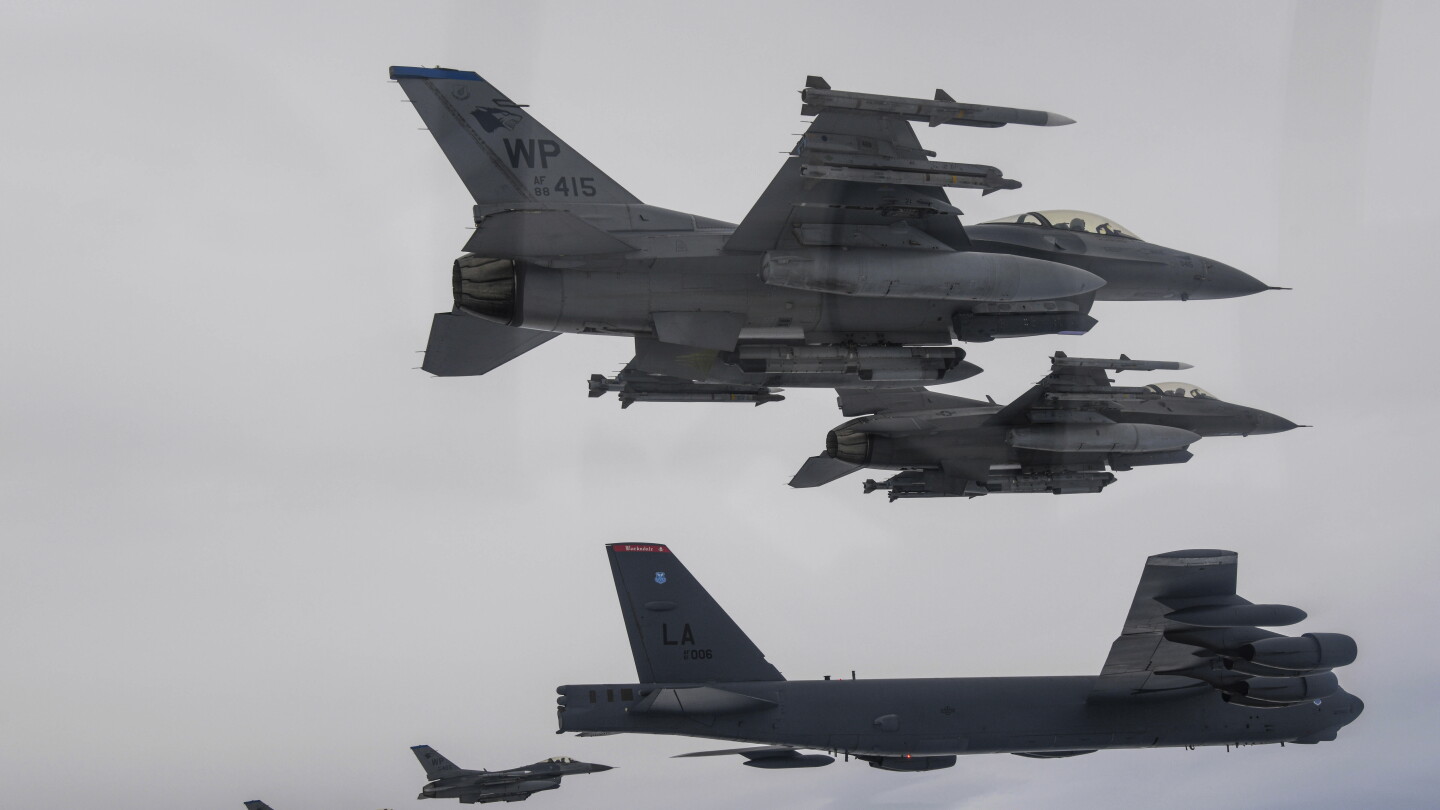
The war with Iran started in February 2026. Congress never voted to authorize it. By late July, the Pentagon's own count showed at least 624 American service members wounded in a war nobody in Washington was ever made to put their name to.
Here is what was landing in Calvert's campaign account during those same weeks, according to the FEC's own database:
- Lockheed Martin's employee PAC — $5,000, on March 9
- RTX, the parent company of Raytheon — $5,000, on March 4
- General Dynamics — $5,000
- General Atomics, the drone maker — $5,000
- BAE Systems — $5,000
- Leonardo DRS — $5,000
- AM General, which builds military vehicles — $5,000
- Booz Allen Hamilton — $5,000
- AeroVironment, Sierra Nevada, Parsons, GE Aerospace, BWX Technologies, Blue Origin, Airbus America, Hermeus, Ursa Major, Applied Research Associates, Applied Intuition, ES3 — $5,000 each
That is not the whole list. It is just the ones who gave $5,000 — the most a PAC may give a candidate for a single election.
All told, FEC records show that at least three dozen PACs tied to defense, aerospace and military-technology companies sent roughly $146,000 to Calvert's campaign committee in those three months — before you count a dollar of what the executives gave personally. Anduril, Leidos, Viasat, KBR, Thales, Parker Hannifin, HawkEye 360, Second Front Systems, AEVEX, Fuse Integration, Pacific Defense Strategies, Air Space Intelligence, Robotic Research, K2 Space, Reliable Robotics — the list reads like an exhibitor floor plan.
NOTUS also found the personal checks. On March 2 and March 3 — which the outlet notes was "days after the Iran war began" — Calvert took two $1,000 donations from executives at AM General: Darrell Duckworth, an executive director, and Ryan DuRussel, the chief financial officer.
Calvert's office did not dispute any of it. His senior congressional adviser, Jason Gagnon, told NOTUS:
"Rep. Calvert appreciates the support he receives from a wide variety of Americans. His votes and actions are always based on what he believes is in the best interest of the constituents he represents and all Americans."
"A wide variety of Americans" is doing a great deal of work in that sentence.
What that money is buying a seat at the table for
This is not abstract. The Pentagon has asked Congress for a $1.5 trillion budget for 2027 — a jump of nearly $500 billion over what Congress approved the year before, and the highest ever, surpassing the inflation-adjusted peak of World War II. The request asks lawmakers to approve about $1.15 trillion the normal way and to push another $350 billion through a fast-track budget process that needs only a simple majority in the Senate.
The subcommittee Calvert chairs is the body that writes the bill deciding how that money is carved up.
Every company on the list above has a direct financial stake in that decision. They are not donating to Ken Calvert because they admire his views on Riverside County traffic. They are donating to the man holding the pen.
And this isn't a one-quarter blip. Across this election cycle, Calvert has taken $366,000 in defense PAC money against a House average of $29,408 — more than twelve times what the typical member of Congress receives. Only about 6% of his money came from small grassroots donors. Roughly 75% came from PACs, super PACs and large donors.
He also voted to keep the war going
Here is where the money and the votes meet.
On July 23, 2026, the House voted 214 to 208 to order the president to pull U.S. forces out of the fighting in Iran. Calvert was one of 185 Republicans we track who voted no — voting to keep American troops in a war Congress had never authorized in the first place.
He is not the only member of Congress whose donors do well out of this war. We've documented an Iowa Republican who privately called the Iran war a "political liability" to a voter at a campaign stop, then voted seven times to keep it going while taking $98,000 from oil and gas PACs. The pattern repeats because the incentives repeat.
But Calvert's case is sharper than most, for a simple reason: most members vote on the defense budget. He writes it.
And he is fighting to keep the gavel
There is one more piece, and it explains why the industry's money got so urgent this spring.
House Republican conference rules bar a subcommittee chair from holding the job for more than three consecutive terms. Calvert has already blown through that limit — he is already serving under a waiver, Roll Call reported in April. His gavel, the outlet noted, "is the most sought-after on the Republican side." If he's reelected in November, he'll need another waiver to keep it.
That is the situation the defense industry was writing checks into. The chairman who signs off on their contracts is in the fight of his political life — California's new congressional map drew him into the same district as fellow Republican Young Kim, so two sitting incumbents are running against each other — and he needs a favor from his own party leadership to keep the job that makes him valuable to them.
Money flows toward exactly that kind of insecurity.
What we're owed
Nobody is alleging a crime here. The donations are legal, they're disclosed, and that is precisely the problem. This is what the system looks like when it's working the way it was designed to work.
A person who spends his working hours deciding how to spend $1.5 trillion of our money on weapons should not spend his evenings collecting checks from the people who sell the weapons. Not while the war is on. Not while Americans are getting hurt in it. Not while he is fighting to hang on to the gavel that makes those checks worth writing.
Calvert says his votes "are always based on what he believes is in the best interest of the constituents he represents." His constituents in Riverside and Orange counties did not ask for a $500 billion increase in the Pentagon budget. Many of them are among the people whose monthly payment for their own health insurance rose 58% on average after he and 196 other Republicans voted to let the tax credits that made coverage affordable expire.
Somebody got taken care of in all this. It wasn't them.
Source
Defense Contractors Pump Big Money Into Congressional Campaign Accounts Amid Iran War — Samuel Larreal, NOTUS, May 1, 2026. Lead photo: Associated Press.