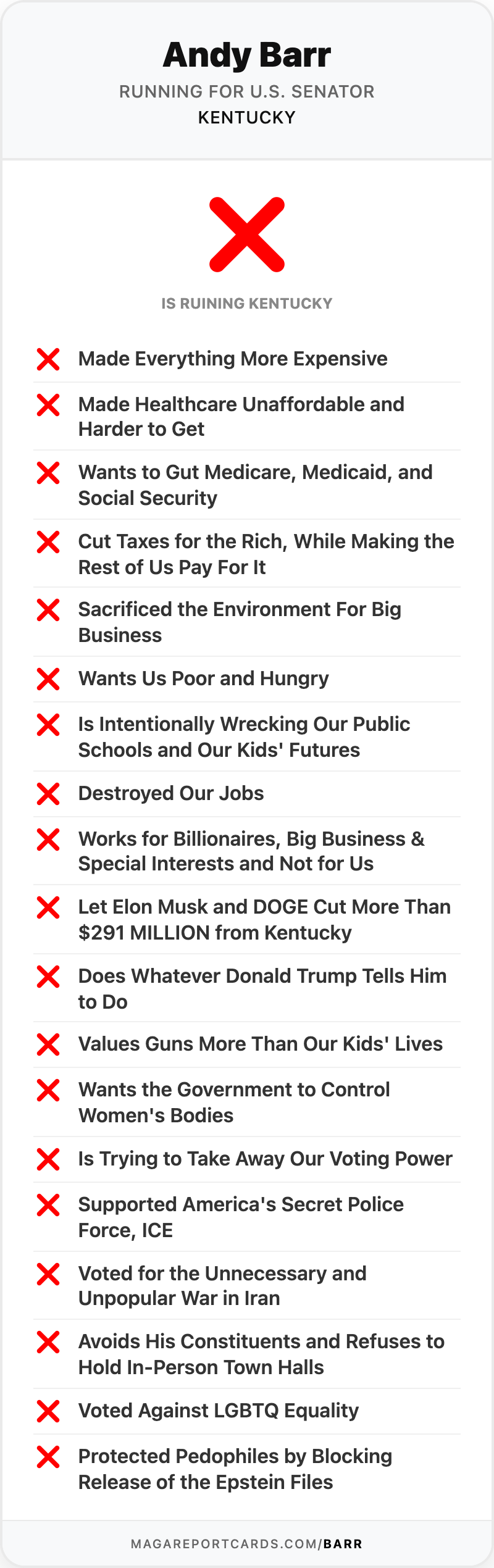
Governor Andy Beshear has said since June 2025 that 35 Kentucky rural hospitals are at risk of closing because of the 2025 Republican budget bill — Barr's own office dates the first statement to June 23 of that year. On September 4, 2026, Andy Barr stood at the Lexington Clinic with Dr. Mehmet Oz, who runs Medicare and Medicaid for the Trump administration, and said the premise is simply false.
"This idea that the governor here in Kentucky and others around the country, the critics of the president, the critics of our law, are saying that somehow this is a cut is wrong."
Barr is running for Mitch McConnell's Senate seat. He voted for the bill. We wrote in August about the letter he sent Beshear demanding he prove the 35 hospitals are at risk — a letter that never mentioned his own vote.
This is the next round, and it turns on one specific claim.
Barr's defense is a $50 billion fund
Barr's argument is that the study naming 35 at-risk Kentucky hospitals was done before Congress created the Rural Health Transformation Program, which puts $50 billion into rural health care between 2026 and 2030. Kentucky's first-year share is $212.9 million, awarded by the Trump administration on December 29, 2025. Barr's own letter says the state "has now received" it.
In other words: yes, Medicaid is changing, but here is money to cover it.
Beshear answered that in a letter Barr's office received on Tuesday. His answer is not that the money is too small. It is that the money is not allowed to go where the problem is.
Under the program's federal guidelines, Beshear wrote, the funds are barred from being used on financially struggling hospitals.
What he pointed to, Beshear said, was the op-ed Health and Human Services Secretary Robert F. Kennedy Jr. and Oz published when the program was announced. Their words: "Throwing money at struggling hospital operations is like a Band-Aid on a severed artery, leaving a broken system in place."
That is the whole argument in one sentence. Barr's proof that the at-risk hospitals will be fine is a fund the state says cannot be spent on hospitals in financial trouble.
What is actually changing
Barr describes the changes as saving Medicaid from fraud, waste and abuse, and says Medicaid spending will rise by $250 billion over ten years.
Here is what the law does to people in Kentucky, with the effective date the law itself sets for each:
- Work requirements, by December 31, 2026 — adults covered by the Medicaid expansion have to complete 80 hours a month of work or a qualifying activity. Where the state cannot verify that from data it already holds, it must send a notice of noncompliance and drop the person if they cannot show compliance within 30 days.
- Six-month eligibility renewals, for renewals scheduled on or after December 31, 2026 — twice the paperwork of the annual renewal it replaces.
- Minimum out-of-pocket payments, October 1, 2028 — up to $35 a service for expansion adults earning between 100 and 138 percent of the poverty line. This one is two years out, not next year.
Barr's framing for the first one:
"We want work requirements so that people can graduate out of Medicaid into work-provided health insurance, commercial health insurance that reimburses providers, physicians, hospitals, and nurses on a more market-based level."
"Graduate" is doing a lot of work in that sentence. A person who loses coverage because they missed a renewal deadline has not graduated into anything.
Oz threatened to take the money back
The most striking thing said at that press conference did not come from Barr.
Oz explained that the rural health money goes to governors because people trust governors to spend it correctly. Then he added a condition:
"I don't want to do it. But if the money is not used wisely to improve the state of health in rural parts of Kentucky ... then we're going to have to take steps that we don't want to have to take."
So the $212.9 million that Barr is holding up as the answer to the hospital closures comes with a federal official standing beside him saying that "if for whatever reason the governor cannot use the money as promised in the grant, it will be taken by the federal government" — while the state says the rules already forbid spending it on the hospitals most at risk.
The part that hasn't changed
Barr's whole position rests on the claim that a law he voted for will not close hospitals. His evidence is a fund the state says it cannot aim at the hospitals in question, administered by an official who says he may take it back.
Meanwhile the changes themselves — work paperwork and six-month renewals from the end of this year, new out-of-pocket costs for low-income Kentuckians in 2028 — are not in dispute. Barr is not arguing they won't happen. He is arguing they are not a cut.
What the record shows
Andy Barr voted for the 2025 budget bill and now says its Medicaid changes are not cuts. His evidence is Kentucky's $212.9 million first-year share of a $50 billion rural health fund, awarded last December. Governor Beshear says federal rules bar that money from going to financially struggling hospitals, which are the ones the closure warnings are about. Standing next to Barr, the federal official who runs Medicaid warned the money could be taken back. Work requirements and six-month renewals start at the end of this year; the new out-of-pocket costs follow in 2028.
Sources
- Hannah Pinski, Andy Barr and Dr. Oz defend changes coming to the Medicaid program, Lexington Herald-Leader (September 4, 2026).
- Oz says rural health funding responsibility falls to governor, WKYT (September 4, 2026).
- Christian Wohlfeil, Gov. Beshear defends rural hospital funding after scathing letter from Rep. Barr, LEX 18.
- Barr Calls Out Beshear Over Inaccurate Rural Hospital Claims, Office of Rep. Andy Barr (August 25, 2026).
- Robert F. Kennedy Jr. and Mehmet Oz, Rural America's health care is collapsing. Here's how we transform it., USA TODAY (September 15, 2025).
- Congressman Rogers Announces Nearly $213 Million Award for Rural Healthcare in Kentucky, Office of Rep. Hal Rogers (December 29, 2025).
- Health Provisions in the 2025 Federal Budget Reconciliation Law, KFF.