Texas hospitals are losing $27 million a day, the Texas Hospital Association says.
The Trump administration is holding up $10 billion in Medicaid payments the state's hospitals were counting on. The money comes from a federal program that tops up what hospitals are paid for treating Medicaid patients, because the base rate does not cover what the care costs.
Three years ago, the Biden administration threatened to withhold the same money over the same legal objection. Ken Paxton took that fight to federal court and won.
Last year he put out a news release calling it a "major nationwide legal victory."
"This is not only a win for the integrity of Texas health care, but it's also a defeat of Joe Biden's unlawful overreach. This rule is just one example of the Biden administration's misuse of CMS, which was employed to target conservative states."
This week, with the identical dispute and a Republican in the White House, the Texas Tribune reported that Paxton has not filed a lawsuit, has not said whether he intends to, and has not commented at all. Neither has his campaign.
What the fight is actually about
Texas hospitals pay about $4.2 billion a year in local taxes, which the state uses as its share of the program. Since 2013, state law has also let hospitals make informal agreements with one another, so a hospital hit harder by the Medicaid shortfall can be helped out by one in better shape.
Federal regulators say a tax has to be broad-based and applied uniformly. Their objection, both times, is that those agreements effectively shield some hospitals from the tax.
Texas has argued that the agreements are private contracts and the federal government has no business policing them. That argument won in federal court last September, in a case Texas itself had brought against CMS in 2023. Here is how his office described the win in last year's news release:
"These agreements were permitted by the Legislature in 2013 and are allowed by federal law... Biden's CMS attempted to force Texas and other states to police purely private contracts, imposing unlawful federal overreach that could have led to a massive cut in critical Medicaid funding."
Every word of that applies to what the Trump administration is doing now. This time the demand goes further — regulators appear to want Texas to rewrite its tax structure entirely, which state officials say is unnecessary.
Paxton has not answered whether he will sue.
Even Greg Abbott is fighting this one
Governor Greg Abbott, who is not known for crossing Trump, has publicly backed the state's position. His spokesperson said on Wednesday that Texas was not backing down. That is a rare thing in Texas — a Republican in office publicly fighting for Medicaid.
Brandon Rottinghaus, a political scientist at the University of Houston, told the Tribune he is not surprised Paxton is the one staying quiet. Paxton is in a close race against Democratic state Rep. James Talarico, early voting begins October 19, and the Republican midterm convention opens in Dallas next week.
"He's in a very politically delicate situation, and he doesn't want the story to be, Trump versus Paxton. He's biding his time in a way that is useful as a delay tactic to not make this a story that could splash back up on him."
Rottinghaus also said the money is too big to walk away from. "It's gonna be politically messy for the Republicans, especially for Greg Abbott and for Ken Paxton, but it's a fight that they have to have."
One of them is having it.
What the money pays for
Medicaid covers 4 million Texans, most of them low income. About a third of all children in Texas are on it. So are two-thirds of Texans in nursing homes.
The Texas Hospital Association says that without this funding stream, hospitals are at risk of shutting down their neonatal intensive care units and maternity wards. Those are among the most expensive services a hospital runs.
At Parkland Health in Dallas, where a third of the patients at Parkland Memorial Hospital are on Medicaid, chief executive Dr. Frederick Cerise told Dallas County commissioners on Tuesday what the number looks like for one hospital system: $528,000 every day for the coming fiscal year, which starts October 1.
He said there are no immediate service cuts, but that the first casualty will be capital improvements, and that it gets worse the longer the standoff lasts. He does not expect the state to fill the hole.
"The state depends heavily on this as a financing mechanism and... it's hard to imagine the state's going to backfill that with general revenue."
He is also less hopeful than usual that it gets sorted out. In the past, he said, the funding has been approved late and applied retroactively. "There's a lot more uncertainty right now than we've ever had."
The job he is running to leave
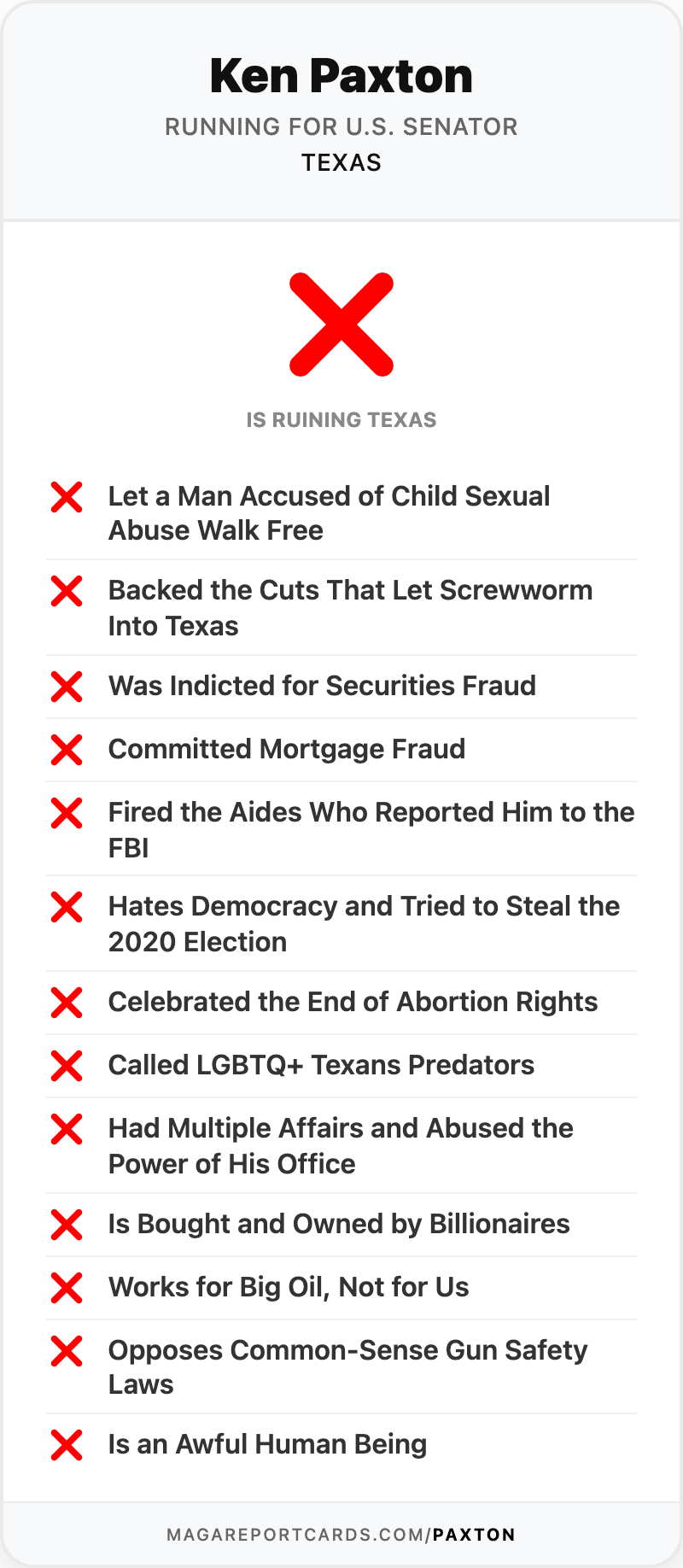
Paxton is the attorney general of Texas. Suing the federal government over Medicaid funding is not a favor he does for hospitals; it is the work of the office he currently holds, and it is work he has already done successfully on this exact question against a different president.
He is asking Texans to promote him to the Senate. The argument for doing that rests on his record as the state's lawyer.
His record on this dispute, so far, is silence.
Voters have seen this shape before. We wrote about him investigating America's pediatricians for taking money from donors, and about the Republican mega-donors who will not touch his campaign.
What the record shows
Ken Paxton sued the Biden administration to stop it from withholding this exact Medicaid funding, won, and issued a news release calling it a major nationwide legal victory and an act of unlawful federal overreach. The Trump administration is now withholding the same $10 billion on the same legal theory, at a cost of $27 million a day to Texas hospitals and $528,000 a day to Parkland Health alone. Governor Greg Abbott has publicly backed the state's position. The attorney general has filed nothing and said nothing, six weeks before early voting begins in his Senate race.
Source
Ken Paxton quiet about Texas' $10B Medicaid cut, by Terri Langford, The Texas Tribune, September 4, 2026. Photo by Shelby Tauber for The Texas Tribune.