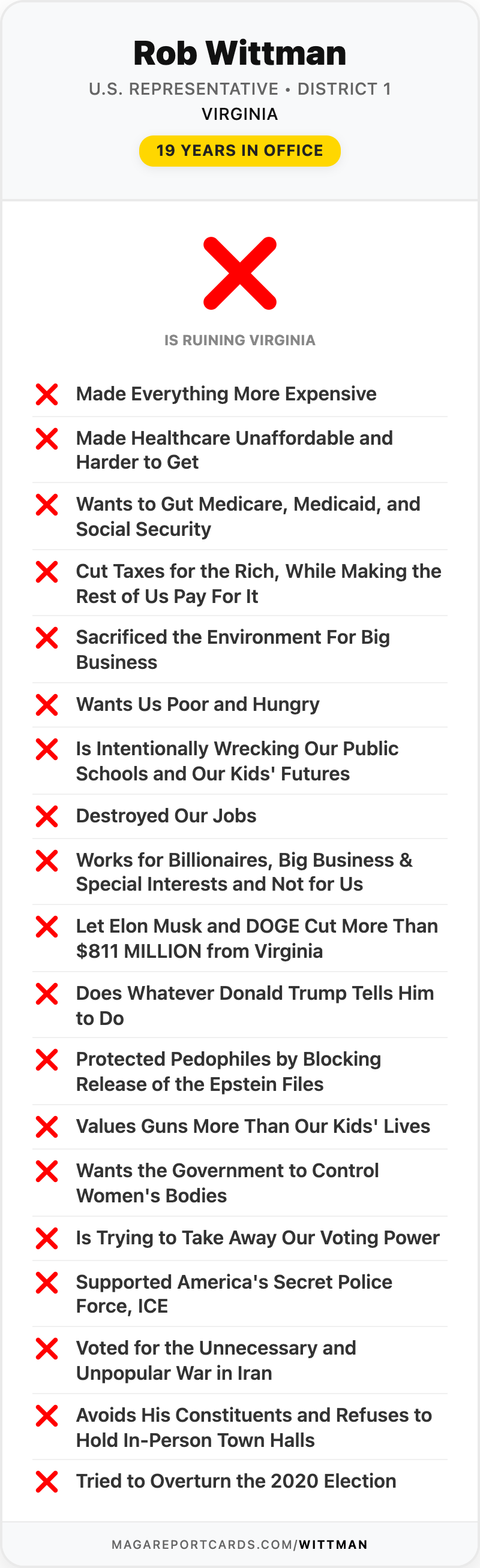
Back in 2017, Rob Wittman was proud of the number. He had voted to repeal and replace the Affordable Care Act 60 times, and he said so.
Nearly a decade later, on January 8, 2026, he did something different. He was one of just 17 Republicans in the entire House to vote for a three-year extension of the ACA's enhanced premium subsidies. The bill passed 230 to 196 over the objections of Speaker Mike Johnson. Then the Senate let it die, and the subsidies stayed expired.
Virginia Mercury's Charlotte Rene Woods put the two facts next to each other this week and asked Wittman the obvious follow-up: would he back a future repeal effort?
He didn't answer.
What he said instead
Asked to explain the January vote, Wittman gave a reason about his own constituents. "I did not believe families should face dramatic increases in their health insurance costs without a transition," he said.
Asked whether he'd vote to repeal the law again, he offered a paragraph of goals instead of a yes or a no — competition, patient choice, price transparency, "greater control over their healthcare decisions."
That is not a small dodge. The whole question voters in Virginia's 1st District have to answer this November is which Rob Wittman they are electing: the one who counted 60 repeal votes as an accomplishment, or the one who cast a single vote the other way nine years later. He was asked directly and he would not say.
University of Virginia's Larry Sabato read the January vote as a calculation rather than a conversion. Wittman's district, he said, is "competitive enough that he can't stick to (President Donald) Trump and GOP congressional positions 100% of the time."
The vote came after the damage was locked in
Timing matters here, and it does not flatter him.
The enhanced subsidies expired on December 31, 2025. Wittman's vote to extend them came on January 8, 2026 — eight days after they were already gone, in a bill his own party's leadership opposed and the Senate never brought to a vote. A similar measure had already failed in the Senate on December 11, when a cloture motion on S. 3385 was rejected 51 to 48.
Since last year, 94,000 Virginians have dropped their ACA insurance. That is the number of people who looked at what a plan cost without the subsidies and walked away.
Nationally, about 2.6 million people have lost ACA coverage as the same math played out in nearly every state — New Mexico, which replaced the federal subsidies with its own, was the only one where enrollment went up. Virginia's 94,000 is Virginia's share of a bill that Congress chose not to pay.
The other health care vote he did cast
While the subsidy vote was one vote against his party, Wittman's vote on Trump's budget bill was one with it — and it is the vote with the bigger price tag.
He and Representative Jen Kiggans both pushed back on parts of the bill while it was being debated. Both then voted for it.
What that bill does to Virginia, per Virginia Mercury's reporting:
- About 300,000 Virginians are at risk of losing Medicaid coverage next year.
- 5,800 lawful immigrants are guaranteed to lose it next month.
- A projected $31 billion cut to the state's Medicaid funding over the next decade.
- Changes to how hospitals are paid that may push rural hospitals toward closing or cutting services.
This is also not the first time Wittman's stated position and his recorded vote have pointed in opposite directions on Medicaid. In April 2025 he signed a letter promising he would not support any bill that reduced coverage for vulnerable people, told a columnist a month later that Virginians were protected, and then voted yes.
"A different pathway" that analysts read as another repeal
Wittman has also backed the Lower Health Care Premiums For All Americans Act, which passed the House last December and has not become law. It would let small businesses and self-employed people band together to buy insurance through association health plans.
Wittman describes it as bulk buying. "Anything that you buy in bulk or in mass quantities, you get a reduction in price," he said.
Some analysts describe it as a way to chip away at the ACA. The reason is not complicated. Since the ACA passed, insurers have not been allowed to charge you more because of your health. Pooling healthy people separately from sick people undoes that quietly, without a repeal vote.
Georgetown researcher Sabrina Corlette explained why the shared pool is the point. "We all get older and sicker," she said. The Democrats' approach "is recognizing that you might be subsidizing a sicker person today, but someone else will be subsidizing you down the road."
His Democratic opponent, prosecutor Shannon Taylor, put the political read plainly: "Now, with an election around the corner and families facing higher premiums, he wants to try and change his tune."
What the record shows
Rob Wittman touted 60 votes to repeal and replace the Affordable Care Act, then cast one vote to extend its subsidies eight days after they had already expired, in a bill that died in the Senate. Asked this week whether he would vote to repeal the law again, he would not answer. In between, he voted for Trump's budget bill, which puts about 300,000 Virginians at risk of losing Medicaid and cuts a projected $31 billion from the state's Medicaid funding over ten years, and 94,000 Virginians have already dropped their insurance since the subsidies lapsed.
Source
Wittman voted 60 times to undo the Affordable Care Act. Then he backed extending its subsidies. — Charlotte Rene Woods, Virginia Mercury, September 3, 2026. Photo by Charlotte Rene Woods / Virginia Mercury.