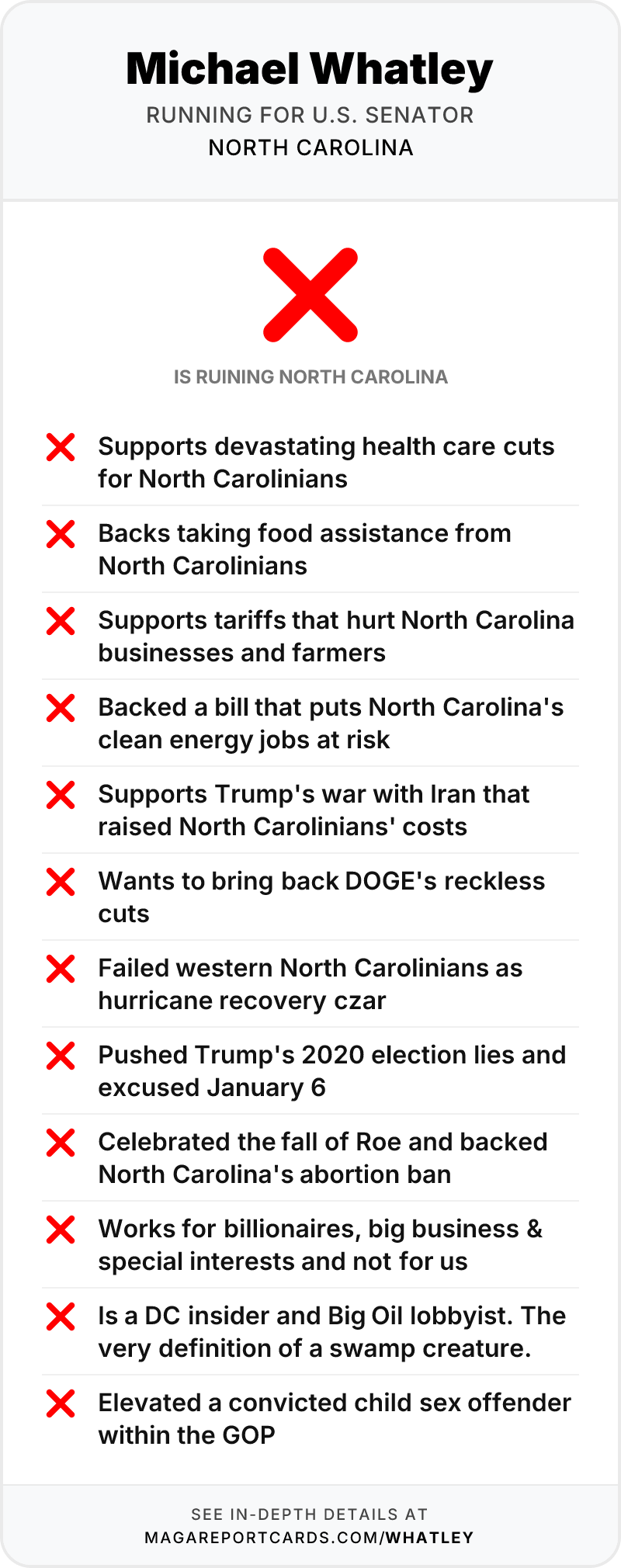
Michael Whatley, the Republican nominee for Senate in North Carolina, has been telling voters that the cost of living has gone down.
Here is the sentence, from a clip his opponent is now running in an ad: "Grocery prices are down, gasoline prices are down, housing prices are down, inflation is down."
Here is another, from a podcast: "There is no inflation."
Neither of those is true. And when his campaign answered the ad in the Washington Post, it did not walk the claim back. It doubled down.
What his campaign told the Post
The Post's Dan Merica reported on the North Carolina Senate race on September 1, 2026. Whatley's campaign spokesperson defended the claim:
"Prices were down considerably in 2025 from the record-setting inflation caused by Joe Biden's reckless spending policies endorsed by Roy Cooper."
The Post checked it. Its conclusion, in plain words: "That point is not entirely correct: Inflation was lower in 2025 than the highs in 2022, but prices did not fall."
That distinction is the whole thing, and it is the one Whatley keeps collapsing. Slower inflation means prices are climbing more slowly. It does not mean prices came down. A grocery bill that goes up 2% instead of 8% is still a grocery bill that went up.
The government's own numbers
You do not have to take the Post's word for it. The Bureau of Labor Statistics publishes the Consumer Price Index every month, and it is a level, not a rate — you can look at where prices sat in December 2024 and where they sat in December 2025.
| Dec. 2024 | Dec. 2025 | Change | |
|---|---|---|---|
| All items | 315.6 | 324.1 | up 2.7% |
| Groceries (food at home) | 308.4 | 315.7 | up 2.4% |
Prices did not go down in 2025. They went up, and groceries — the first thing on Whatley's list — went up right alongside everything else.
They have kept going up since. By July 2026 the all-items index had reached 333.9, another 3% higher than where it ended 2025.
So when Whatley says "grocery prices are down," the answer is not a matter of opinion or framing. The federal statistic he is describing moved the other way.
"There is no inflation"
The second claim is worse, because it is not even a spin on a real number. If prices rose 2.7% in 2025 and roughly 3% again in the first seven months of 2026, there is inflation. It is simply lower than the 2022 peak.
Whatley's argument requires North Carolinians to accept that their own grocery receipts are wrong. Voters generally know what they paid last year.
This is the campaign's central fight, and he picked the wrong side of it
Affordability is the issue in the North Carolina Senate race. Both campaigns say so. Roy Cooper is running an ad on it, and the clip in it is Whatley's own voice saying prices are down.
There is a reason that clip is effective, and it is not clever editing. Whatley volunteered a claim that every shopper in the state can check against their own receipts, and it is wrong.
It is also not the first time his cost-of-living message has run into his own record. He and his wife own between $163,000 and $445,000 in Duke Energy stock while Duke seeks a residential rate increase in North Carolina — meaning the power bill going up is, for him, partly income. And his $1.5 million ad about driving a truck in a flannel shirt ran while his campaign committees were spending $136,000 on private jets.
What the record shows
Michael Whatley has said on camera that grocery, gasoline and housing prices are all down and that "there is no inflation." His campaign repeated the claim to the Washington Post on September 1, 2026, saying prices "were down considerably in 2025." Federal price data says the opposite: overall prices rose 2.7% across 2025, groceries rose 2.4%, and prices have risen roughly another 3% since. He is asking North Carolinians to believe a cost-of-living claim their own receipts disprove.
Source
Dan Merica, The Washington Post, September 1, 2026, "Why this popular Dem is running like he is behind" (republished by Jewish World Review). Price data: U.S. Bureau of Labor Statistics, Consumer Price Index for All Urban Consumers.