H.R. 21 is Ann Wagner's bill, the Born-Alive Abortion Survivors Protection Act. She filed it on January 3, 2025 — the opening day of the 119th Congress, on the lowest bill number House leadership had not reserved for itself — with 163 cosponsors. Three weeks later, on January 23, the House passed it 217–204: every voting Republican in favor, all but one Democrat against. It went to the Senate Judiciary Committee, where it has sat ever since.
Getting a bill from introduction to the House floor in twenty days takes leadership behind it. This one had it.
She has filed some version of it for years. "I have championed this issue for decades and I have been blessed and honored to lead this legislation since 2019," she said when an earlier version passed in 2023. After the 2025 vote she called it "my vital legislation."
It's worth reading what it actually says.
What's already illegal
The bill's own findings section states the law as it already exists:
"If an abortion results in the live birth of an infant, the infant is a legal person for all purposes under the laws of the United States, and entitled to all the protections of such laws."
That's not new. It's the Born-Alive Infants Protection Act of 2002, codified at 1 U.S.C. § 8, which Wagner's bill cites by name. FactCheck.org laid this out in 2019: federal law already defines a "person" as "every infant member of the species homo sapiens who is born alive at any stage of development," and every state's homicide laws already apply. As one legal expert put it there: "States can and do punish people for killing children who are born alive."
So the protection Wagner says she is creating has existed for more than two decades. What her bill adds is the enforcement machinery.
What the bill actually adds
Read the text the House passed. Three things:
1. A mandatory hospital transfer, whatever the family wants. A practitioner must exercise the same care as for any child born at the same gestational age, and then "ensure that the child born alive is immediately transported and admitted to a hospital." Not "if medically indicated." Not "unless the parents choose comfort care." Immediately, in every case.
2. Mandatory reporting — by everyone in the room. Any practitioner "or any employee of a hospital, a physician's office, or an abortion clinic" who knows of a failure to comply "shall immediately report the failure to an appropriate State or Federal law enforcement agency." A nurse who watched a family hold a dying infant instead of sending it to a NICU is required by federal law to call the police on the doctor.
3. Five years in prison. "Whoever violates subsection (a) shall be fined under this title or imprisoned for not more than 5 years, or both." A separate provision punishes intentional killing as murder — which, again, was already the case.
There's also a private right of action letting the woman sue for damages "equal to 3 times the cost of the abortion," plus punitive damages and attorney's fees.
What doctors say this does to families
The American College of Obstetricians and Gynecologists, the professional body for the physicians this bill would prosecute, has condemned it in unusually direct language. Here is ACOG President Dr. Iffath Abbasi Hoskins, after the House passed the 2023 version of Wagner's bill:
"The offensively named 'born-alive' legislation is another cruel and misguided attempt to interfere with evidence-based medical decision making between patients and their physicians. This bill is not based in science or medicine. It is meant to incite emotions, rather than reflect the reality of evidence-based clinical care."
And on the specific harm:
"This reckless bill would impede families from making significant quality-of-life decisions, such as being able to provide comfort or spiritual care in tragic and painful situations. Abortions later in pregnancy are the result of complex decisions, and patients make these health care decisions thoughtfully, carefully, and painstakingly."
"Instead, this bill takes decision making out of the hands of families in crisis and limits the freedom of our patients to make the decisions that are right for them."
Think about the situation the mandatory-transfer clause actually governs. An infant delivered at the edge of viability, with a condition incompatible with life, whose parents have decided — with their doctor — to hold their baby rather than subject it to intubation and transport in its final minutes. Wagner's bill makes that a federal crime punishable by up to five years, and makes every nurse in the room a witness legally obligated to report it.
How often this actually happens
Rarely, and almost never in the way the bill's title implies.
FactCheck.org compiled the available data: the CDC documented 143 deaths involving induced terminations across the twelve years from 2003 to 2014. State reports tell the same story — Florida logged 6 such cases out of 70,083 abortions in 2018; Minnesota, 3 out of 10,177 in 2017. In the CDC data FactCheck cited, from 2015, 65% of abortions occurred within the first eight weeks of pregnancy.
The rare cases that do occur are the ones ACOG describes: "Abortions later in pregnancy are the result of complex decisions, and patients make these health care decisions thoughtfully, carefully, and painstakingly." Those are exactly the families the bill takes the decision away from.
Where this sits in her record
Wagner earned a 0% score for 2025 from Reproductive Freedom For All. H.R. 21 isn't an outlier in her record; it's the flagship of it.
It also fits a pattern we've now documented twice in her legislating: a bill with a title nobody can vote against, aimed at conduct that's already illegal, that produces criminal exposure for the wrong people. Her signature anti-trafficking law, FOSTA, was used in exactly one federal prosecution and, according to the GAO, was one of two April 2018 events that pushed the market overseas, where investigators found it harder to reach.
Legislating that is "meant to incite emotions, rather than reflect the reality," in ACOG's phrase, is a description of a governing style, not a single bill.
She won't discuss it at home
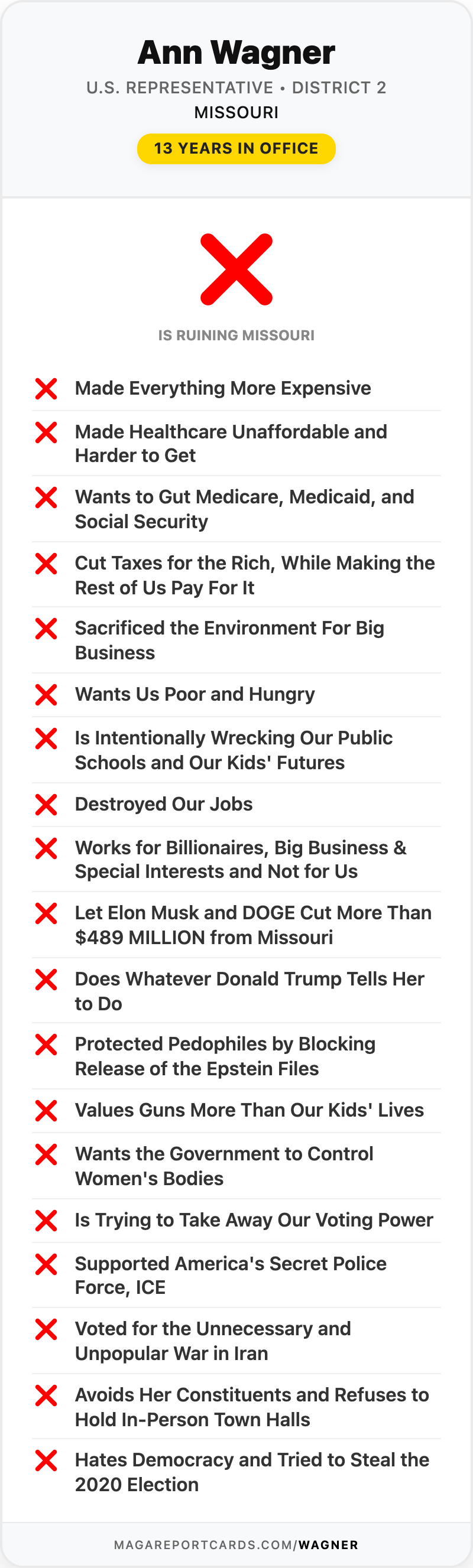
In April 2025, more than 1,000 people turned out for a town hall-style event in Chesterfield, inside her own district. Wagner didn't attend and dismissed it as "just another political stunt from the Democrats." In October 2025, constituents stood outside her Manchester office asking her simply to communicate. "She is our direct line to Washington and she is refusing to be accountable," said Ammie Minton of Sunset Hills.
Wagner is on the November ballot against Democrat Fred Wellman. She has refiled this bill in every Congress since 2019. There is no reason to think the next one will be different.
Source
H.R. 21 — Born-Alive Abortion Survivors Protection Act, 119th Congress, sponsored by Rep. Ann Wagner, passed the House 217–204 on January 23, 2025. Photo: official congressional portrait.