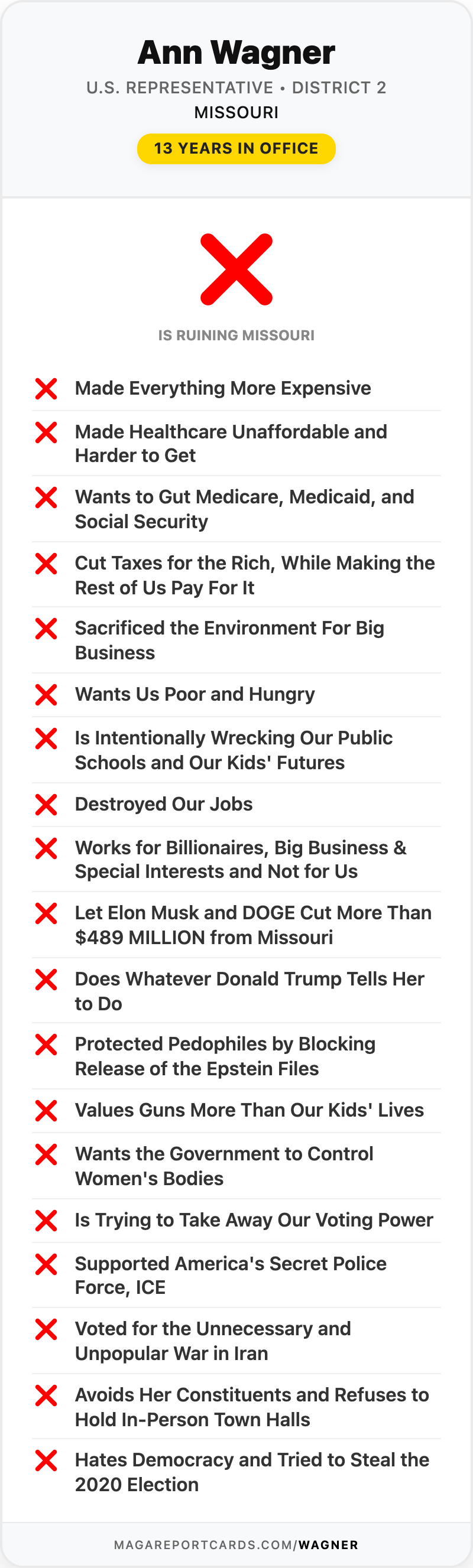
On May 27, 2026, Ann Wagner introduced the Sex Trafficking Demand Reduction Act, a bipartisan bill directing the State Department to grade foreign countries on whether they're working to reduce demand for commercial sex.
"This is a global issue, and it requires a global response," she said.
Fighting sex trafficking is the thing Wagner is best known for in Congress. So before Congress hands her another law on the subject, it's worth looking at what happened to the last one — the one that carries her name and became the centerpiece of her career.
What FOSTA was
Wagner sponsored H.R. 1865, the Allow States and Victims to Fight Online Sex Trafficking Act — FOSTA. It picked up 174 cosponsors and became Public Law 115-164 on April 11, 2018.
The idea was straightforward and popular: strip websites of their legal shield when they knowingly facilitate prostitution or sex trafficking, so that prosecutors and victims could go after the platforms directly. It created a new federal crime for "aggravated" violations, and it created a path for victims to sue.
It passed overwhelmingly. It was signed with fanfare. Then the Government Accountability Office went and checked.
What the GAO found
GAO-21-385, published June 21, 2021, runs 56 pages and reads like a post-mortem. The bluntest line is in the report's own "Fast Facts" summary:
"In 2018, Congress passed a law to hold online platform providers accountable for prostitution and trafficking facilitated by their platforms. But, federal prosecutors say they have only used the law once because it is new and they've had success using other laws to prosecute such offenses in the past."
Once. In June 2020, more than two years after the law took effect.
On victims recovering anything:
"Criminal restitution has not been sought and civil damages have not been awarded under section 3 of FOSTA... As of March 2021, restitution had not been sought or awarded."
For context on how little FOSTA mattered to actual enforcement: GAO found DOJ brought at least 11 criminal cases against people running these platforms from 2014 through 2020 — including three against Backpage.com. Only one of the eleven used FOSTA. Prosecutors kept using the laws they already had.
The part that should worry everyone
The failure isn't just that the law went unused. GAO found the landscape it helped create made trafficking harder to investigate.
Two things happened in April 2018: federal authorities seized Backpage.com, and FOSTA was enacted. In GAO's words:
"These events led many who controlled platforms in this market to relocate their platforms overseas. Additionally, with backpage.com no longer in the market, buyers and sellers moved to other online platforms, and the market became fragmented."
And then:
"The current landscape of the online commercial sex market heightens already-existing challenges law enforcement face in gathering tips and evidence. Specifically, gathering tips and evidence to investigate and prosecute those who control or use online platforms has become more difficult due to the relocation of platforms overseas, platforms' use of complex payment systems, and the increased use of social media platforms."
A single American website that cooperated with subpoenas became dozens of foreign ones that don't. Reason's Elizabeth Nolan Brown, reviewing the same report, pointed to a 2019 FBI document noting that the Bureau's ability to identify and locate trafficking victims and perpetrators went down significantly after Backpage was taken down — precisely because the site had been responsive to law enforcement.
That is the opposite of the outcome the law was sold on.
Wagner has never reckoned with this
Eight years on, FOSTA is still the accomplishment Wagner leads with. It's the reason she's treated as Congress's authority on trafficking policy. We could not find any public statement from her addressing GAO's findings, revisiting the law, or proposing a fix for the enforcement gap the auditors documented.
Instead the pattern repeats: a new bill, a new bipartisan press release, a new set of quotes from advocacy groups. This time it's the State Department's country report cards. What it isn't is an answer to the question of why a law she wrote, that carried 174 cosponsors and the force of federal statute, produced one prosecution and zero dollars of restitution for victims.
A law that goes unused isn't neutral. It cost something. It consumed the political energy Congress had for this issue in 2018, and it reshaped a market in a way federal investigators say made their jobs harder.
Meanwhile, in her actual committee seat
The rest of Wagner's legislative energy goes somewhere less photogenic. She chairs the Financial Services Subcommittee on Capital Markets — the panel that writes the rules for Wall Street — and in June 2026 she introduced the SEC Reform and Restructuring Act, a package to roll back Securities and Exchange Commission regulation.
The industries governed by that subcommittee are also among her biggest funders. People at Jones Financial Companies, the parent of Edward Jones, have given her $48,750 this cycle; people at the private equity giant KKR, $46,500; and Robinhood, the trading app, $34,000 — $15,000 of that from the company's own PAC.
And she isn't easy to reach
In April 2025, more than 1,000 people turned out for a town hall-style event in Chesterfield, inside her district. Wagner didn't go, and dismissed it as "just another political stunt from the Democrats" showing "just how disconnected from hardworking Americans they really are."
That October, constituents stood outside her Manchester office asking her to communicate with them. "She is our direct line to Washington and she is refusing to be accountable for her party's lack of action and abdication of her duties," said Ammie Minton of Sunset Hills.
Wagner won her primary on August 4, 2026, and faces Democrat Fred Wellman in November. Somebody should ask her about GAO-21-385.
Source
Sex Trafficking: Online Platforms and Federal Prosecutions (GAO-21-385) — U.S. Government Accountability Office, June 21, 2021. Photo: official congressional portrait.