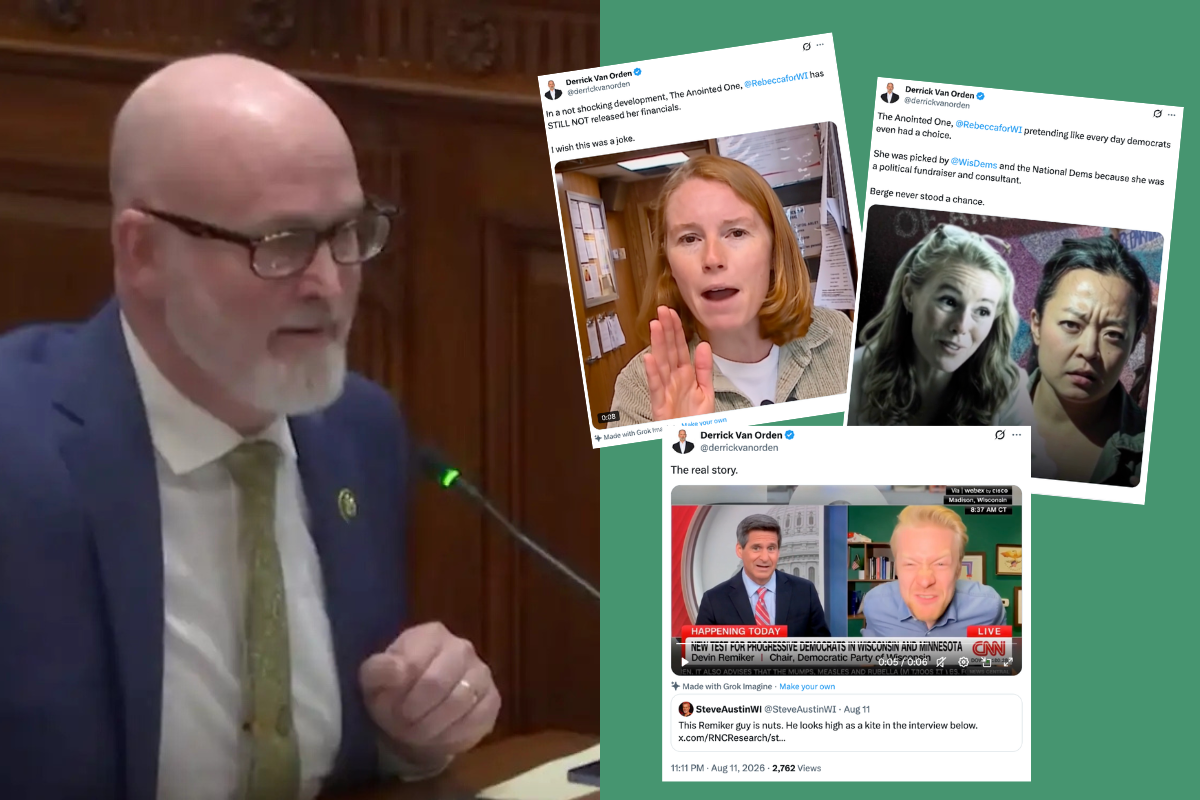
Derrick Van Orden posted a video of his opponent this month with the caption "I wish this was a joke."
It is a joke. The video is fake. He made it.
In the fake video, Democratic challenger Rebecca Cooke says things she has never said:
"Do you really think it matters what you peasants think?"
"I am the anointed one."
She didn't say either one. An AI tool did, in a synthetic version of her voice and face, and the sitting congressman for Wisconsin's 3rd District put it on social media as though it were something his constituents ought to see.
UpNorthNews founding editor Pat Kreitlow reported the story on August 21, and noted this is not a one-off — Van Orden has posted deepfakes repeatedly.
Wisconsin already thought about this
Here is what makes it worse than an ordinary campaign stunt: Wisconsin passed a law about exactly this behavior, and it passed with Republican votes.
In March 2024, Gov. Tony Evers signed 2023 Wisconsin Act 123, which added a synthetic-media disclosure requirement to state law. It cleared a Republican-controlled Legislature and was signed by a Democratic governor. "Synthetic media" is defined as audio or video content substantially produced in whole or in part by generative artificial intelligence.
The requirement in Wis. Stat. 11.1303(2m)(c) is not vague. A covered political video containing synthetic media must display, "throughout the duration of each portion of the communication containing synthetic media, in writing that is readable, legible, and readily accessible," the words:
"This video content generated by AI"
Or, if there's fake audio too, "This content generated by AI." The law sets a penalty of up to $1,000 for each intentional violation.
That's the whole ask. Put a label on it. Tell people the thing they're watching didn't happen.
Van Orden's posts don't carry it. The only marker anywhere near the video was fine print underneath it on X reading "Made with Grok imaging" — which is not the statutory language, is not on the video, and does not run throughout it.
"Certainly isn't within the spirit of the law"
There's a technicality Van Orden gets to hide behind, and it's worth naming honestly.
The disclosure requirement attaches to political communications of the kind Wisconsin's campaign finance law regulates. Van Orden's deepfakes were posted to his own social media accounts, not bought as paid advertising, so as a legal matter they likely fall outside it.
Rep. Jodi Emerson, a co-sponsor of that law, told UpNorthNews that Van Orden's behavior, though technically legal, "certainly isn't within the spirit of the law."
That is the whole story in one sentence. The Wisconsin Legislature — Republicans and Democrats together — looked at the arrival of tools that can make any candidate appear to say anything, and agreed on a minimum standard of decency: if it's fake, say it's fake.
A sitting member of Congress found the seam in it and drove through.
Why the label matters more than the joke
Defenders will say it's obviously satire, that nobody's fooled, that everyone knows Rebecca Cooke never called voters "peasants."
Two problems with that.
First, that's not how any of this travels. A clip gets screenshotted, cropped, re-uploaded, and stripped of context within hours. The "Made with Grok imaging" fine print does not survive the second repost. The quote does. Six weeks from now, some share of voters in western Wisconsin will believe Rebecca Cooke said the word "peasants," because the last version they saw had no label on it at all. That is precisely the harm the Legislature wrote the law to prevent.
Second, "I wish this was a joke" is not a satire caption. It's a caption designed to read as outrage at something real. Van Orden did not post the video saying look at this funny thing I made. He posted it in the voice of a man appalled by what his opponent said. That is the opposite of a disclosure.
UpNorthNews also raises a question worth sitting with: this is a man using AI to generate video of a woman saying things she never said, for his own political benefit. His own chamber understands why that's a problem — it voted 409 to 2 for the TAKE IT DOWN Act, a law aimed at a different and far more serious use of the same technology. Van Orden's videos aren't that. But a congressman who knows the House took AI impersonation seriously enough to pass a law about it does not get to plead ignorance about what a fake video of a real woman does.
Not the first time his phone has been the problem
Van Orden's social media habits keep becoming news, and never the good kind. We've written before about how he spends his time smearing Muslims online.
Meanwhile, the things his district actually needs attention on go elsewhere. He voted to cut Medicaid by roughly $900 billion and then asked Wisconsin for credit when the state got an exemption.
Wisconsin's Legislature — Republicans included — looked at this technology and asked political candidates for one thing: six words on the screen, so voters know what's real.
Derrick Van Orden couldn't manage six words.
Source
Van Orden mocks state law against using AI deepfakes with videos depicting Cooke — UpNorthNews, August 21, 2026, by Pat Kreitlow.