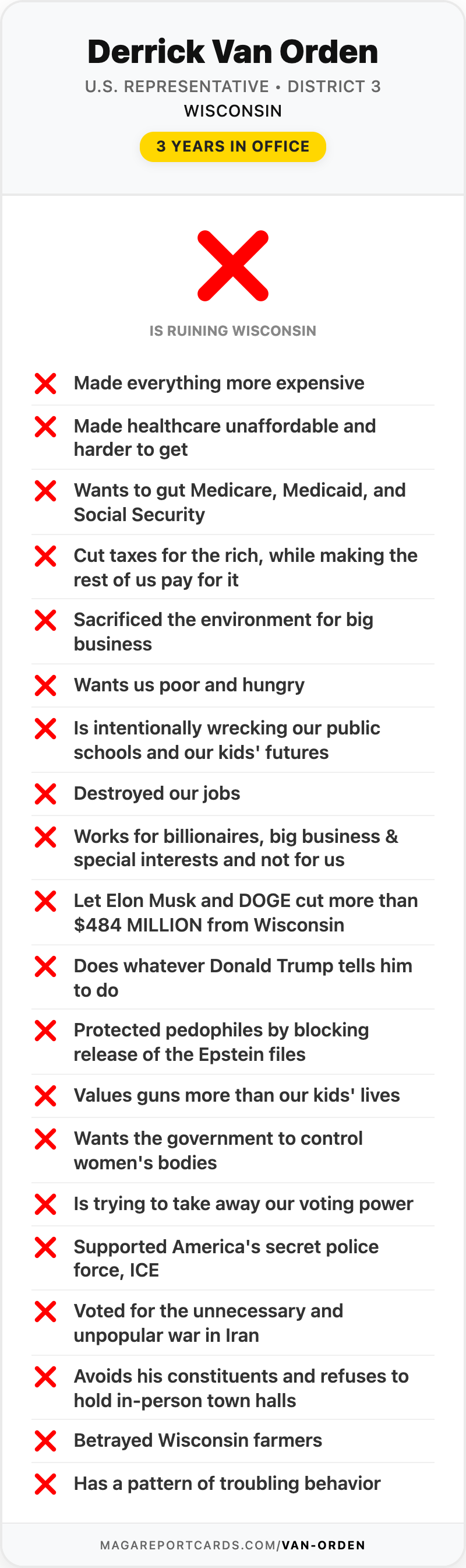
On July 21, Derrick Van Orden put out a press release announcing a win. Federal regulators had agreed to grandfather Wisconsin's 6% hospital provider tax, which meant hospitals in the state would keep getting enhanced federal Medicaid money instead of losing it on October 1.
Here is his own description of what he did, from the release:
"When I learned Wisconsin hospitals were at risk of losing critical Medicaid funding, I immediately got to work with CMS and the Trump Administration to fix it. I fought to make sure Wisconsin's provider tax was grandfathered exactly as intended under the One Big Beautiful Bill Act."
Read that last clause again.
The reason Wisconsin hospitals were "at risk of losing critical Medicaid funding" is the One Big Beautiful Bill Act. And on July 3, 2025, Derrick Van Orden voted for it.
He is asking for credit for cleaning up a problem he helped create — and describing the cleanup as the bill working the way he wanted.
What the bill did to Wisconsin
This is not a small thing he's carving an exception out of.
A report from Protect Our Care, covered by the Wisconsin Examiner, forecasts that the 2025 law's Medicaid changes will cut $7 billion from Wisconsin's Medicaid program over ten years. Separately, KFF — the nonpartisan health policy organization — calculates that at least 57,000 more Wisconsinites will be uninsured by 2034 as a result.
The law also added new hoops. Some Medicaid recipients will have to prove they're working, or prove they're exempt from working. Everyone covered has to file eligibility paperwork twice a year instead of once. Those rules kick in in 2027.
Researchers have been blunt about what that does. Dr. Kiley McLean, a social work professor who works with people with disabilities, told the Examiner:
"Work requirement policies often do not meaningfully increase employment... Instead, they create paperwork barriers that cause eligible people to lose coverage, not because they are ineligible but because the system becomes too difficult for them to navigate."
That's the design. The savings mostly don't come from fraud. They come from eligible people falling off the rolls because the forms beat them.
The math of the "win"
So let's put Van Orden's announcement in proportion.
What he voted for: roughly $900 billion in Medicaid cuts nationally, $7 billion out of Wisconsin over a decade, and at least 57,000 Wisconsinites losing coverage.
What he's touting: a regulatory approval letting Wisconsin keep an existing hospital provider tax arrangement, which raises the state's reimbursement rate from 1.8% to 6%.
Protecting hospital financing is genuinely good. If this approval keeps a rural hospital's doors open in western Wisconsin, that matters enormously to the people who depend on it.
But you cannot set a building on fire and then ask for a medal for carrying one chair out of it.
Opportunity Wisconsin made the same point this week. "Derrick Van Orden wants credit for funding Medicaid," said the group's Meghan Roh, "but ignores the hundreds of billions that have been cut."
The group also notes something worth checking on: the CMS approval was of Wisconsin's own state Medicaid plan submission — a plan built by the state legislature and Governor Evers's administration. Van Orden's role, by his own account, was advocating for it in Washington. That's real work, and it's not the same thing as authoring the funding.
What he hasn't said anything about
There's a second half to accountability, and it's the part that never makes a press release.
Van Orden has been loud about the exemption. Opportunity Wisconsin points out that he has said nothing about a new Trump administration rule that would require seriously ill Medicaid recipients to work or lose their benefits — a rule that turns a cancer diagnosis or a chronic illness into a paperwork deadline.
That's the pattern, and it's worth naming plainly:
- The parts of the bill that hurt his constituents: no statement.
- The parts of the bill he can get a carve-out from: press release, quote, "major win for Wisconsin."
What this looks like from here
Western Wisconsin is a district where a lot of families are on Medicaid or one bad month away from needing it. Those families are about to deal with twice-a-year paperwork, new work-reporting rules, and a state program that will have $7 billion less in it than it would have had.
Van Orden's answer to that is a press release about a reimbursement percentage.
He had the chance to prevent the whole problem. There was a recorded vote, on July 3, 2025, and he pushed the button for it. Everything since has been damage control on his own handiwork — and he'd like to be thanked for it.
Source
- Opportunity Wisconsin: Fact Check: Van Orden takes credit for Medicaid funding while ignoring the historic cuts he voted for, WisPolitics (July 29, 2026), plus Van Orden's own press release (July 21, 2026).