Congressional oversight is supposed to work like this: something might be going wrong, so Congress calls in the people responsible and makes them answer questions under oath.
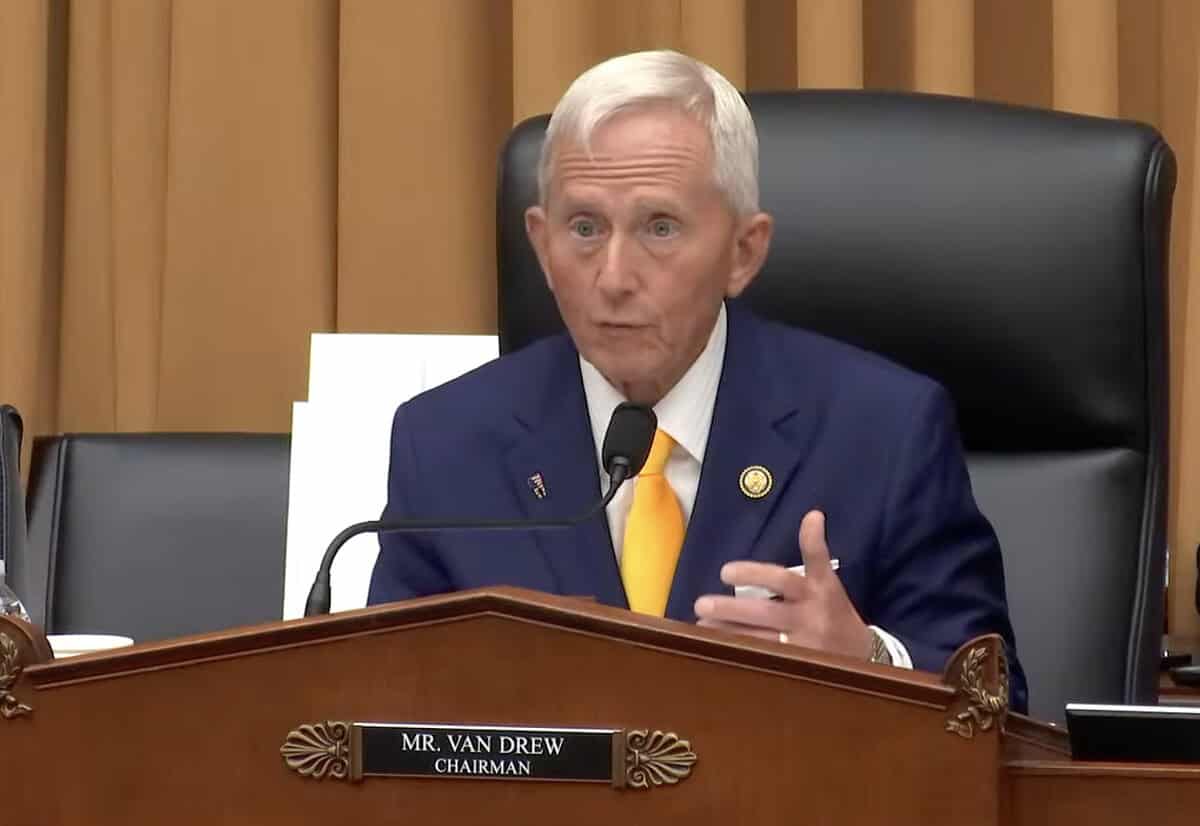
On Wednesday, July 22, 2026, Jeff Van Drew ran a hearing that did the opposite. He announced the answer in the title, then spent nearly two hours making sure nobody who could contradict it was in the room.
The hearing was called "False Narratives Surrounding Conditions at the Delaney Hall ICE Detention Center."
Delaney Hall is a 1,000-bed immigration jail in Newark, run for ICE by a private prison company. Detainees there have described rotten food, waits of more than a week to see a doctor, and broken air conditioning in 100-degree heat. Hundreds of them went on a hunger strike over it.
Van Drew's committee decided, in advance and in writing, that all of that was made up.
He didn't call anyone who runs the place
Van Drew chairs the House Judiciary Committee's Subcommittee on Oversight. That gavel is real power. It means he decides who has to show up and answer.
Here is who he did not make show up:
- Nobody from U.S. Immigration and Customs Enforcement, which pays for the facility
- Nobody from the Department of Homeland Security, which runs ICE
- Nobody from GEO Group, the private prison company that owns and operates Delaney Hall
Instead, the official witness list shows he called three witnesses to defend the facility: a retired ICE deputy field office director, a border security adviser from the Federation for American Immigration Reform, and a fellow at the Center for Immigration Studies.
Not one of them had current firsthand knowledge of Delaney Hall. Two had never set foot in it. The third had last been there before the building closed in 2017 — nearly a decade ago.
One of them said so out loud, in his opening statement.
"First, a confession. I've never been to Delaney Hall, and I've never toured the facility to assess any of the allegations that have been made about it." — Andrew Arthur, Center for Immigration Studies
That is the hearing. A chairman announces the reports are false, and then calls three witnesses to agree with him, at least one of whom has to open by admitting he has no idea.
The one witness Democrats were allowed was Amol Sinha, executive director of the ACLU of New Jersey — the only person at the table who had actually talked to people held inside.
What the witness who had done the work said
Sinha described a man who did not eat for three days after arriving at Delaney Hall because the food smelled rancid. When hunger finally forced him to eat it, he was in severe pain. He asked for a doctor and waited seven more days to see one. After he got out, he spent a week in the hospital and needed surgery for a serious stomach condition that developed while he was locked up.
Then Sinha made clear that man was not a one-off.
"I wish I could tell you that his case was unusual, but I could sit here and tell you about the man denied his wheelchair for 40 days, the 18-year-old denied the ability to finish high school on time, the husband who lost so much weight that even lying down became physically painful."
He described the pattern the same way every time: no access to medical care, pressure to sign "voluntary" departure papers, filthy conditions, inedible food, broken air conditioning in 100-degree temperatures.
Rep. Jamie Raskin, the top Democrat on the full Judiciary Committee, added what Sen. Andy Kim found on unannounced visits: milk so spoiled it had curdled, water people said was undrinkable, and detainees sleeping on floors because the place was too crowded.
Raskin also brought the numbers that undercut the whole "dangerous criminals" framing. Of the 891 people held at Delaney Hall in April, he said about 90% had no criminal record at all. For the ones who did, the most common offense was a traffic violation. Sinha put it at more than 70% with no criminal history, nearly 90% with no conviction, and 84% with no final removal order.
And people have died. Sinha noted that more than 50 people have died in ICE custody under this administration. ICE's own death-reporting data backs that up: 54 people have died in ICE custody since the start of fiscal 2025 — 125% more than died across all four previous fiscal years combined, which was 24. One of them was Jean Wilson Brutus, who died after being at Delaney Hall for a single day.
This is not a New Jersey problem alone. Senate Judiciary staff who got two hours inside a CoreCivic-run family detention center in Texas came back with a report describing worms in the food and coloring books passed off as school.
"Potato chips and Twinkies"
Van Drew's answer to all of it was that he had walked through the building himself.
"I walked the facility. I met with the staff. What I saw goes against all the narratives that you hear and that the Democrats have tried to say about this facility."
He said detainees get three meals a day reviewed by dietitians, plus medical, dental, and mental health care, a gym, and soccer fields. He cited a state inspection that found the kitchen satisfactory and no sign of vermin — an inspection that looked at the kitchen and did not examine any of the things Sinha had just described.
Then he took on the hunger strike. Hundreds of people refusing food to protest the conditions, and Van Drew's rebuttal was that commissary sales went up:
"They were going to the commissary, and they were getting their potato chips and Twinkies. They were getting plenty of food."
He also went after a man he identified as a leader of the strike, telling the room the man had been arrested on a domestic violence charge before ICE picked him up, and adding: "He ain't my hero."
And then Van Drew offered the people inside Delaney Hall his solution.
"If it's so bad at Delaney Hall, just so you know, everybody has the option to self-deport."
That is a chairman of a congressional oversight subcommittee telling detained people that if they don't like the conditions, they can leave the country. It is not oversight. It is a taunt.
Raskin answered it in the room with the case of Marlon Andres Torres Gomez — a man who did try to leave. An immigration judge approved his departure. He had a plane ticket and an agreement with ICE. Federal officers stopped him at the airport and hauled him back to Delaney Hall. A federal judge ruled the day before the hearing that holding him was unlawful.
So the option Van Drew was so sure everybody had was one the government had physically prevented at least one man from taking.
The company he didn't subpoena writes him checks
Delaney Hall is not a government building. It is owned and operated by GEO Group, a publicly traded private prison company.
GEO's own annual report to the Securities and Exchange Commission spells out the deal. On February 27, 2025, the company announced it had been awarded a 15-year, fixed-price contract from ICE for the company-owned, 1,000-bed Delaney Hall Facility in Newark. The same filing lists the contract as starting in May 2025, and credits Delaney Hall as one of the new activations behind $152.4 million of a $222.6 million rise in its U.S. detention revenue last year.
Sinha put the local number on it at the hearing: "We're spending billions of taxpayer dollars detaining people who pose no threat to the public, while GEO Group pockets over $60 million a year from Delaney Hall alone."
That is the company Van Drew declined to put under oath. It is also a company having an extremely good year — GEO Group and CoreCivic together booked $1.4 billion in a single quarter as ICE detention neared record levels, paid for by money Congress appropriated.
Van Drew helped appropriate it. He was one of the Republicans who voted to send $70 billion to immigration enforcement on a 214–212 margin, where every single Republican yes vote was the deciding vote.
And Federal Election Commission records show GEO Group's political action committee gave $3,000 to Van Drew for Congress on June 30, 2025 — weeks after Delaney Hall opened under the new contract, and roughly a year before he gaveled in a hearing declaring that complaints about the place were false narratives.
Three thousand dollars is not a fortune. That's not the point. The point is that the chairman deciding whether GEO Group has to answer questions is on GEO Group's donor list, and he resolved that question by not calling them.
He is not the only one. The Republican who took over the House committee that oversees ICE last July collected $30,000 from three private prison companies in the months right after he got the gavel — more than any other member of Congress.
He has done this before
There is a pattern in how Jeff Van Drew handles a story where the facts aren't in yet: he goes on television, states a conclusion with total confidence, and never revisits it.
In December 2024, during the New Jersey drone panic, he told a national Fox News audience that Iran had parked a "mothership" off the East Coast and was launching drones from it, citing "high sources." The Pentagon knocked it down within hours. He accused the Pentagon of lying instead.
In January 2026, after federal agents shot and killed Alex Pretti, Van Drew went on Fox and said, "Peaceful protesters don't have 9mm weapons with two extra magazines" — while three Republican senators were asking for independent investigations.
Now his subcommittee has ruled on conditions inside a jail without hearing from the people who run it. Sinha closed by asking Van Drew's members for the one thing that would actually settle it:
"Allow the press in. Allow members of Congress in. Allow advocacy organizations in for full access."
Van Drew adjourned instead, noting that members had five days to submit written questions.
What this costs South Jersey
Van Drew has the gavel that decides what gets investigated. His constituents have been asking him to use it on something closer to home.
In March 2025, about 600 people lined the road outside his Northfield office asking him to protect their health care. They brought written concerns to hand in. The doors were locked and the building was closed. He has no plans for an in-person town hall, telling a reporter they just draw "the same 50 or 100 people who just don't like you."
They had a reason to show up. The Joint Economic Committee projects that 30,460 people in his district will lose health coverage — 17,960 of them from the Medicaid cuts in the budget bill he voted for, and 12,500 from the Affordable Care Act.
No hearing on that. But a nearly two-hour hearing, in the Rayburn building, with a title written to pre-decide the outcome, to tell the country that a private prison company's customers are lying about the food.
Congress has one tool for finding out whether the government is mistreating people in its custody. Jeff Van Drew is holding it. He used it as a shield.
Source
This post is based on reporting by the Jersey Vindicator: At House hearing, Republicans dismiss reports of abuse at Delaney Hall by Krystal Knapp. Photo: screenshot via YouTube, House Judiciary Subcommittee on Oversight.