On November 3, a blue wave swept the country, and it reached Utah too. The state's U.S. House vote moved 30 points toward Democrats since 2022, the biggest shift of any state, by Nate Silver's count.
All three Republicans on this site from Utah won. But they won by less, sometimes by a lot less. And Republicans lost something they have held in the Utah House for more than three decades.
Here's the good, the bad and the ugly.
The good: the supermajority is gone
Utah certified its results on November 23. They confirm that 14 Democrats and two unaffiliated candidates flipped 16 Republican seats in the Utah House, according to Utah News Dispatch. The House Democratic caucus doubled, from 14 members to 28.
That breaks the Republicans' two-thirds supermajority in the House for the first time in more than 30 years. Republicans still hold a simple majority. But they can no longer override a governor's veto without Democratic votes.
"There was never a world where we were looking at double-digit (wins) being on the table this year," Democratic strategist Eric Biggart told Utah News Dispatch. He said his party had hoped for maybe four to seven seats.
Here's where some of the wins came:
- Provo. Rep. Norm Thurston lost to David Chappell, a 27-year-old progressive, in a district that swung 54 points in its U.S. House vote, according to the Deseret News. It was the 16th flip, the one that sealed the end of the supermajority.
- West Valley City. Rep. Matt MacPherson, who opened a bill to impeach the judge who threw out the Legislature's congressional map, had 36% of the vote on election night to Democrat Michael Finch's 64%, according to Utah News Dispatch.
- Across the Wasatch Front. Reps. Ken Ivory, Steve Eliason, Jim Dunnigan, Jordan Teuscher and Clint Okerlund all lost to Democrats. In the final count, Democrat Zane Woolstenhulme beat Rep. Tiara Auxier 10,006 to 9,326, and Democrat Phil Graves beat Rep. Melissa Ballard 6,713 to 6,369.
- The state Senate. Senate Majority Leader Kirk Cullimore, the No. 2 Republican in the Senate, lost to Democrat Shana Anderson, an Army veteran and stay-at-home mom from Sandy. He was expected to become the next Senate president. He won his seat by 24 points in 2022 and lost it by more than 6. Democrat "CJ" Christina Hernandez also flipped an open Republican seat. Anderson said voters told her Cullimore had been "working for people in power, people with money, and special interests."
Then there's Congress. Democrat Ben McAdams won the new 1st District with 70.5% of the vote to Republican Riley Owen's 25.7%, a margin of 115,036 votes, according to NBC News. Utah will have a Democrat in Congress for the first time in six years. That district exists because of a court order, and McAdams said so on election night: "This seat exists because you would not let it go."
Voters also turned down the Legislature's Amendment B. It would have made citizen ballot measures that raise taxes need 60% of the vote to pass, not a simple majority. It was losing about 62% to 38% on election night when the AP called it. Opponents said it was lawmakers' response to losing the redistricting fight. More on that fight below.
The bad: they won, by less
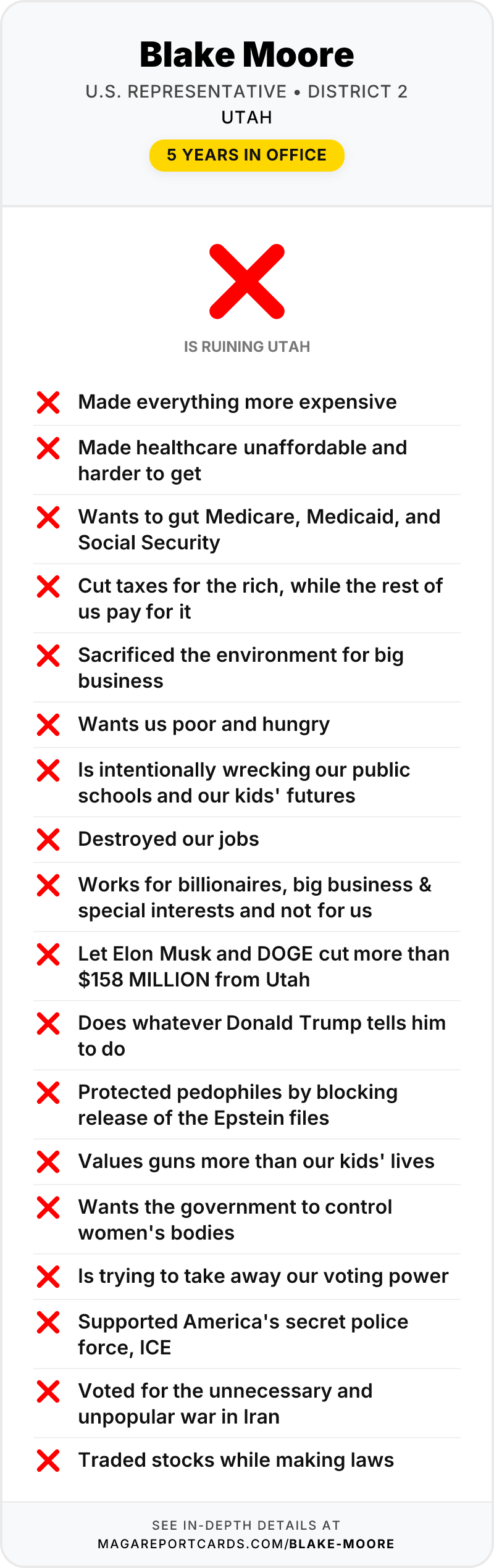
Blake Moore won a fourth term in the 2nd District, northern Utah, with 49.7% to Democrat Peter Crosby's 42.6%, a margin of 18,339 votes with all votes counted as of Nov. 27, according to NBC News. Two years ago he won with 63.1%. The new map renumbered his district, but its northern Utah lines stayed largely the same, according to KUER. The Cook Political Report rated it 15 points more Republican than the country, and the AP still didn't call it until 10:02 a.m. Thursday.
Moore is vice chair of the House Republican Conference, part of his party's leadership. He told KUER what hurt him most was national, not local: the war with Iran and the gas prices that came with it. "Look, when gas prices are what they are, and Republicans have the White House, House, and Senate, you're going to get blamed for it," he said. He would know. In September, he voted against ending the Iran war for the sixth time that year.
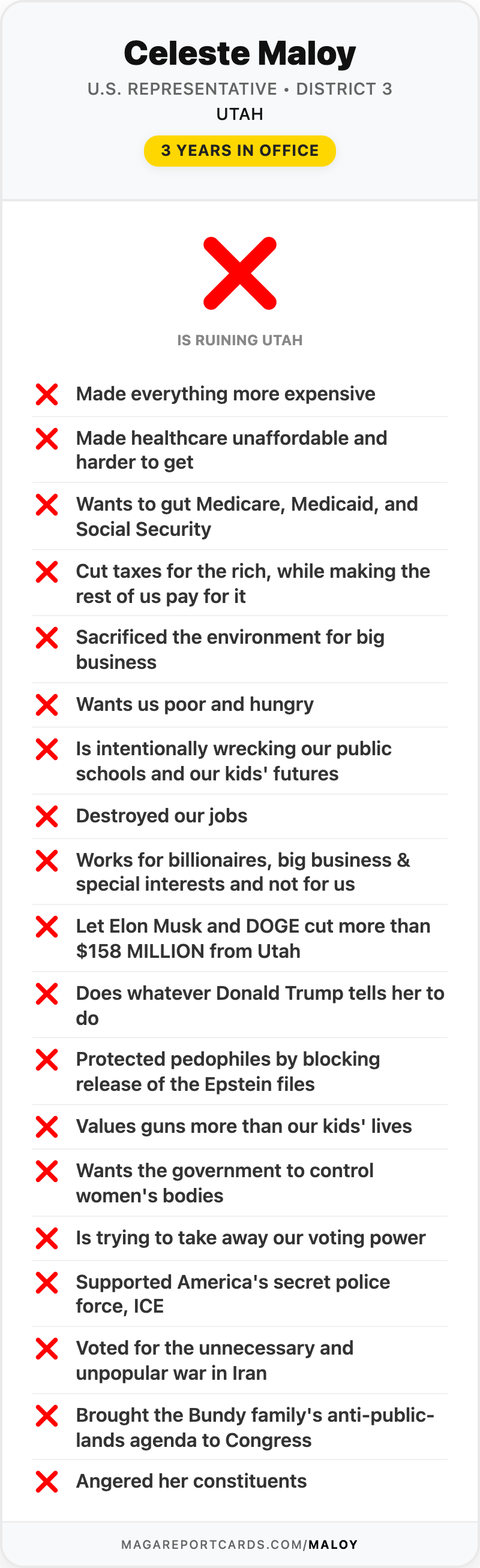
Celeste Maloy won the new 3rd District with 56.4% to Democrat Kent Udell's 35.9%, according to NBC News. In 2024 she won the old 2nd District with 58%. She told supporters it was almost an entirely new district for her, about 700,000 new people stretching from St. George to Moab and Park City. It holds Utah's five national parks and much of its public land. That same Maloy once tried to sell off more than 10,000 acres of Utah public land to help pay for tax cuts.
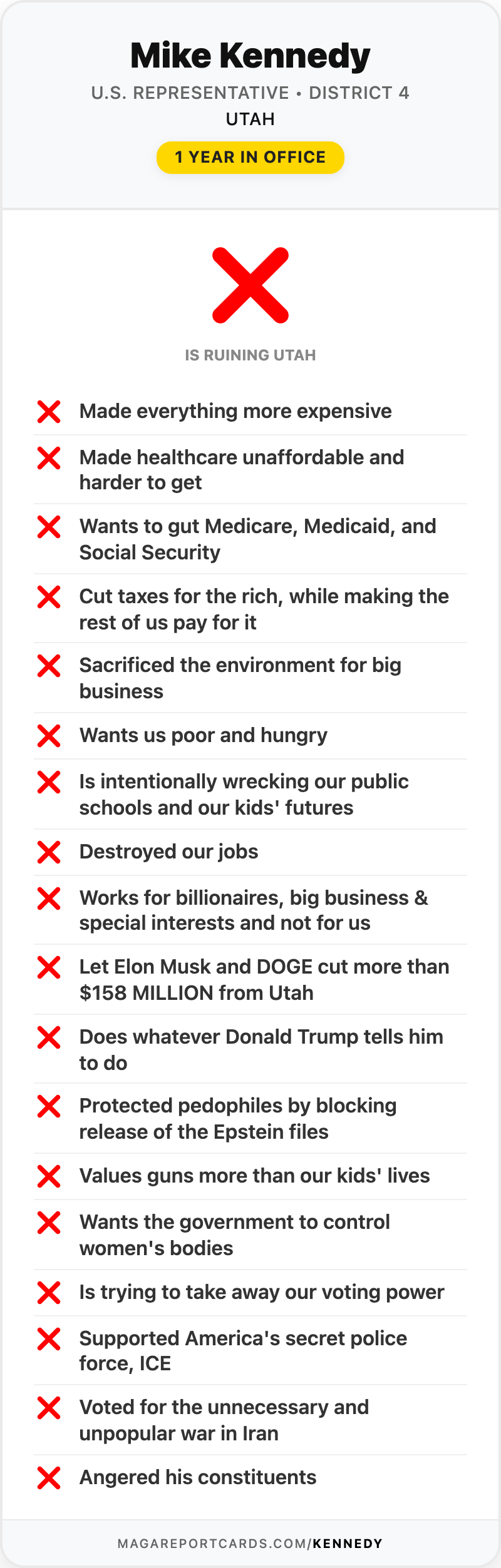
Mike Kennedy won the new 4th District with 53.1% to Democrat Jonny Larsen's 39.3%, according to NBC News. In 2024 he won the old 3rd District with 66.4%. The race wasn't called until the evening of November 5, after a large chunk of Salt Lake County ballots came in. Larsen, a Marine veteran whose campaign was run by volunteers, was most comfortable talking about the war with Iran. Kennedy is a family physician who voted for a budget bill KFF projects will leave 77,000 more Utahns uninsured.
None of the three Republican winners reached 60%, Axios noted.
The ugly: seven years of fighting the voters
In 2018, Utah voters passed Proposition 4. It banned partisan gerrymandering and set up an independent commission to draw the state's maps. It passed with 50.3% of the vote.
Utah's Republican leaders have spent every year since trying to get the pen back.
How they took the map back
In 2020, the Legislature passed a law that turned the commission into an advisory body. In 2021, lawmakers ignored the commission's maps and drew their own. Their map cut Salt Lake County, the bluest part of the state, four ways and gave Republicans four safe seats.
The League of Women Voters of Utah and Mormon Women for Ethical Government sued in 2022.
What the courts said
- July 2024. The Utah Supreme Court ruled unanimously that the state constitution limits the Legislature's power to amend or repeal an initiative that reforms the government. House Speaker Mike Schultz and Senate President Stuart Adams called it "one of the worst outcomes we've ever seen" from the court. Asked about the voters who approved the commission, Schultz said "there's always things that we all want that we can't have because they are unconstitutional," and "the pathway forward is to change the Constitution."
- September 2024. That's what they tried. Lawmakers held an emergency special session and put Amendment D on the ballot, which would have let them repeal or change any citizen initiative. The ballot told voters it would "strengthen" the initiative process. The Utah Supreme Court unanimously voided it, ruling that the ballot language Republican leaders wrote would have misled voters. Votes on it weren't counted.
- August and November 2025. Judge Dianna Gibson ruled the Legislature had unconstitutionally gutted Prop 4. Lawmakers drew a new map. She rejected it, writing that the Legislature's map was "purposefully configured to favor the Republican party and to disfavor the Democratic Party in violation of Proposition 4." She adopted the plaintiffs' map instead, which splits Salt Lake County only in two.
What came after
The fight didn't stop when the map was picked.
- A federal lawsuit. Celeste Maloy and Rep. Burgess Owens, who later chose not to run again, sued to throw out the new map and bring back the Legislature's 2021 map. Three federal judges turned them down. She dropped the case after winning her primary under the map she'd sued to erase.
- A repeal petition. A campaign led by Utah Republican Party chair Rob Axson gathered signatures to put a repeal of Prop 4 on this year's ballot. Better Boundaries, the group behind Prop 4, mailed signers forms to take their names back. On March 6, the Legislature passed a law, signed by Gov. Spencer Cox the next day, that threw out removal forms mailed with prepaid postage and postmarked after that date. About 9,000 voters removed their names, enough to drop the petition below the count it needed in one state Senate district and keep the repeal off the ballot. Axson's answer: "Whether now or in the future, by litigation or initiative, we will Repeal Prop 4."
- A change of heart. Blake Moore was one of the Republicans who helped launch Prop 4 back in 2017. When a judge finally enforced it, he criticized the ruling and asked the group he'd co-chaired to stand down.
What the map was worth on election night
The court's map gave Democrats one seat, and McAdams won it easily. But here's the part that should embarrass the people who fought it: the fair map may have saved Republicans a seat.
A FOX 13 reporter took this year's votes, precinct by precinct, and laid them over the Legislature's old map. The result was two Democratic wins, with all four races very close. He called the numbers "a snapshot or a data-driven intellectual experiment," not a sure thing.
It was close statewide, too. As of November 9, Republican House candidates led Democrats statewide by less than half a percentage point, Axios reported. NBC's final counts flip that. Adding up the votes for just the Democrat and the Republican in each of the four races gives 491,225 for Democrats and 485,346 for Republicans. Republicans won three of the four seats anyway.
So Prop 4 never guaranteed Democrats anything. It said maps can't be drawn to help a party. Republicans fought that rule in the Legislature, at the state Supreme Court, in federal court and with a petition.
Cox, a Republican, said afterward that he had warned legislative leaders that pushing too hard on issues like redistricting made lawmakers look out of touch. Biggart, the Democratic strategist, put it more bluntly: "Data centers and gerrymandering and Amendment B and Amendment D before that, all these tricks and power grabs, have weighed on people." Republican consultant Taylor Morgan told Utah News Dispatch that years of frustration with the Legislature over redistricting, ballot initiatives and unions, together with a rejection of Trump, "caught up with Utah legislative Republicans."
The rest of the ugly
- The Senate supermajority survived, barely. Republicans still hold 21 of the 29 seats in the state Senate. They won one back when Republican Brooks Benson beat Sen. Emily Buss, the only Forward Party legislator in the country, by 122 votes, 16,358 to 16,236.
- Republicans asked Utah not to certify. Lt. Gov. Deidre Henderson, a Republican and the state's top election official, said she got a "whopper" of a letter from what she called the "'enthusiast' wing of the Republican Party." It demanded the state not certify the results, over unverified election-security concerns. She said the letter had no merit. Henderson had already refused the Trump Justice Department's demand for private voter data, despite threats of criminal prosecution. This fall she learned the department was investigating her.
What the results show
Utah Democrats flipped 16 Utah House seats and doubled their caucus to 28, ending the Republican supermajority in that chamber for the first time in more than 30 years, and they beat the Senate's No. 2 Republican. Blake Moore's share fell from 63.1% to 49.7%, Mike Kennedy's from 66.4% to 53.1%, and Celeste Maloy's from 58% to 56.4% in a mostly new district. Republican leaders spent seven years fighting the anti-gerrymandering law voters passed in 2018, and in a year when Democratic U.S. House candidates outpolled Republicans in Utah by our sum of NBC's final counts, the court-ordered map still left Republicans three of the four seats.
Source
Utah's 2026 election results are certified, solidifying Democrats' gains in the Legislature — Katie McKellar, Utah News Dispatch, November 23, 2026.