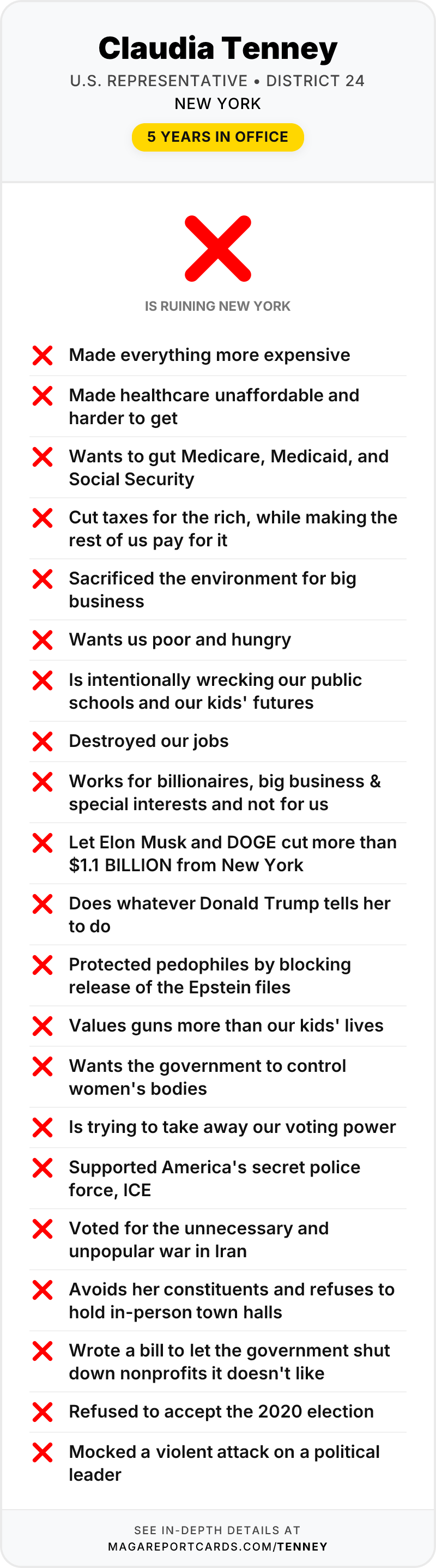
On August 28, 2026, Claudia Tenney stood in Oswego and unveiled what she calls her "Make Voting Great Again" plan — a package of bills she says will make elections "easy to vote and hard to cheat."
Read what's actually in it and that slogan falls apart. Almost every item makes voting harder for someone. None of them catches a cheater, because the cheating she's protecting against barely exists.
What the plan would do to a voter in New York's 24th
Tenney's own issue page lists the bills. Here is what they do, in plain terms:
- Require proof of citizenship to register — the SAVE Act, which she cosponsored and voted for. Not a driver's license. A passport or a birth certificate, presented in person. When a fellow New York Republican went on Fox News to defend that bill, she used a snow-shovel program's photo ID requirement as her example — and the SAVE Act wouldn't accept a photo ID either.
- Require photo ID and citizenship verification to vote in national elections — H.R. 7300, the "Make Elections Great Again Act," which she cosponsored.
- Throw out ballots that arrive after Election Day. Same bill. That is a rule about the mail, not about fraud.
- Ban ranked choice voting — H.R. 2561, which she co-led. New York City uses ranked choice voting in its primaries. Her bill would take it away from federal races nationwide.
- Restrict "ballot harvesting" — also H.R. 7300. It makes it unlawful to possess a ballot that is not your own, a family member's, or that of someone you are a caregiver for. Dropping off someone else's ballot is how a lot of homebound and disabled voters actually vote.
- Bar states from taking private money to run elections — H.R. 723, which she cosponsored. A state could not accept a donation for election administration, "including any programs with respect to voter education, voter outreach, and voter registration."
- Defund voter registration drives on federal property — H.R. 4823, which she introduced.
- Bar charitable nonprofits from funding any election activity — H.R. 4943, which she introduced.
- Amend the Constitution to bar noncitizens from voting at any level — H.J.Res. 107, which she introduced.
Not one of those makes it easier for an eligible American to cast a ballot. Several of them are simply a list of ways a legitimate vote can now be rejected: wrong document, wrong ID, arrived a day late, dropped off by a neighbor.
The problem she's solving does not exist at the scale she implies
The load-bearing claim under all of it is that noncitizens are voting. Tenney's constitutional amendment, her SAVE Act support, her letters to the Justice Department — all of it rests on that.
The measurements keep coming back the same way. When another House Republican made the same argument to Minnesota's election chief, a University of St. Thomas professor's 10-year study had found three cases out of 13.3 million votes cast. Voting as a noncitizen is already a federal felony and a deportable offense. It is one of the worst risk-reward propositions in American life, which is why almost nobody does it.
Tenney's response to that gap is to go looking. She has asked the IRS to investigate more than 650 New York nonprofits. She has asked the Justice Department to investigate a New York State Senate bill — S88A, which would automatically register Medicaid applicants to vote unless they opt out. Not a fraud, not a case, a state legislature's bill she does not like.
She said the quiet part about how they plan to pass it
The SAVE Act has passed the House twice and died in the Senate both times without ever getting a vote, because it needs 60 to break a filibuster. Tenney's page explains, in her own words, what Republicans are doing about that.
She voted for a budget resolution, H.Con.Res. 113, that sets up a fast-track process carrying $10 billion for "election integrity measures." Her reasoning, verbatim from her own website:
"While legislation, such as the SAVE America Act, is subject to the 60-vote cloture threshold allowing Democrats to prevent its passage, budget reconciliation can pass by a simple majority vote in the Senate."
That is a member of Congress writing down that the point of the maneuver is to get around the 60-vote threshold that has kept the bill she cosponsored from ever reaching the Senate floor. We wrote about this route when it first appeared: House Republicans trying to move voter suppression through the budget back door. Tenney is not hiding it. She is advertising it.
Her own election was decided by 109 votes
Here is what makes Tenney a strange messenger for "restoring faith" in elections.
Tenney was not in Congress on January 6, 2021. Her own race against Anthony Brindisi was still being counted. It went through three months of court hearings over disputed and mishandled ballots, and was certified in her favor by 109 votes in February 2021.
She accepted that result. She did not call it rigged. A slow, contested, court-supervised count is what handed her the seat.
Then, in May 2021 — months after every state had certified the presidential results and dozens of courts had thrown out the fraud claims — she told CNN this about the 2020 election:
She also voted against establishing an independent, bipartisan commission to investigate the January 6 attack, and against creating the select committee that ultimately did.
That is the loop. Tenney's plan says "many Americans have lost confidence in the fairness of elections." Five years ago she was one of the people telling them there was reason to doubt — while sitting in a seat that a careful count had just given her by 109 votes.
What the record shows
Claudia Tenney's "Make Voting Great Again" plan is eight bills, and not one of them makes it easier for an eligible American to cast a ballot. Most add a document a voter must produce, remove a way a ballot can be counted, or defund someone who helps people register. Its central justification — noncitizens voting — is a crime a decade-long Minnesota study measured in single digits out of millions of votes. She has written on her own congressional website that the plan for passing it is a budget maneuver designed to avoid the Senate vote threshold it cannot meet. And the member selling it is the one who said in May 2021 that nobody could know whether the last presidential election was stolen, after a three-month contested count awarded her her own seat by 109 votes.
Source
Congresswoman Tenney Unveils her 2026 "Make Voting Great Again" Plan to Strengthen Election Integrity, Office of Rep. Claudia Tenney, August 28, 2026, and the plan's full text.