In the spring and summer of 2018, federal juries in North Carolina did something the state's political establishment had spent decades making sure never happened. Three times in a row, they sided with the people who live next to industrial hog operations.
The first verdict, in April, awarded 10 Bladen County plaintiffs $50 million against Murphy-Brown, the Smithfield Foods subsidiary that owns the pigs. In June, two Duplin County neighbors won $25 million. On August 3, a third jury took three hours to award six neighbors of a Pender County operation $473 million in compensatory and punitive damages.
That last verdict came in while David Rouzer was in a room in Raleigh, holding a meeting about how to stop these lawsuits.
The roundtable
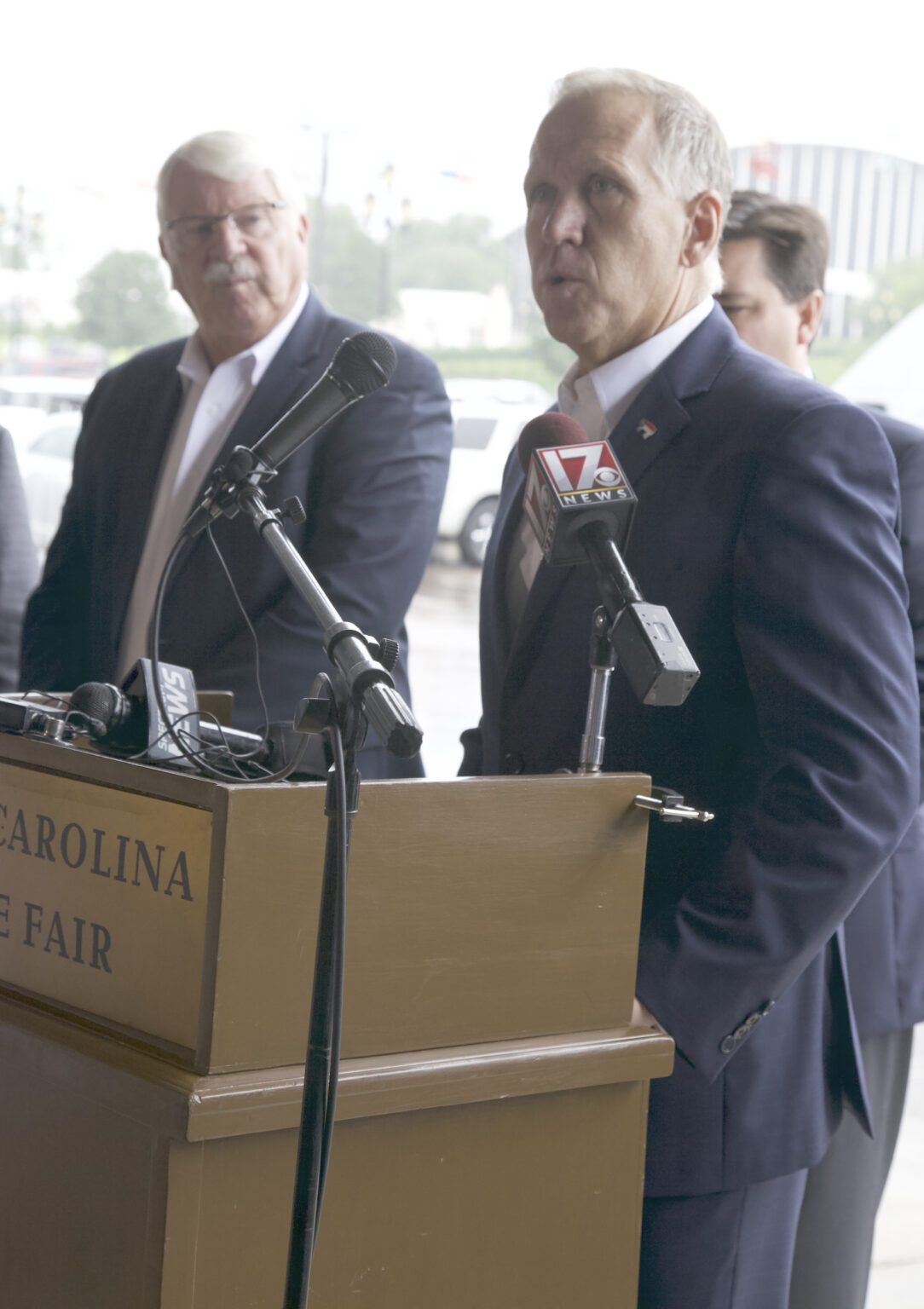
On less than 24 hours' public notice, Rouzer convened a "National Agriculture Leaders Roundtable" at the state fairgrounds. NC Newsline reporter Lisa Sorg was in the room and wrote down what was said.
The room was packed with contract swine growers, USDA representatives, farm interest groups, and elected officials — several from out of state. Over 90 minutes they blamed Smithfield's courtroom losses on the media, on environmentalists, on trial lawyers, and on the federal judge hearing the cases.
Sen. Thom Tillis, who led the roundtable alongside Rouzer and Agriculture Commissioner Steve Troxler, said of the plaintiffs' lawyers: "We need to change the statutes and stop [the trial lawyers] from spreading like cancer in the country." He added: "I hope we can put them out of a job."
Rouzer's own contribution was a definition:
"Nuisance is like beauty. It's in the eye of the beholder."
Ahead of the event he had put out a written statement calling the suits "a very slippery slope that threatens the very existence of every form of agriculture nationwide," saying they were "destroying livelihoods and communities in North Carolina," and arguing that "every single farm family that is in compliance with all applicable regulations – no matter what they are growing – should have a safe harbor from legal action being brought against them."
Nuisance is not, in fact, in the eye of the beholder. It is a legal standard. As Sorg's fact-check laid out, a North Carolina plaintiff has to prove the defendant's use of their property was an unreasonable interference with the plaintiff's use of theirs, and that the plaintiff suffered substantial harm as a result. Three juries heard the evidence and found both.
Who was on the other side of the table
The families suing were not activists who moved next to a farm and then complained. Many had been there first. Others had lived there while the farms expanded around them, adding open-pit waste lagoons and sprayfields that mist liquefied manure into the air. Others had come back to land their families already owned.
And the communities around these operations are disproportionately Black, Latino and Native American. That is not our characterization — it is the allegation at the center of a federal civil rights complaint that the state settled.
In September 2014, the Waterkeeper Alliance, the NC Environmental Justice Network and REACH filed a Title VI complaint with the EPA alleging that North Carolina's general permitting process for swine farms — which let facilities operate with "grossly inadequate and outdated systems of controlling animal waste" — produced an "unjustified disproportionate impact on the basis of race and national origin against African Americans, Latinos and Native Americans."
In May 2018, three months before Rouzer's roundtable, the state's environmental agency settled it. The settlement required ambient air monitoring in and around Duplin County — the first time the state had committed to measuring what people there were breathing — plus a year of surface water monitoring and new transparency rules for animal waste permits.
"For too long people living in Duplin, Sampson and other counties in the heart of hog country have had trouble breathing when they go outside," said Devon Hall of REACH.
Bladen and Pender counties, where the first and third juries sat, are in Rouzer's district, and so is part of Sampson. Sampson and neighboring Duplin have more hog farms than any other counties in the nation.
The money
Sorg noted at the time that the National Pork Producers Council, Prestage Farms and the NC Farm Bureau were among Rouzer's major campaign contributors.
That has not changed. The National Pork Producers Council's PORK PAC has given Rouzer $35,000 since 2020, according to FEC-derived records — his twelfth-largest PAC donor. Over the same period the National Cattlemen's Beef Association has given $40,000, the National Turkey Federation $40,000, and the National Chicken Council $37,500. Rouzer has sat on the House Agriculture Committee, which writes the rules for all of them, since his first day in Congress.
He ranks #307 out of 440 House members in the share of his money that comes from small grassroots donors.
2026: the same fight, federalized
Eight years on, Rouzer is still at it — and now he's winning.
On April 30, 2026, the House passed H.R. 7567, the Farm, Food, and National Security Act of 2026, by 224–200. Rouzer put out a press release listing the provisions he secured. One of them is titled "Defending North Carolina Pork":
"Ensures the free movement of North Carolina-raised pork products for sale across the country, upholding the federal government's constitutional authority to regulate interstate commerce."
That is Section 12006 of the bill. Read the actual text and it is broader than the press release makes it sound. It declares that "no State or subdivision thereof may enact or enforce, directly or indirectly, a condition or standard on the production of covered livestock other than for covered livestock physically raised in such State or subdivision." It applies to any domestic animal raised for slaughter or for dairy.
In plain terms: if a state's voters pass a law about how the meat sold in their state has to be raised, and the animal was raised somewhere else, that law is void. One category is carved out — animals raised primarily to lay eggs.
The Humane League, which tracks these provisions, calls Section 12006 language "identical to" the Save Our Bacon Act and "modeled after" the failed "Ending Agricultural Trade Suppression" (EATS) Act — and Save Our Bacon, it says, is nearly identical to EATS "with one strategic tweak: it exempts egg-laying hens." Its main target is California's Proposition 12, which 63% of that state's voters approved in 2018.
Rouzer's framing is "free movement." The mechanism is a federal veto over what other states' voters decided about their own grocery stores. It is the same instinct as 2018, scaled up: when a jury, a regulator, or an electorate imposes a cost on the pork industry, find a way to take the decision out of their hands.
What he does when it's his own state
The tell is what Rouzer wants when the shoe is on the other foot. He also wrote the 2012 North Carolina law telling the state not to plan for accelerated sea-level rise — overriding his own state's science panel because coastal developers didn't like its numbers.
Local control, in other words, is a principle he applies exactly as far as it protects the industries that fund him, and not one inch past that.
All three juries found for the neighbors. A federal appeals court affirmed the first verdict in November 2020 while ordering the punitive damages reconsidered, and hours later Smithfield settled the remaining cases on financial terms it would not disclose. The only public accounting anyone in hog country got was the air monitor the state agreed to install.
Sources
Fact-checking the allegations lodged about hog farms at the National Ag Leaders Roundtable — Lisa Sorg, NC Newsline, August 6, 2018. NC politicians support Chinese-owned hog farms, say nuisance lawsuits hurt American farmers — Port City Daily, August 2, 2018. Photo: Sen. Thom Tillis, Agriculture Commissioner Steve Troxler and Rep. David Rouzer at the Raleigh roundtable (Lisa Sorg / NC Newsline).