In June 2012, a North Carolina state senator stood in front of a legislative committee and explained why the state should not plan for the ocean rising as fast as its own scientists said it would.
"Science should be based on real hard data," said David Rouzer, who presented the bill. "Just because there is a group of folks that project the sea-level rise does not mean the sea will rise. There was consensus years and years and years ago that the earth was flat; turned out to be round."
That is verbatim from the committee hearing, reported at the time by Coastal Review. Rouzer was the sponsor of the Senate version of the bill — House Bill 819, filed by Rep. Pat McElraft — and he voted for the conference report that became law.
Fourteen years later he is the congressman for North Carolina's 7th District, which takes in Wilmington and the state's southeastern coast. And North Carolina's own science panel has now told his constituents to prepare for a foot of sea-level rise by 2050.
What the law actually did
North Carolina's Coastal Resources Commission has a science panel. In 2010 it recommended the state prepare for sea-level rise of up to 55 inches by 2100, with 39 inches being likely.
Coastal developers and some coastal counties objected. They wanted the state to use only the rate the ocean had risen over the previous century, which extrapolates to about 8 inches.
The bill Rouzer presented sided with the developers. It would have prohibited any "rule, ordinance, policy, or planning guideline that defines sea level or a rate of sea-level rise within a coastal-area county" outside an official state rate — and it barred the commission from using accelerated sea-level rise models if they were not "consistent with historical trends."
That is the whole trick. Sea-level rise is a problem precisely because the rate is accelerating. A rule requiring projections to match the past is a rule requiring the state to plan for a future it already knows is wrong.
Four of the scientists on the state's own panel — Rob Young and Steve Benton of Western Carolina University, David Mallinson and Stan Riggs of East Carolina University — wrote to the committee that the bill contradicted the scientific consensus and that its method for calculating sea-level rise had not been vetted or peer-reviewed in any transparent fashion. "In our opinion," they wrote, "it is not scientifically valid."
Duke professor Rob Jackson testified against it. "This bill basically says we can't use the best scientific information to protect people along the coast of North Carolina," he said.
The committee passed it anyway. Rouzer's hearing came, in Coastal Review's words, after "a heavy barrage of worldwide criticism and outright ridicule by sources ranging from Scientific American to the 'Colbert Report.'" He presented the bill anyway.
The text that finally became law that August, Session Law 2012-202, dropped the "historical trends" language — and still did the job. It barred the Coastal Resources Commission and the Division of Coastal Management from defining rates of sea-level change for regulatory purposes at all "prior to July 1, 2016." It made the commission the only state agency allowed to define such rates, while expressly leaving counties and towns free to set their own. And it ordered the science panel's next assessment to cover "sea-level fall, no movement in sea level, deceleration of sea-level rise, and acceleration of sea-level rise" — putting the possibility that the ocean is going down on the same footing as the finding the panel had already made twice.
Then the commission narrowed the horizon. For the 2015 update it directed the panel to limit the scope to 2015–2045 — 30 years — rather than the 90-year time frame of the original report. It took until 2019 for the commission to give its scientists permission to look past 30 years again.
The ocean did not consult the statute
Here is the historical trend the bill Rouzer carried would have tied the state to. At the tide gauge in Wilmington — the biggest city in his district — NOAA measures relative sea level rising 2.8 millimeters a year, based on data from 1935 to 2025. That works out to 0.92 feet in 100 years.
Here is what the state's science panel said in its 2024 update, applying the federal government's 2022 interagency projections to North Carolina: sea level rise of 1 foot to 1.4 feet by 2050, measured against 2000.
A foot in fifty years, instead of a foot in a hundred. And the panel says that number barely moves no matter which emissions scenario you pick — the divergence between scenarios comes later, after 2050, when it gets worse.
Reide Corbett, the East Carolina University coastal scientist on the panel, put the takeaway this way:
"This is a reality that we need to start planning for today. A 1 foot rise in sea level will significantly increase the number of days coastal North Carolina will experience high tide flooding."
The state's Division of Coastal Management director, Tancred Miller, said tide gauge observations and modeling for all scenarios are nearly the same out to 2050, "indicating we are solidly on track for at least one foot of sea level rise by 2050."
The bill Rouzer carried would have tied North Carolina to the first number. The law that passed stopped the state from naming a number at all until 2016.
He has not changed his mind. He has been promoted.
Rouzer has a 0% score from the League of Conservation Voters for 2025 and a 3% lifetime score. That is not a man who has quietly come around.
On December 3, 2025, he put out a statement applauding the Trump administration for its plan to gut federal fuel economy standards:
"I applaud President Trump and Secretary Duffy for revising the previous Administration's radical and unnecessary fuel economy mandates and their horrendous impact on working family budgets."
The rollback he was applauding would take the fleetwide standard for new cars and light trucks from roughly 50 miles per gallon by model year 2031 down to about 34.5 miles per gallon — a number his own press release supplies, from a rule NHTSA has proposed and not yet finalized. Burning more gasoline is the mechanism by which the ocean rises. He is now chairman of the House Transportation and Infrastructure Committee's Highways and Transit Subcommittee, which is to say he is in charge of the roads.
He is also not shy about the money side of it. Since the start of the 2020 cycle, FEC filings show $35,500 to Rouzer's campaign from the American Council of Engineering Companies' ACEC/PAC and $40,000 from the National Stone, Sand & Gravel Association's ROCKPAC — the engineering and aggregates industries that depend on the highway funding his subcommittee controls.
Who pays for this
Not Rouzer. The people who pay are the ones who bought a house on the North Carolina coast, or whose town has to decide right now how high to build a road, a pump station, a school.
Every year a local government plans without a state sea-level number — and the law Rouzer voted for forbade the state to set one until 2016 — is a year of infrastructure built to the wrong specification. That bill comes due later, and it lands on homeowners, county budgets, and the federal disaster funds the rest of us pay into.
This is not an isolated position. We've written before about how North Carolina's Republicans in Congress have voted on the things their constituents actually pay for, in our rundown of what they're costing the state.
Fourteen years ago Rouzer told a legislative committee that projecting sea-level rise was like believing the earth was flat. His own state's scientists have now told the coast he represents to plan on a foot of water by 2050. He responded by cheering the rollback of fuel economy rules.
The earth turned out to be round. The water is still coming.
Sources
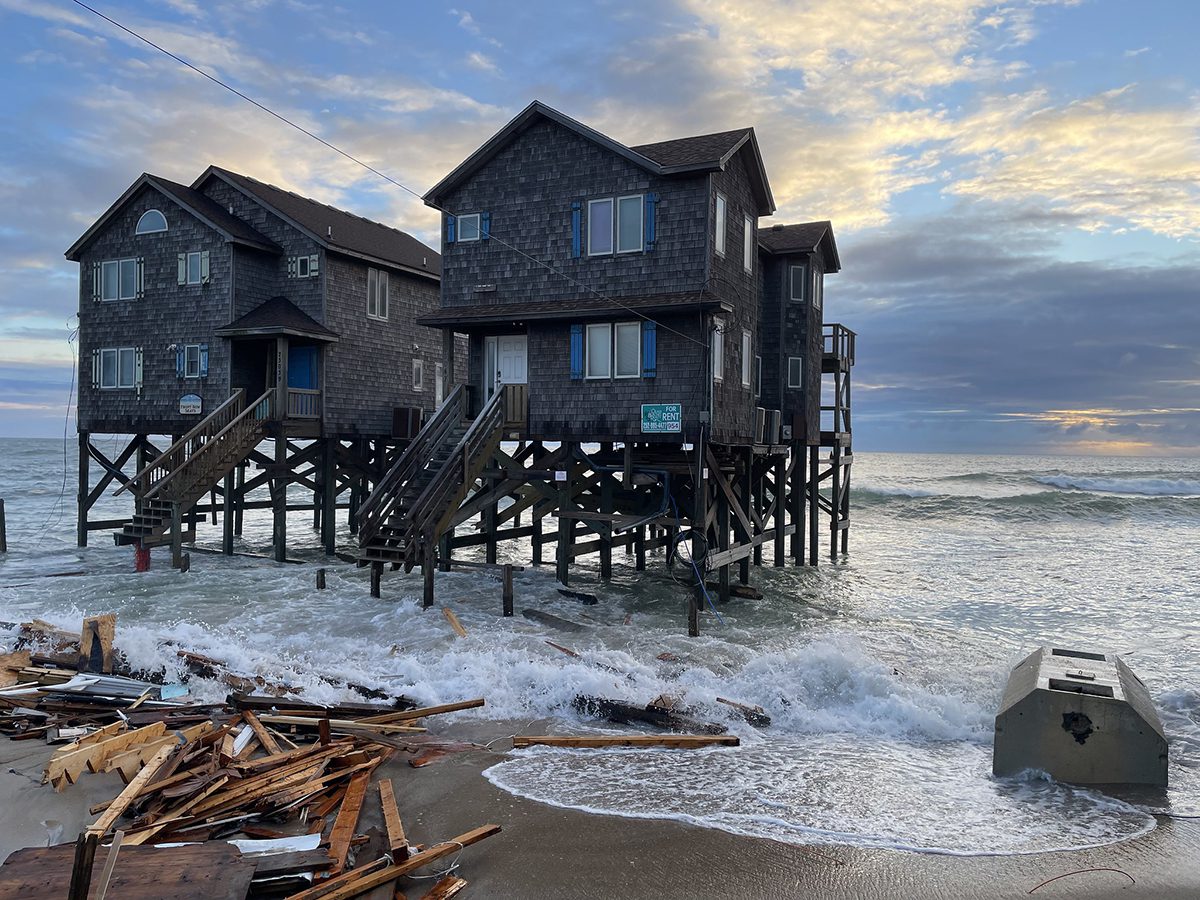
Senate Panel OKs Sea-Level Rise Bill — Kirk Ross, Coastal Review, June 8, 2012. Science panel applies 2022 sea level report projections to NC — Jennifer Allen, Coastal Review, October 28, 2024. Photo: debris from a house collapse at Buxton, N.C., September 20, 2024 (National Park Service).