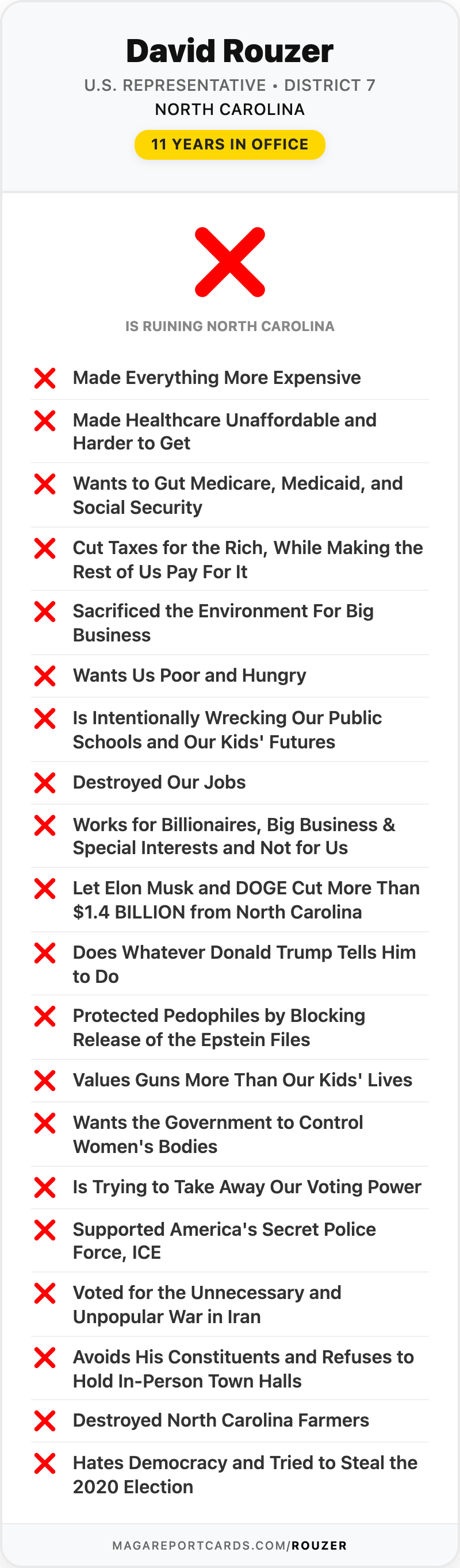
The Cape Fear Memorial Bridge was built in 1969. More than 60,000 vehicles cross it every day, linking New Hanover and Brunswick counties. Transportation officials call it functionally obsolete — its design doesn't meet current standards. Local leaders have pushed for years to replace it.
David Rouzer has represented that district since 2015. He now chairs the House Transportation and Infrastructure Committee's Subcommittee on Highways and Transit, which means he is in charge of the panel that writes federal highway and bridge policy.
Here is the sequence.
November 2021: he votes no
On November 5, 2021, the House passed H.R. 3684, the Infrastructure Investment and Jobs Act — the bipartisan infrastructure law. It created the Bridge Investment Program, a new pot of money for replacing large bridges exactly like the one in Wilmington.
Rouzer voted Nay.
July 2024: the law he voted against pays for half the bridge
On July 12, 2024, the U.S. Department of Transportation notified Congress it would direct $242 million to North Carolina for the Cape Fear Memorial Bridge replacement, through the Bridge Investment Program's Large Bridge Project grants. At the time, that covered roughly half of the project's estimated $485 million cost.
The money came from the Bipartisan Infrastructure Law. Sen. Thom Tillis, a Republican who helped negotiate that law and voted for it, announced the grant. So did Rouzer, who had voted against it, in a statement to Carolina Journal:
"This grant is a game-changer and the result of a strong, strategic, coordinated effort by local, state and federal officials to make it happen."
That's his statement from July 2024. A strong, strategic, coordinated effort by federal officials — the same effort he had voted to stop three years earlier.
This is a well-worn move. Derrick Van Orden voted for the law that cut Medicaid by roughly $900 billion, then claimed credit for shielding Wisconsin hospitals from one of its provisions. Susan Collins voted against $300 million for ICE body cameras, then took credit when ICE bought them anyway. What makes Rouzer's version notable is the scale — $242 million into one district — and the fact that he now chairs the subcommittee that oversees the program he voted against creating.
February 2025: Trump freezes it, and Rouzer defends the freeze
On February 26, 2025, a Trump executive order triggered a pause on discretionary U.S. Department of Transportation grants. The Cape Fear bridge grant was caught in it. NCDOT told the Greater Wilmington Business Journal it was the only project in New Hanover, Brunswick or Pender counties expected to get discretionary grant money, and a month after the order the state still had no idea when it would move.
"At this time, we do not know when the grant for [the Cape Fear Memorial Bridge] will be able to move forward, and we do not know what impact the review process may have on projects," an NCDOT spokesperson wrote.
The congressman who chairs the Highways and Transit Subcommittee could have picked up the phone. Here is the statement he sent instead:
"The administration is reviewing all previously approved grants, including those going back several administrations, to root out waste, fraud and abuse of taxpayer dollars. I have every confidence the grant funding previously approved for the Cape Fear Memorial Bridge will be released once their review is complete. Replacement of the bridge is an important project, and I will continue to work with local, state and federal officials to see it to its completion."
Read that again. The waste, fraud and abuse being rooted out is the money for the bridge his own constituents drive across 60,000 times a day. His position was that the freeze was fine and the money would probably come back.
Tillis, for his part, said the review "should not impact the bridge's progress in any meaningful way."
2026: the bill lands on the people who drive it
The money did eventually clear review. The problem is what happened in the meantime.
The estimated cost of the replacement has gone from $485 million in 2024 to $1.1 billion, driven by inflation and refined designs. NCDOT has put in $85 million. The federal grant is $242 million. That leaves roughly $773 million with no funding source.
As Port City Daily reported in July 2026, NCDOT has exhausted the grant options available for the project. Unless another source appears, the only way to close the gap is to toll the new bridge — and the region's planning organization has until February to vote either to accept tolling or to withdraw the project entirely, which would kill the state funding too. The project has to be shovel-ready by September 2027 or the $242 million goes away.
A tri-county sales tax was floated as an alternative. The subcommittee studying it last met in September 2025. It would need the General Assembly's permission and a voter referendum, and the only ballot before the February deadline is this November's.
So the choice in front of southeastern North Carolina is a toll, a new sales tax, or no bridge.
What the job is
Rouzer's own press releases show he knows how this works. He touts provisions he secured in the farm bill. He understands appropriations. He is not a bystander to federal infrastructure funding; he runs a piece of it.
Which is why the 2021 vote matters. The Bridge Investment Program that is putting the single largest chunk of money into that bridge exists because a bipartisan majority created it over his objection. When it delivered, he called it a game-changer. When the president froze it, he called the freeze a fraud investigation. And now the shortfall it was meant to help cover is going to be paid by drivers in Brunswick and New Hanover counties, at a toll booth, one crossing at a time.
Sources
Bridge money on pause? — Emma Dill, WilmingtonBiz / Greater Wilmington Business Journal, April 9, 2025. CF Memorial Bridge toll decision due by February to keep grant, other funding options stall — Brenna Flanagan, Port City Daily, July 3, 2026. House vote: Roll Call 369, November 5, 2021. Photo: Cape Fear Memorial Bridge, Wilmington (Wikimedia Commons).