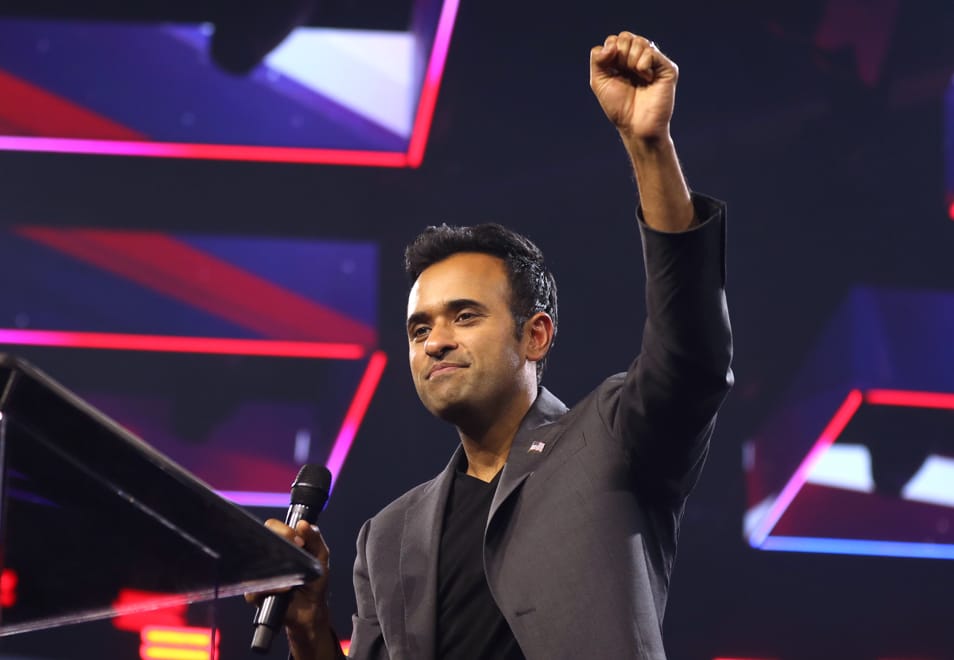
Vivek Ramaswamy wants to be governor of Ohio. He also owns roughly $71 million worth of a company whose entire business is buying bitcoin with borrowed money.
That company is deep in the red. And Ramaswamy has publicly praised a bill that would let Ohio's public pension systems — which hold about $284 billion of teachers', cops', and state workers' retirement money — start buying the exact same asset.
He hasn't broken any law. That's the point. Ohio doesn't have a law that covers this.
TiffinOhio.net reporter Bonnie Lucas laid out the whole arrangement this week, and the details are worse than the headline.
What he owns
Ramaswamy co-founded Strive in Ohio as an anti-ESG asset manager. Today it's headquartered in Dallas and it's what the industry calls a bitcoin treasury company — a firm whose main business is piling up bitcoin and measuring itself against bitcoin. He holds no executive role now. His most recent securities filing lists his occupation as "entrepreneur."
He is still one of its biggest shareholders. His amended Schedule 13D, filed June 1, reports beneficial ownership of 5,693,897 shares — 7.6% of the class — assuming his Class B stock converts. At Monday's closing price of $12.44, that's about $71 million. A family trust holds another 1,418,942 shares, and an investment company he controls holds 106,245 more.
His April disclosure to the Ohio Ethics Commission also shows he personally owns bitcoin and ether.
Why "leverage" is the word that matters
Plenty of politicians own stock in industries they'd regulate. This is sharper than that, for one reason: Strive doesn't just hold bitcoin. It borrows to buy it.
The company funds its bitcoin purchases by issuing perpetual preferred stock that pays a dividend every business day at a 13% annual rate. As of June 30, that preferred stock carried a redemption value and liquidation preference of $783 million. Preferred holders get paid before common shareholders like Ramaswamy.
That structure is built to amplify. When bitcoin goes up, the gain lands disproportionately on the common stock, because the preferred claim is fixed. When bitcoin goes down, the same math runs backward — and it has been running backward.
Strive reported Monday that it lost $257.6 million in the second quarter. Almost all of it — $234.0 million, by the company's own accounting — came from writedowns on its bitcoin and a preferred-stock position. Losses over six months: $523.5 million. Accumulated deficit: $1.04 billion.
The bitcoin math is brutal. At June 30 the company held 19,864 bitcoin, bought at an average cost of $94,793 each. Fair value that day was $58,631. Cost basis $1.88 billion; actual worth $1.16 billion. The hole was $718.3 million.
Bitcoin has since recovered to around $65,000. Strive's stack is still about a third below what it paid. To break even on the coins it already owns, the price has to climb roughly 46% from here.
Which brings us to the bill.
The bill has no cap where it counts
House Bill 18, the Ohio Strategic Cryptocurrency Reserve Act, is usually described as letting Ohio put 10% of certain funds into crypto. That's half true, and the missing half is the important half.
The 10% ceiling applies only to the state treasurer. The treasurer could put interim money from the general revenue fund, the rainy-day fund and the lottery's deferred prizes trust into digital assets, capped at a tenth of the fund balance. The bill also requires the asset be an exchange-traded product with a 12-month average market cap of at least $750 billion. Bitcoin, at roughly $1.33 trillion, clears that easily. Ether, at about $233 billion, does not. The bill never uses the word "bitcoin." It doesn't have to.
The pension language is built completely differently. Instead of authorizing a capped allocation, the bill amends the investment rules for all five of Ohio's retirement systems to say that nothing in those rules prevents a board from investing in a qualifying exchange-traded product.
It's a permission slip. There's no percentage limit. There's no market-cap floor.
You may have seen the figure "$27.5 billion" attached to this bill. That number comes from applying the treasurer's 10% cap to pension assets — which the bill text does not do. Ohio's five systems held roughly $284 billion as of Jan. 1, 2026, according to the Ohio Retirement Study Council. The statutory ceiling on how much of that could go into bitcoin funds isn't 10%. It's whatever the trustees decide is prudent.
And here's the thing about a state buying bitcoin: large institutional buying is one of the main things that moves the price. A state committing even a small slice of a quarter-trillion dollars is exactly that kind of buyer — and the announcement alone usually moves the market before a single purchase clears.
The levers a governor actually holds
The governor doesn't run Ohio's pension funds. It's worth being precise about that.
The governor appoints one investment-expert trustee to each of the five boards. On four of the five, that appointee holds the seat through a four-year term.
The teachers' system is the exception — and it became the exception recently. The state budget signed in June 2025 rewrote the board of the State Teachers Retirement System. Elected educators, who used to hold seven of eleven seats, now hold three. The director of education and workforce and the chancellor of higher education — both governor appointees — sit on the board or send designees.
And the budget added one sentence that appears nowhere in the law governing the other four systems: every appointed member of the teachers' board serves at the pleasure of the appointing authority.
An appointee who can be fired at will is a different kind of appointee. That change was made in a budget bill, not in standalone pension legislation, and it was made before anyone knew who'd win in November. But it's the law the next governor inherits.
He's been saying this out loud for a year and a half
None of Ramaswamy's enthusiasm is hidden.
In January 2025, five days after stepping down from his post co-leading Trump's federal Department of Government Efficiency, he called HB 18 "a thoughtful & powerful bill" and urged Ohio to "think creatively about hedging against government-created inflation risks."
Six weeks later at the Bitcoin Policy Institute, he described bitcoin in almost patriotic terms — saying it "helps fill that void, fill that hunger for a symbol, a reminder of what American greatness was all about."
The industry has noticed. V-PAC, the super PAC backing him, has raised about $42 million, and a few donors account for most of it: Pennsylvania trading magnate Jeff Yass gave $20 million across three checks; Ross Stevens, who founded the bitcoin-only firm NYDIG in 2017, gave $6 million; Ratmir Timashev and Elon Musk gave $5 million each; Bill Ackman gave $1 million.
We've written before about how five out-of-state men fund Ramaswamy's ad campaign — and about how $10 million of that Ohio spending sits in the state's own public database with the purpose field left blank.
To his own campaign committee, founders of World Liberty Financial — the Trump family's crypto venture — along with their spouses and the CEO of a major stablecoin company routed roughly $116,000 in maximum-legal contributions, nearly all of it on primary day or the morning after.
None of that is illegal. Ohio's ethics law says so directly: absent bribery or intent to defraud, campaign money is treated as accruing to a candidate in the ordinary course.
And the money didn't buy the position — he held it first. The point is that the people writing those checks knew exactly what they were paying to be near.
The honest caveats
We should say plainly what cuts the other way, because the reporting does.
HB 18 has gone nowhere. It got five hearings in the House Technology and Innovation Committee and has never been voted out. Republican Speaker Matt Huffman has been openly cold to it: "I think these kinds of risky things, we need to have a long, hard look at… I'm still scratching my head over cryptocurrency." House Minority Leader Dani Isaacsohn was blunter: "We have to be very careful with the crypto industry. We've seen a lot of abuse; Because of a lack of oversight, we've seen a lot of people losing their livelihoods."
The pension boards aren't free agents. Ohio law requires trustees to act solely in the interest of participants and beneficiaries, and to diversify investments to minimize the risk of big losses. A heavy bet on one volatile asset would sit badly against that standard.
And Ramaswamy has been accused of nothing. No charge, no investigation, no rule violation. Backing legislation that lines up with your portfolio is legal in Ohio and common everywhere. Nothing in Ohio's ethics chapter requires a governor to divest anything or use a blind trust.
That last one is the real finding. The problem isn't a rule he broke. It's a rule that doesn't exist.
Why this one is different from the data centers
Ramaswamy's investments in the data center industry he'd regulate are a conventional conflict — he owns companies that gain from policies he likes. We've covered that: his own ethics filing lists NVIDIA, Microsoft and Amazon stock, and energy PACs gave him $97,468 this year while he promises free electricity.
The crypto position is sharper, for three reasons:
- It's one asset, one direction. A data center portfolio has many moving parts. A bitcoin treasury company has exactly one.
- It's leveraged. A move in bitcoin hits his equity harder than it hits an ordinary holder's.
- It's underwater by hundreds of millions. So the policy isn't a way to grow a comfortable position. It's a way to close a hole.
That third point deserves to sit for a second. When a politician's holdings are doing fine, a favorable policy is gravy. When they're down $718 million, it's rescue.
This is also not the first time Ohio has been in this neighborhood. The state has been burned before — in Coingate, when Ohio workers' compensation money was steered into rare coins controlled by a politically connected insider. The comparison has real limits, and nobody is alleging a crime here. But the structural lesson holds: public money aimed at a volatile asset class where connected people already hold positions has a bad history in this state.
It also fits a pattern we've already documented with this candidate. His capital gains tax plan would save him roughly $5.8 million while costing Ohio's schools and hospitals hundreds of millions a year. Different policy, same shape.
The fix he could do tomorrow
There's an obvious remedy, and it's entirely in his hands.
He could commit to selling the Strive stake and his personal crypto before taking office. Or put it in a genuinely blind trust.
No law requires him to. Ohio doesn't have one. Which means the only thing standing between Ohio's retirement money and a governor with a leveraged bet on bitcoin is whether Ramaswamy volunteers — and whether voters ask him to before Nov. 3.
Source
Ramaswamy backs opening Ohio retirement funds to crypto while holding a $69M stake in a bitcoin treasury company — Bonnie Lucas, TiffinOhio.net, August 10, 2026. Photo: Gage Skidmore/Flickr.