A good rule of thumb in politics: when a billionaire pushes a tax cut, look closely at who actually gets the money. More often than not, it's the billionaire.
That's exactly what's happening in Ohio. Vivek Ramaswamy, the Republican running for governor, wants to get rid of the state's tax on capital gains — the money people make when they sell stocks and other investments. He says it'll grow the economy. But when you do the math on his own tax returns, the picture gets a lot less flattering. Applied to the gains on his own released tax returns, Ohio's current rate works out to roughly $5.8 million — a measure of how much income like his the plan would shield. And it would do it by draining hundreds of millions of dollars a year out of Ohio's schools, hospitals, and basic services.
What a capital gains tax actually is
Most working people earn money from a paycheck. You do a job, you get paid, and the state takes a small cut in income tax. A capital gains tax works the same way — except it's on money you make from selling investments, like stocks.
Here's the catch: the people with huge piles of stock to sell are almost never the people working a regular job. They're the wealthiest people in the state. So when you erase the tax on selling investments, you're handing the biggest checks to the folks who already have the most.
We don't have to guess how this would shake out in Ohio. The nonpartisan Legislative Service Commission — the state's own number-crunchers — looked at the plan and found that 81.6% of the benefit would go to Ohioans making more than $200,000 a year. People earning under $100,000 — which is most of the state — would split just 7.3% of it.
That's not an economy-wide tax cut. That's a giveaway to the top, dressed up as one.
How it pays Ramaswamy millions
Now here's the part that should make every Ohioan sit up.
Ramaswamy isn't just any rich guy. He's worth an estimated $1.8 billion. And the tax returns he released during his 2024 presidential run show exactly the kind of income his plan is built to protect. Across two years, those returns reported roughly $211 million in capital gains — $37 million in 2015 and $174.5 million in 2020, the latter tied to selling off stakes in his drug company Roivant to Japan's Sumitomo.
Apply Ohio's current 2.75% rate to those gains and it comes to roughly $5.8 million — a figure TiffinOhio calls illustrative, since Ohio's rates were higher in those years, but one that shows the scale of the income his proposal would exempt. And it's not ancient history, either. His 2025 financial disclosure, filed in April with the Ohio Ethics Commission, reported more than $1.1 million in dividends and capital gains — including $768,968 from a single sale of BlackBerry stock.
This is a candidate writing a tax policy that, by the numbers, places him among the Ohioans who would gain the most. When the person proposing a law is also one of its single biggest beneficiaries, that's not a coincidence. That's the whole point.
What Ohio loses
Tax cuts aren't free. That money pays for things — and when it's gone, somebody has to make up the difference or do without.
The Legislative Service Commission estimated that repealing the capital gains tax would cost Ohio between $615 million and $645.6 million in 2027 alone — and even more the year after, climbing toward $680 million. That's revenue that helps fund public schools, Medicaid, and the everyday services Ohio families count on.
So where does that missing money come from? One of two places. Either Ohio cuts services — fewer dollars for classrooms, health care, and public safety — or it raises other taxes that fall harder on regular people, like sales taxes. Either way, working families end up holding the bag so that the wealthiest Ohioans can keep more of their investment income.
Ramaswamy waves this off. He told News 5 Cleveland that "we don't even as a state derive that much revenue from it," calling the repeal "part of the first step to eventually get to zero income taxation." But $645 million isn't pocket change — it's roughly the cost of running entire state programs. Telling Ohioans it barely matters is how you get them to stop paying attention to the bill that's coming.
A pattern, not a one-off
This isn't the first time Ramaswamy has used his fortune to get what he wants in this race.
He's already written himself a $25 million check to fund his own campaign — about 83% of the money his campaign raised in 2026. He can do that because he's a billionaire. Now he wants the policy to match the lifestyle: a tax code where people exactly like him pay less, and everyone else covers the gap.
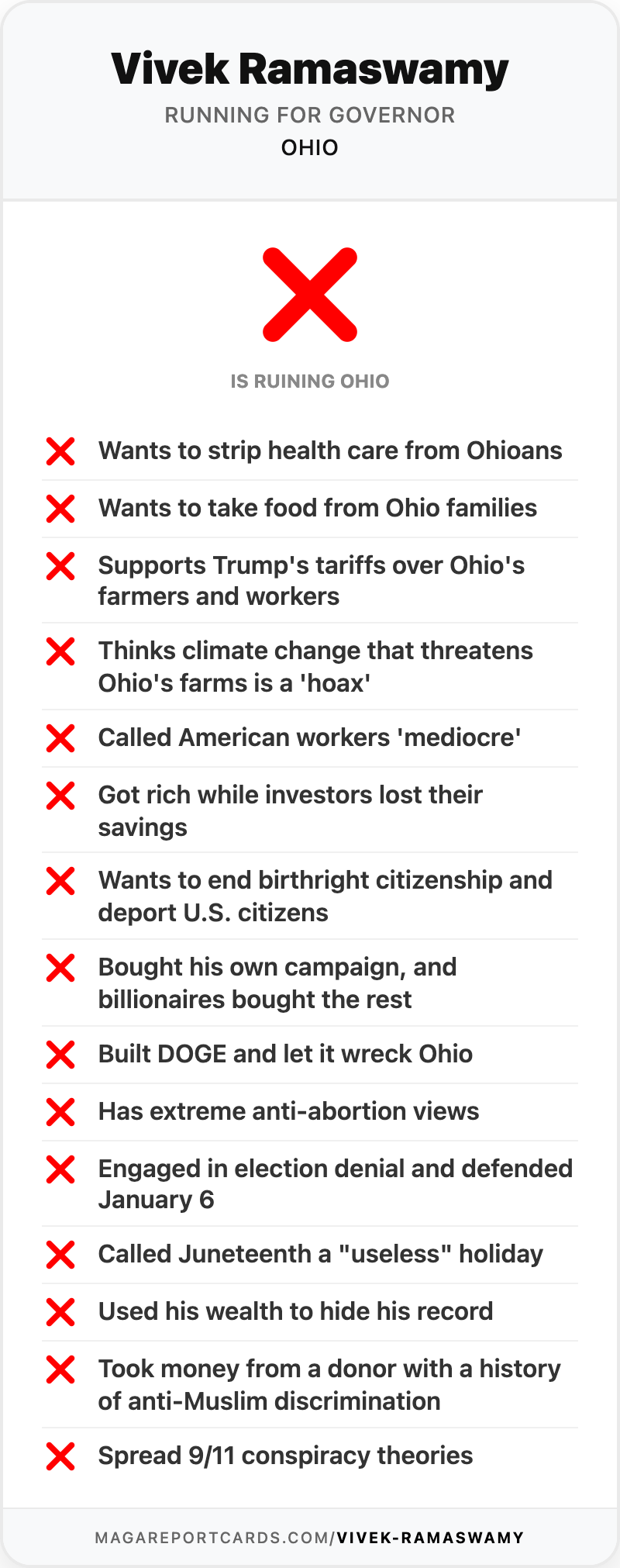
It fits a record we've documented before. Ramaswamy said it was "time to transition from permanent welfare to common-sense work requirements" in Medicaid, in a state where the Medicaid cuts in Trump’s budget bill are projected to take health coverage from about 255,000 people by 2034. He helped build DOGE, which put an Ohio Social Security office on its list to close. Over and over, the story is the same: take something away from ordinary Ohioans, and protect the people at the very top.
The capital gains plan is just the most direct version of it yet — because this time, the person cashing the biggest check is the candidate himself.
The bottom line
Strip away the talk about "growth" and "entrepreneurs," and here's what's left. Vivek Ramaswamy wants to erase a tax that mostly the wealthy pay. Applied to his own released returns, today's rate works out to around $5.8 million. The state would lose more than $600 million a year — money that funds schools, Medicaid, and basic services. And more than four out of every five dollars in savings would land in the pockets of people making over $200,000.
That's not a plan to help Ohio. It's a plan to help Vivek Ramaswamy, paid for by everyone else. We deserve better.
Source
This post is based on reporting by TiffinOhio.net, "Ramaswamy wants to end Ohio's capital gains tax, benefiting wealthy residents—and himself," and a report from the Ohio Democratic Party.