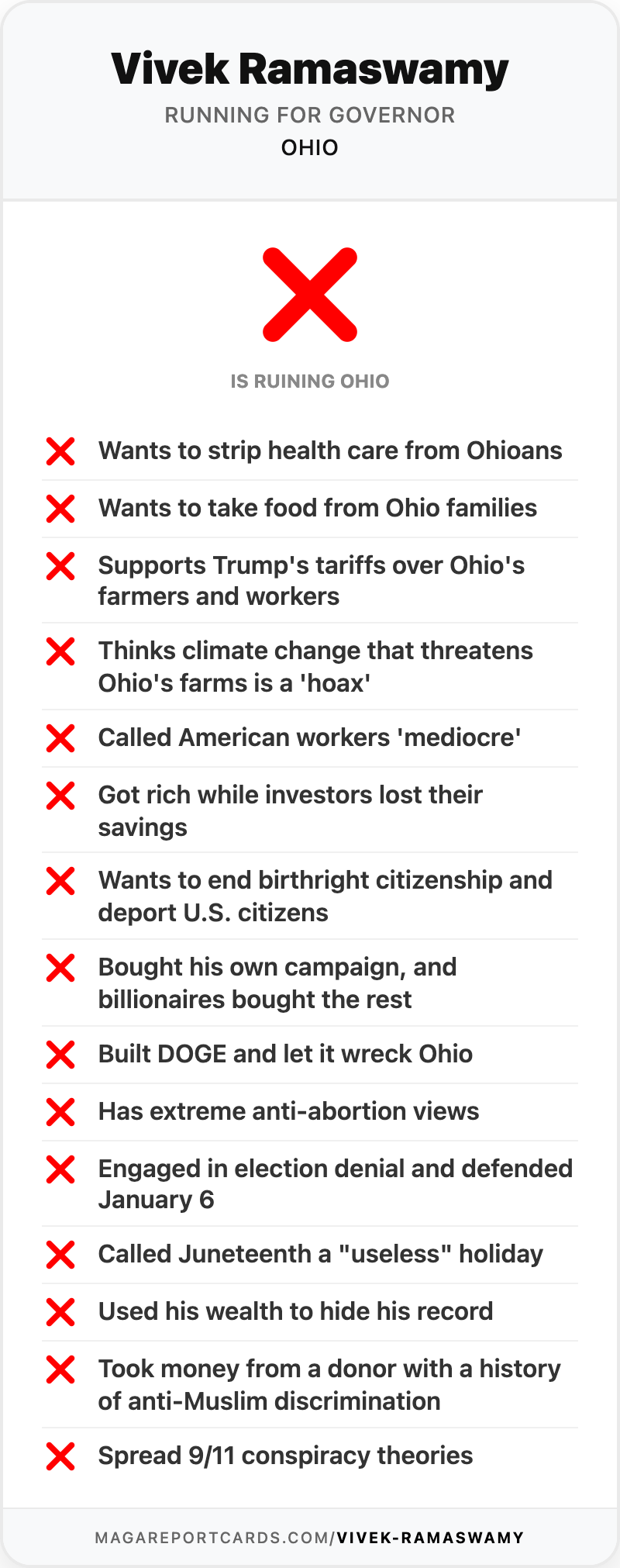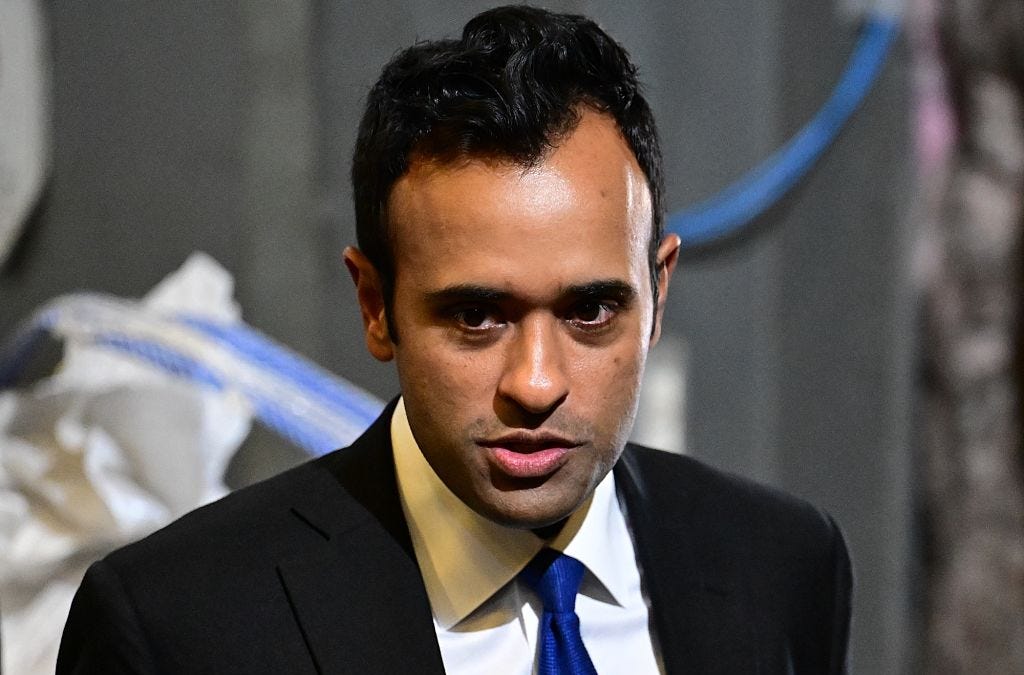
On August 12, 2026, the accountability outlet Oligarch Watch published something new about how the Republican nominee for governor of Ohio got rich. It's not a story about a business that grew. It's a story about a drug that never worked, a family on the payroll, and a stock that collapsed three weeks after $1.1 billion landed at the parent company.
Vivek Ramaswamy has spent this campaign telling Ohioans he's a builder. Here's what he actually built.
He bought a drug that had already failed — for lunch money
In December 2014, Ramaswamy's company Axovant bought the rights to an Alzheimer's drug from GlaxoSmithKline. The price was $5 million up front.
That price tells you everything. GlaxoSmithKline is one of the biggest drug companies on earth. It had run the drug — then called SB-742457 — through multiple mid-stage clinical trials, including two with 576 and 684 patients. It didn't work. AlzForum, the field's clearinghouse for Alzheimer's research, put it simply: Glaxo "developed intepirdine, formerly SB-742457, through Phase 2, but based on the efficacy results decided to discontinue the drug."
Glaxo threw it away. Ramaswamy picked it up.
Industry reporters saw the problem in real time. In June 2015, Fierce Biotech ran a piece headlined "Why Axovant's $315M IPO bonanza should scare the hell out of you." The reporting was blunt: Glaxo "had a chance to take a look at this drug in the clinic, and concluded that they couldn't do better than selling it for lunch money." Axovant, the piece said, had "no track record, no experience and one questionable product," and had raised its money "without recruiting a single patient for a pivotal study."
Another trade outlet asked the obvious question in its headline: how did a company with one asset and no clinical data of its own raise $315 million? Its answer noted the same facts — one drug, no data, no patients enrolled — and that "there is concern that the market valuation is not particularly grounded in reality."
The answer to that question, it turns out, involved his mother.
The family payroll
Ramaswamy hired his mother, Geetha Ramaswamy, as Axovant's vice president of medical and scientific strategy. He was 29.
You don't have to take a reporter's word for the arrangement. Axovant disclosed it in its own pre-IPO registration statement to the Securities and Exchange Commission, under a heading called "Family Relationships." The filing states that Geetha Ramaswamy "is the mother of Vivek Ramaswamy," and that Shankar Ramaswamy, also an Axovant employee, "is the brother of Vivek Ramaswamy." It goes on: in March 2015, his mother "was granted a stock option for 262,500 common shares" and his brother "a stock option for 750,000 common shares," both priced at 90 cents a share.
Ninety cents a share. Three months later, the public paid $15.00 a share in the IPO.
Oligarch Watch's reporting adds the part that had never been published before: what his mother actually did there. Her prior jobs at Abbott and Merck were management and training roles. She appears never to have run a clinical trial. Within weeks of the IPO, she had co-published two reanalyses of Glaxo's failed 684-patient trial — the exact data the whole company was built on.
What "reanalysis" meant here
Glaxo's 684-patient trial had two primary yardsticks it had to clear: a cognition score (ADAS-cog) and a dementia severity score called CDR-SB. The company's own IPO prospectus lists both as the trial's primary outcome measures. The trial didn't clear the bar Glaxo had set, and Glaxo dropped the drug.
The reanalyses got to a better answer two ways.
A "responder" analysis. Instead of measuring how much each patient's thinking actually changed, this method sorts patients into two buckets: responder or non-responder. Pass/fail instead of a grade. It sounds harmless. It isn't. A 2025 paper in Alzheimer's & Dementia, the field's leading journal, warned specifically about this: "Statistical approaches that rely on a dichotomized binary outcome, including responder analyses ... result in a loss of information and reduced statistical power, increasing the risk of false positives and negatives." The authors' term for what can happen when a responder gap gets presented as a treatment effect is "causal fraud."
A "completer" analysis. This one throws out every patient who dropped out — and more than 30% of the patients dropped out over the trial's 48 weeks. Thomas R. Fleming, a biostatistician who co-developed the leading statistical method for monitoring clinical trials, put complete-case analysis in a list of "simplistic methods for handling missing data" in a 2011 paper. His summary: "Missing data on outcome measures in clinical trials meaningfully reduce the integrity and interpretability of results." Dropouts aren't random. People who quit a drug trial often quit because they're doing badly. Delete them and the survivors look great.
Then came the swap. The failed trial's second primary yardstick, CDR-SB, stopped carrying weight — and the prospectus argued for dropping it in print, telling buyers that "No Alzheimer's disease drugs have ever been approved on the basis of CDR-SB as a primary endpoint." A daily-living scale, ADCS-ADL — not one of the two measures Glaxo had set as primary — got promoted into the headline claim. Same patients. Same data. Different scoreboard.
Axovant put the result out in a July 2015 press release announcing that patients on the drug "demonstrated statistically significant improvements in cognition and function at 12, 24, 36, and 48 weeks." Buried in the same release: "The completer analysis includes only patients with complete data at each study visit."
What he told investors
Ramaswamy was Axovant's principal executive officer, the title the filings give him. The IPO prospectus told buyers the drug "has the potential to be a best-in-class 5-HT6 receptor antagonist for the treatment of Alzheimer's disease based on its safety, tolerability and efficacy for up to 48 weeks" — pointing at the same Glaxo trial that had failed.
On CNBC he called it a "unique drug that we actually think could help millions of patients," and told Jim Cramer the company was "only one additional Phase 3 study away from the approval of this drug."
Millions of American families are living with Alzheimer's. There is no cure. That desperation is the market Ramaswamy was selling into.
The cushion
Ramaswamy structured Axovant so that insiders held the deck. Four parties controlled more than 90% of the shares; the public got a float of roughly 10%. A limited public float, and the allocation of a big block of shares "to a small number of investors," both appear on FINRA's list of hallmarks of a "ramp-and-dump" scheme — a list aimed mostly at far smaller offerings than this one.
And the warning lights were already on. In February 2016, Pfizer discontinued its own drug in the same class after concluding there was no point continuing. A third, from Lundbeck, failed three late-stage trials between September 2016 and February 2017.
Ramaswamy never owned Axovant stock directly — his stake ran through the parent company, Roivant, which held 75 million Axovant shares. Those couldn't be sold on the open market without tanking the price and triggering public disclosures. So they weren't sold at all. Money arrived from the other direction instead. On August 9, 2017, Roivant announced it had raised $1.1 billion in new equity led by SoftBank's Vision Fund — an investment the company said was "intended to accelerate the launch of new subsidiaries." An SEC filing records the closing on September 6, 2017: as Roivant shareholders, the SoftBank funds were deemed to hold beneficial ownership over those 75,000,000 Axovant shares — 69.8% of Axovant.
Twenty days later, on September 26, 2017, the Phase 3 trial failed. The stock lost most of its value in a single day and kept falling. The company was eventually renamed, lost 99.8% of its value, and shut down.
Someone held those shares on the way down. The California State Teachers' Retirement System — the pension fund for public school teachers — watched its Axovant stake fall from about $1.2 million to $68,000.
Ramaswamy made an estimated $260 million out of Roivant. That figure isn't from an opponent; it's Forbes, which reported that "he has sucked over $260 million out of Roivant in the form of salary, bonuses and capital gains."
Asked about it later, he said he was proud that "we did a clear experiment that got a clear result, that resulted in a clear decision to terminate the development of that drug," and that "there is probably nothing in a meaningful way we could've done differently in the decision of advancing that drug into Phase 3 development in the first place." He said it at a conference held while Axovant shares traded around a dollar.
Why this matters in Ohio
Ohio isn't being asked to grade a stock trade. It's being asked to hand this man the government.
A governor appoints the people who regulate utilities, run the pension systems, oversee the Medicaid program, and decide what counts as adequate proof when a business tells the state something. The question Ohio has to answer is what this record predicts about how he'd use that power.
And notice what he does with the record now. He won't talk about it. He went months without a data center plan until, by cleveland.com's account, its pressure got one out of him — while describing his business past only in the vaguest terms.
The pattern from Axovant shows up in the rest of his campaign, too. His tax plan would wipe out Ohio's capital gains tax — at today's rate, roughly $5.8 million on the gains in his own released tax returns, the same kind of income he pulled out of Roivant. And the money behind his run comes from five men who don't live in Ohio, including Elon Musk and Jeff Yass, who put up 88 cents of every dollar in his super PAC.
Heads he wins. Tails somebody else's retirement fund pays for it.
Ohio's teachers, seniors, and families don't get a billion dollars from Tokyo three weeks before the bad news lands. Ramaswamy did, and he has taken $260 million out of Roivant since. The people who believed his pitch about an Alzheimer's breakthrough got the crash.
Source
Caleb Ecarma, "How Vivek Ramaswamy's mom manipulated Alzheimer's data and made her son rich," Oligarch Watch, August 12, 2026.