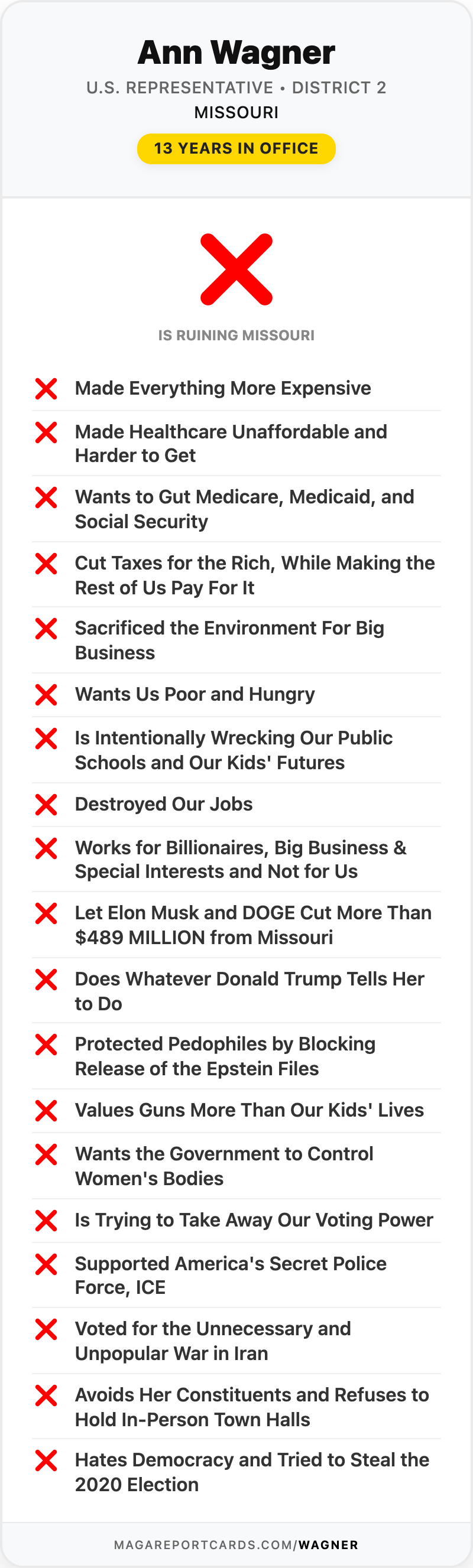
Ann Wagner walked into Congress a wealthy woman. Thirteen years later, she is a lot wealthier.
St. Louis Magazine reported on August 12, 2026 that Wagner's net worth has gone from just north of an estimated $6 million when she was sworn in to around $26 million today, according to Quiver Quantitative, which tracks the finances of members of Congress. That's an increase of about $22 million while holding public office.
Wagner's spokesman says that's just hard work paying off — that she and her husband Ray "worked hard in their respective fields, saved their money, and have been successful," and that "the Wagners will never apologize for working hard and saving for their future." Ray Wagner spent 27 years as an executive at Enterprise Mobility before retiring in 2022.
Fine. Nobody is required to apologize for being rich.
The problem isn't the money. It's the job she holds while she has it.
The subcommittee she chairs
Wagner is the chair of the House Financial Services Subcommittee on Capital Markets. That panel oversees the Securities and Exchange Commission — the agency whose entire job is policing the financial markets, punishing fraud, and setting the disclosure rules that investment firms have to follow.
So the person writing the rules for the investment industry is also a person with an estimated $26 million to her name, some of it in private equity funds.
Wagner's defense is that she stays away from individual stocks. When the House voted this past summer on banning stock trading by members, she said publicly:
"I have neither owned nor traded individual stocks since long before I was elected to Congress, and neither has my husband."
Her spokesman told St. Louis Magazine the point of that is to avoid even the appearance of a conflict, and argued it makes insider knowledge useless to her: "Besides the fact that insider trading remains illegal, it just isn't possible to use insider knowledge that would affect a portfolio of exchange traded funds, mutual funds, and municipal bonds."
Except that isn't the whole portfolio. The same reporting notes Wagner has invested in private equity funds — funds that buy stakes in private companies, outside the public markets entirely.
Her Democratic opponent, veteran Fred Wellman, calls the individual-stocks line a matter of semantics: "If you know anything about the financial markets, you know there's a whole lot of investment vehicles that aren't individual stocks, and she has been very, very good at managing those investment vehicles with great success."
He also says almost half her fundraising comes from corporate PACs tied to financial services, and that she's "not watching out for the working Americans anymore." That's a candidate's claim about his opponent — so look at the actual donor list instead.
Who funds her
Wagner's top contributors read like a roster of the industry her subcommittee regulates:
- KKR & Co. — $46,500. KKR is one of the largest private equity firms on earth. Wagner invests in private equity. People at KKR invest in Wagner.
- Jones Financial Companies — $48,750. The parent company of Edward Jones, the brokerage headquartered in her own St. Louis area — regulated by the SEC her subcommittee oversees.
- Robinhood Markets — $34,000. The retail trading app, another SEC-registered firm.
- American Israel Public Affairs Committee — $129,173, the largest single name on the list. TrackAIPAC, reading the same FEC filings, puts the total Wagner has taken from pro-Israel PACs at $315,619.
Corporations cannot legally write checks to a federal candidate, so most of that is money from the people who run these firms, their employees and their families rather than from the firms themselves. That is how the industry gives. None of it is illegal, and all of it is the point: the financial industry does not spend that kind of money on a subcommittee chair by accident.
What she does with the gavel
This isn't a hypothetical conflict. Look at what Wagner has actually written into law.
In June 2026, she introduced a bill to abolish the accounting watchdog created after Enron and cut the SEC's ability to fine corporate lawbreakers. The Senate parliamentarian had already thrown the same idea out of Trump's budget bill a year earlier. Wagner brought it back as a standalone — along with a change that would let a company that broke the rules hundreds of times be fined as though it broke them once.
That is the chair of the SEC oversight subcommittee moving to shrink the SEC's teeth.
Ask who benefits from a weaker market cop. Then look back at the donor list.
The comparison she's making
Wagner's campaign would rather you look at her opponent's finances than her own. Wellman has filed for bankruptcy twice — in Tennessee in 2003, which he attributes to his wife losing her job after 9/11, and in Virginia in July 2020, when his firm Scout Comms collapsed during the pandemic. That firm's work was helping companies and nonprofits better serve veterans returning from service. The 2020 filing showed more than $715,000 in liabilities and $116,000 in outstanding taxes.
Wagner is running that history hard in the general election; her spokesman calls Wellman a "tax cheat."
Set aside who you'd rather have dinner with. One of these two people has spent thirteen years in Congress, has held the gavel over the Securities and Exchange Commission since 2023, has grown an estimated $22 million richer in that time, invests in private equity, takes money from people at private equity giants, and has used that gavel to try to shrink the agency's power to punish financial wrongdoing.
The other one went broke running a small business that worked with veterans.
Missouri's 2nd District gets to decide in November which of those two stories says more about how someone would treat other people's money.
Source
Ryan Krull, "Wagner's wealth has tripled during her time in office—even as her Democratic rival has struggled", St. Louis Magazine, August 12, 2026.