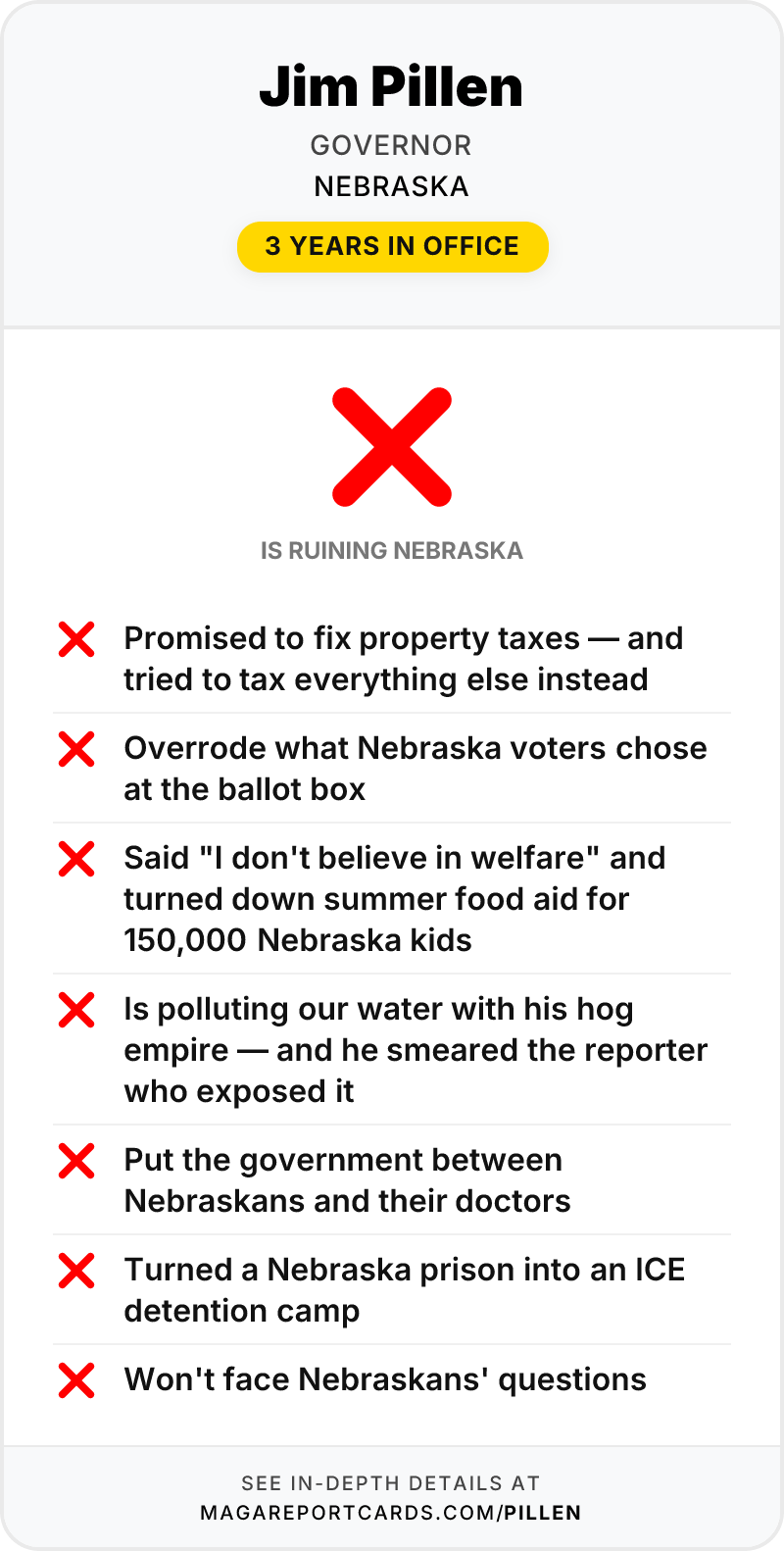
Less than three weeks after Nebraska re-elected him, Jim Pillen's administration sent out a list of Medicaid cuts.
On Friday, November 20, 2026, Pillen's Department of Health and Human Services emailed health care providers. The changes covered dental care, at-home personal care and hospitals, the Nebraska Examiner reported. By Monday, disability advocates, hospitals and home care agencies were calling state senators to try to stop them.
Kris Perkins co-owns A Place At Home, which sends caregivers to hundreds of elderly and disabled Nebraskans. Some of them are on Medicaid. Her email arrived at 4:12 p.m. that Friday. The cuts start January 1.
"That gives agencies just 41 days to prepare for a decision that could fundamentally change the availability of home care services throughout Nebraska," she told the Examiner.
What's being cut
According to the Examiner and the Nebraska Hospital Association:
- Doctors, dentists and other Medicaid providers get a 3% pay cut in 2027, and another 3% cut the year after.
- Home care agencies move to a flat $26.32 an hour for personal care. Perkins is paid $31.69 now. Independent caregivers get $17 an hour.
- New copays for patients: $4 to $35 for services from vision care to hospital stays. Pregnant women and nursing home residents are exempt.
Perkins pointed to a state study from five years ago. It put the cost of running a home care agency at about $43 an hour, once you count caregiver wages, payroll taxes, workers' comp and insurance. The new rate is more than $16 below that.
"You can't balance the budget on the backs of your most needy populations," she said.
Jeremy Nordquist runs the Nebraska Hospital Association. He said the cuts, "combined with Medicaid cuts enacted by the federal government, will be a devastating blow to our already fragile rural healthcare infrastructure." Some rural clinics in Nebraska have already closed.
"When a rural hospital closes its dialysis or labor and delivery unit or shuts down entirely, every resident in that community loses access to care, whether they are on Medicaid, Medicare or private insurance."
Copays 21 months early
The copays are not Nebraska's idea. Trump's budget bill requires states to start charging some Medicaid patients new copays. But Nebraska is starting them 21 months earlier than federal law requires, said Sarah Maresh of the advocacy group Nebraska Appleseed. She called them "extremely harmful."
Maresh said the state expects to save about $6,000 from the copays. That is not a typo. Maresh said the copays are more "punitive" to poor people than they are a help to the state's budget.
Pillen had a chance to soften this. In April, the Legislature passed LB929, a bill from Sen. John Fredrickson that said Nebraska's Medicaid insurers could pay patients' copays and deductibles. It did not make them. Pillen vetoed it anyway. He called it a "do nothing" bill and said it would send the wrong message that Medicaid patients didn't need "skin in the game." The Legislature failed to override that veto or any of his others that session.
"Being first to make it harder to see a doctor isn't a race worth winning," Fredrickson wrote after Friday's announcement.
Racing ahead, again
Being first is the pattern. In May, Pillen made Nebraska the first state to start the budget bill's Medicaid work requirements, eight months before the federal deadline. We covered the early results: more than 1,000 people lost or were denied coverage in four months, mostly over paperwork.
The state hasn't released new numbers in two months, said Angie Lauritsen of Nebraska For Us. The last report counted about 1,100 Nebraskans denied or cut off.
"The Trump administration is now giving the rest of the country an additional six months to execute changes that are well underway here," Lauritsen said. "Nebraska has no plans to slow down."
The deficit Pillen is balancing
Pillen's health department says the cuts are about rising costs. Spokesman Jeff Powell said the agency will still have to ask lawmakers for about $500 million more for Medicaid and related programs. Without the cuts, he said, the request "could exceed $1 billion."
The bigger hole is the state budget. Nebraska's Legislative Fiscal Office now projects a $1.124 billion deficit for the two-year budget starting July 2027, plus $175 million for the current one. It will be the third session in a row lawmakers start with a deficit.
The Examiner's report also shows where much of the money goes. The state's two property tax credit programs and two education funds move nearly $2 billion a year out of the general fund. Sen. Ben Hansen, who chairs the state's Tax Rate Review Committee, said lawmakers may have to scale those back or revisit tax rates. Otherwise, he said, they will keep cutting smaller programs, the strategy of the last several sessions.
Pillen's budget chief, Neil Sullivan, wouldn't say whether the governor would touch the property tax credits. "Property tax relief is hard. It's hard to mess with," he said.
This is the same governor who, in January, said Nebraska had "bushel baskets and bushel baskets of money". By August, one of his agencies was proposing that employees sleep in their cars.
What the record shows
Less than three weeks after his re-election, Jim Pillen's administration announced Medicaid pay cuts of 3% a year for two years for doctors and dentists, a flat home care rate more than $16 an hour below what the state's own study said it costs, and copays of up to $35 for patients 21 months before federal law requires them. The copays are expected to save about $6,000. In April, Pillen vetoed a bill that would have let Medicaid insurers cover those copays, saying patients needed "skin in the game."
Source
Outcry over intended Medicaid cuts grabs lawmakers' attention — Nebraska Examiner