Nebraska used to run something called the Work Ethic Camp in McCook. It was a state corrections facility for minimum-risk inmates, built around rehabilitation. Its inmates helped set up community events in town, including Santa Claus Lane.
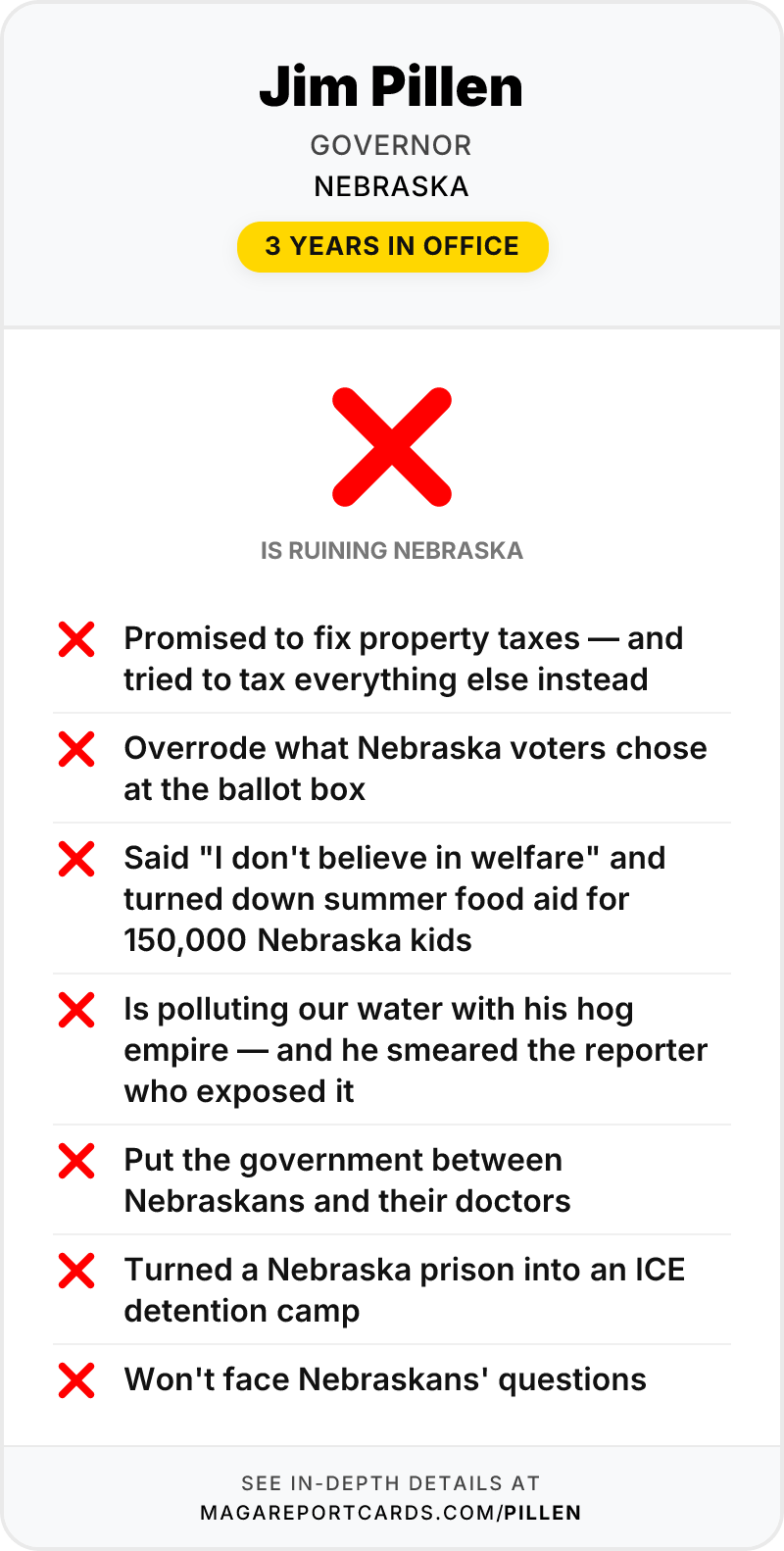
In August 2025, Jim Pillen announced he had made a deal with U.S. Immigration and Customs Enforcement to convert it into a 300-bed jail for immigrant detainees.
On August 15, 2026 — one year later — about 300 people gathered on private land within sight of the facility to say they hadn't forgotten. Nearly 60 of them had ridden a bus from Omaha, a roughly 10-hour round trip. Their signs read: "We have not forgotten."
Pillen's office responded that he remains committed to the partnership. The Nebraska Examiner covered the rally and the year that led to it.
The money didn't show up
Start with the number Pillen used to sell this.
He said last year that he expected the federal government to pay Nebraska a $2.45 million "base" fee every month.
Here is what the state has actually received, according to a spokesperson for the Nebraska Department of Correctional Services: $14.6 million in total. And most of that isn't the recurring payment — it breaks down as $9.3 million based on occupied beds and $5.3 million in one-time costs like vehicles and equipment.
Detainees started arriving in November. Through March, the daily population bounced between about 100 and 171 — well short of 300 — according to the Deportation Data Project, a Freedom of Information Act repository maintained by UC Berkeley Law School.
The state's explanation is that the bigger payments arrive once the facility can hold 300, and that renovations finish later this summer. Maybe so. But Nebraskans were sold a monthly figure, and a year later the state has collected less than what six months of that figure would have been — while the facility itself is a permanent fixture through at least September 2027.
The Republicans in McCook found out on TV
The people most opposed to this aren't who you'd guess.
John and Deborah Walters are registered Republicans who own agricultural land near McCook — including the acres where the protest was held. John was born in McCook 79 years ago.
They learned that their state was putting an ICE detention center in their town by watching a national newscast over hotel breakfast in Iowa.
"We were shocked," John said.
Deborah described most of the immigrants swept up in the deportation campaign as "our neighbors." Both were disturbed when federal and state officials started calling the facility the "Cornhusker Clink."
"Everything's been so secretive, that's what bothers us. It's a perfect location, right? Rural Nebraska, nobody is going to complain."
That is the whole design, stated by a Republican landowner who lives there.
Mindy Rush Chipman, executive director of ACLU Nebraska, said the same thing about the original announcement: "Those plans were shrouded in secrecy."
Pillen went around the Legislature
Nebraska has a 49-member, officially nonpartisan Legislature. Thirteen Democrats and one independent demanded more transparency and asked whether Pillen had violated the Nebraska Constitution by repurposing a state correctional facility without direct legislative approval.
Pillen's argument is that he was doing his duty to help the federal government enforce immigration law.
Thirteen McCook residents, joined by former State Sen. DiAnna Schimek, sued through Nebraska Appleseed to stop it. A Red Willow County district judge ruled for the governor and dismissed the case, finding the Legislature had already tasked the executive branch with managing state prisons. Appleseed has appealed.
So the sequence is: a governor converts a state facility to a federal purpose without a legislative vote, the courts say the Legislature already gave that power away, and the people who live there find out from television.
Now they're building isolation cells
The newest development is the one two state senators are trying to get answers about.
Solitary confinement space is under construction at McCook. State Sens. Margo Juarez of South Omaha and Terrell McKinney of North Omaha met with Correctional Services staff and were told the isolation area is a requirement of the Department of Homeland Security.
The department's spokesperson, Dayne Urbanovsky, says the facility has had a "short-term observation area" for people with thoughts of self-harm, combative behavior, or who request separation — and that more space is being finished this summer as part of the expansion.
Juarez first heard about a planned solitary area during a visit in March, when she says state escorts described it as somewhere detainees could take a "time out."
She wants a record of who goes in and for how long.
"Absolutely I am worried about it. My main concern is how long somebody would be confined in one of the rooms."
McKinney, known as a watchdog of Nebraska's prison system, asked the more basic question. He says he wants to know "why people are being placed in those rooms in the first place."
Asked about accountability, Urbanovsky said "room usage documentation is maintained in alignment with Department of Homeland Security ICE standard procedures" — which is not the same as telling Nebraska's Legislature anything.
Who is actually in there
It matters who these cells are for.
About 70% of people in ICE detention nationally have no criminal convictions, according to the Transactional Records Access Clearinghouse at Syracuse University. They are held on civil violations — being in the country without authorization.
"They're people that are being taken away from their families, taken away from their jobs and taken away from the communities they call home," Rush Chipman said.
ACLU attorney Grant Friedman said McCook offers the "worst lawyer-client accommodations" he's encountered. He can't get a message to a detainee without a full name and immigration identification number — which detainees don't always have.
A rehabilitation camp whose inmates once helped run the town Christmas display is now surrounded by what one McCook resident described as "rows and rows and rows of barbed wire."
The state patrol, too
The ICE jail wasn't the only thing Pillen announced that day. He also disclosed a 287(g) agreement turning Nebraska State Patrol troopers into federal immigration enforcers.
It started with six trained troopers. It's now 16. Since August 2025, troopers have assisted in about 275 immigration-related detentions or transports across 30 Nebraska counties, and Homeland Security has reimbursed the patrol $277,037.
Nationally, a Homeland Security spokesperson told the Examiner in August 2026, 287(g) partnerships had gone from 135 to 2,179 since the start of Trump's second term.
The pattern
Pillen's governing style has a recognizable shape, and Nebraskans have seen it repeatedly:
- Nebraska was offered $18 million to feed hungry children over the summer. Pillen turned it down, saying "I don't believe in welfare."
- When a reporter found nitrate contamination nearly 45 times the safe limit on his hog farms, his response was that "the author is from communist China."
- He called Nebraskans who criticize him "libtards" three times in one hour, then his staff stepped in before he could answer reporters about it.
- In January he said Nebraska had "bushel baskets and bushel baskets of money." By August his agencies were proposing that employees sleep in their cars.
Decide without telling anyone, dismiss the people who object, and don't answer the follow-up questions.
What Nebraskans should ask
The contract runs through at least fall 2027, and Sen. Juarez says she'll work to end it when it expires.
Until then, three questions have gone unanswered for a year:
- Where is the $2.45 million a month? The state has $14.6 million total to show for a year, most of it not recurring.
- Why did a state facility change purpose without a vote of the Legislature?
- Who is going into the isolation rooms, and for how long? Two state senators have asked. They've been told the paperwork exists.
Gary Power, 84, stood in the August heat at the rally and offered his read on why more of his neighbors are showing up: "Six months ago I would never have seen something like this. They woke up. They're paying those gas prices, wouldn't that wake you up?"
Nebraska deserves a governor who tells the town before the television does.
Source
One year after Pillen announced McCook ICE jail, protests continue, governor doubles down — Cindy Gonzalez, Nebraska Examiner, August 17, 2026. Photos by Cindy Gonzalez/Nebraska Examiner.