On September 8, 2026, the Republican nominee for Senate in Texas released a campaign video of his opponent making a speech.
The speech never happened. The man in the video is not real. He was generated by artificial intelligence.
The ad is called "King James." In it, a synthetic James Talarico declares "In the beginning, God was nonbinary," says God created six genders, calls Jesus a "radical feminist," and describes himself as "a Christian who hates Christianity." A narrator calls Talarico "wrong for Texas" and "wrong for America."
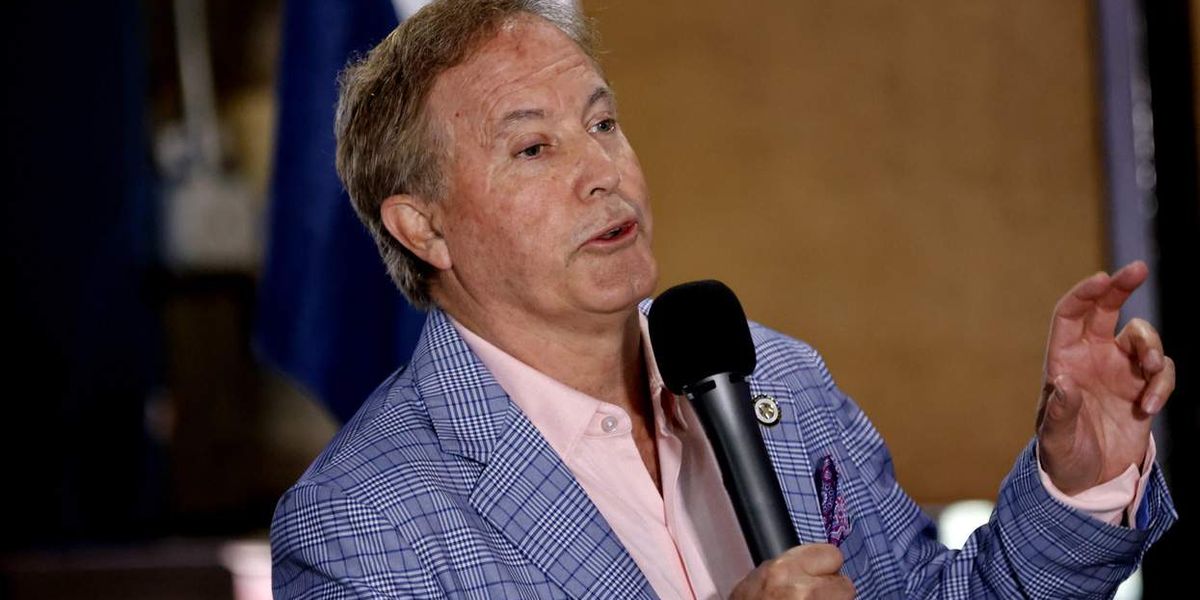
Then Ken Paxton appears on screen and says he approved the message.
That last part is the whole story. This is not an outside group Paxton can distance himself from. He put his face at the end of a fabricated video of his opponent and certified it.
How the fake was built
The ad is not invented from nothing, and that is what makes it effective and dishonest at the same time.
Talarico has said things about Christianity, God and gender in public, over years, as a Presbyterian seminarian and a state legislator. The video takes fragments of those real remarks, lifts them out of the settings where he said them, changes some of his wording, and assembles them into a single monologue he never delivered. The Advocate described the result as blurring the line between Talarico's actual views and statements manufactured by Paxton's campaign.
Here is what he actually said, in each case.
- "God is nonbinary." Talarico said this, and then explained that he meant God transcends gender — a position consistent with his Mainline Protestant tradition, as the Texas Observer has reported.
- "Six genders." This one comes from a 2021 debate in the Texas Legislature in which Talarico discussed chromosomal variations and the biological complexity of sex. It has been recycled as "he believes there are six genders" ever since, including by President Trump.
- "A Christian who hates Christianity." He said it. The ad cuts the rest. He went on to explain that he kept returning to the faith because he found Jesus's teachings more radical than any political or economic philosophy — as the fact-checking site Snopes has documented.
The Advocate asked Paxton's campaign why it manufactured footage of Talarico rather than using real video of him saying his actual words in context.
The campaign did not answer.
This is at least the third AI fake of the same candidate
The "King James" video is not an isolated stunt. Republicans have now built a small library of synthetic Talaricos.
A pro-Trump group put out an earlier AI deepfake showing him singing about transgender children and transition care. A separate conservative organization produced an AI-generated ad in the style of the famous "Daisy" spot that falsely portrayed him as a doctor performing gender transition surgeries on children.
None of those had Paxton's face on the end of them. This one does.
Wisconsin already has a law about this
There is nothing novel about the technique, and at least one state has legislated against it.
Wisconsin requires political AI videos to carry an on-screen label reading "This video content generated by AI." In August we reported that Republican Congressman Derrick Van Orden was posting AI-generated videos putting words in his opponent Rebecca Cooke's mouth, without the label his own state's law requires.
Texas has no equivalent labeling requirement. It has a different kind of law: Election Code 255.004(d), passed in 2019, makes it a criminal offense to create a "deep fake video" with intent to injure a candidate and publish it — but only "within 30 days of an election." Election Day is November 3. The ad went out on September 8.
Paxton's ad did carry a disclosure. A line at the bottom of the video reads that "certain video content depicted in this advertising was generated by artificial intelligence." Wisconsin's rule would not accept that: the label there has to run through every synthetic portion of the video, "readable, legible, and readily accessible."
So in Texas, more than 30 days out, a candidate for the United States Senate can generate his opponent saying things his opponent never said, run it as campaign advertising, and legally sign his name to it.
The money arrived at the same time
The ad landed as national Republican money began pouring into a race the party once assumed was safe.
MAGA Inc., Trump's super PAC, plans to spend at least $10 million in Texas — roughly half supporting Paxton and half attacking Talarico, according to a Federal Election Commission filing reviewed by Reuters. We wrote on September 7 about who is actually paying for Paxton's campaign: Trump's PAC, Elon Musk's PAC at $1.4 million more, and a set of billionaire-funded groups, against roughly $264,000 in ad spending by Paxton's own campaign.
The polling explains the urgency. A Univision/YouGov survey conducted August 27 through September 4 had Talarico ahead 48% to 43%. An August University of Texas/Texas Politics Project poll had him up 42% to 39%. An Emerson College poll had Paxton at 47% and Talarico at 46%, a statistical tie.
What Paxton does when the record isn't enough
Paxton has spent this campaign making transgender people the centerpiece of his case against Talarico. That is the same office and the same playbook that produced the Texas Children's Hospital settlement, where Paxton extracted $10 million, had three doctors' hospital privileges permanently revoked and two former ones barred for life, and ordered the creation of the nation's first "detransition clinic" — a facility a Stanford pediatrician described as built by legal intimidation.
What the "King James" ad adds is a confession about the underlying material. If Talarico's real statements, in their real context, made the case Paxton wants to make, Paxton would have used them. He has the video. He chose to write a new speech instead.
What the record shows
On September 8, 2026, Ken Paxton's Senate campaign released an ad called "King James" built around an AI-generated version of his opponent James Talarico delivering a monologue Talarico never gave, assembled from fragments of his real remarks with the context removed and some wording changed. Paxton appears at the end of the ad stating that he approved it. His campaign did not answer The Advocate's questions about why it manufactured footage instead of using authentic video. It is at least the third AI-fabricated depiction of Talarico produced by Republicans or pro-Trump groups this cycle, and it arrived as Trump's super PAC committed at least $10 million to the race with Talarico leading or tied in three recent polls.
Source
Ken Paxton Puts Fake Words in James Talarico's Mouth With AI, Them, September 2026, originally published by The Advocate.