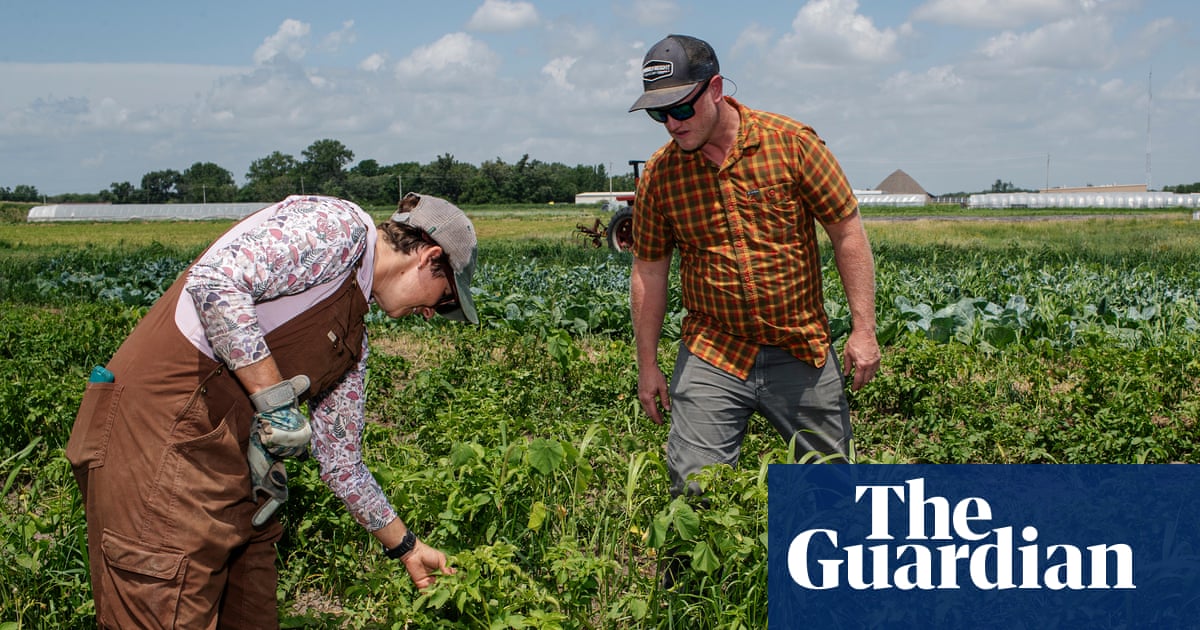
Lawrencia Rogers finally got her shot at farming this spring. The 33-year-old Iowan started a two-year fellowship in March, funded by the U.S. Department of Agriculture, on a plot of land at the Johnson County Historic Poor Farm in Iowa City. It came with a living wage, health insurance, paid time off, and advisers who could teach her everything from irrigation to surviving a crop failure. "It was honestly like school for farmers," she told the Guardian.
Two and a half weeks later, she was laid off.
The Trump administration cancelled the $2.5 million grant that paid for the program, calling it "wasteful spending" that ran afoul of the White House's ban on diversity, equity, and inclusion. To Rogers — whose father is Egyptian, and who was hired, she says, because she was one of the best-qualified applicants — the DEI label felt like "an extra slap in the face."
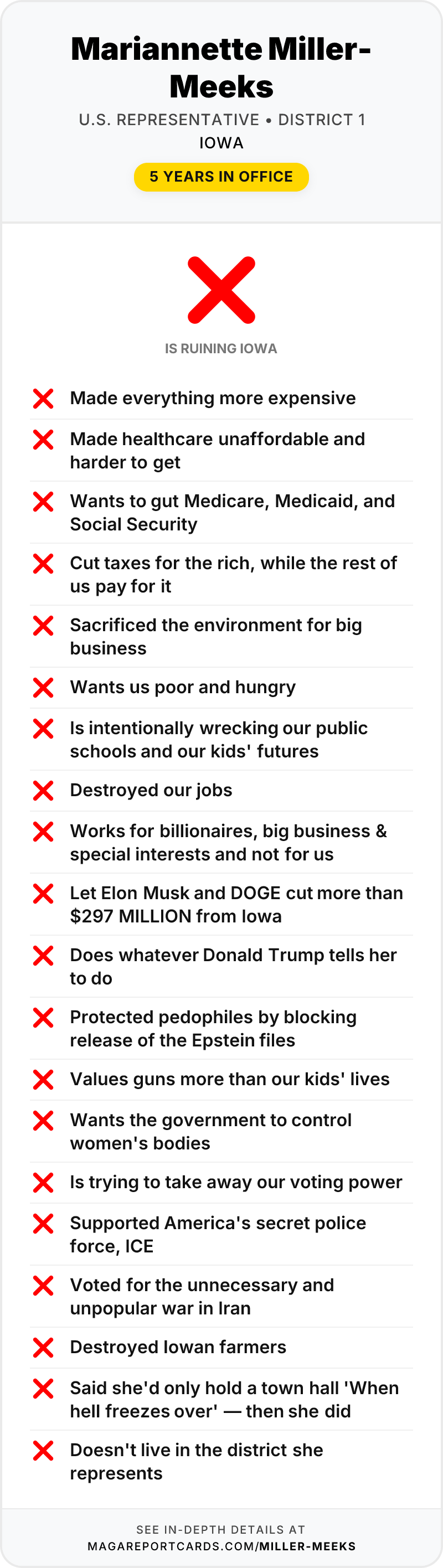
Here's the part every voter in Iowa's 1st Congressional District should sit with: this happened in their district. The farm is in Iowa City. And the Republican who represents them in Congress, Mariannette Miller-Meeks, signed up to cheer this kind of cutting on.
The Cuts Landed in Her Own Backyard
The USDA under Trump has laid off staff and dismantled programs built to help small producers. An analysis by the National Sustainable Agriculture Coalition and the public-policy firm Prospect Partners found the department has shed 20,000 employees nationwide since Trump returned to office — including 17% of its staff in Iowa. The administration also killed two programs, the Local Food Purchase Assistance program and the Local Food for Schools program, that paid food banks and schools to buy food from nearby farmers.
For the small farmers in and around Miller-Meeks's district, those weren't handouts. They were paychecks:
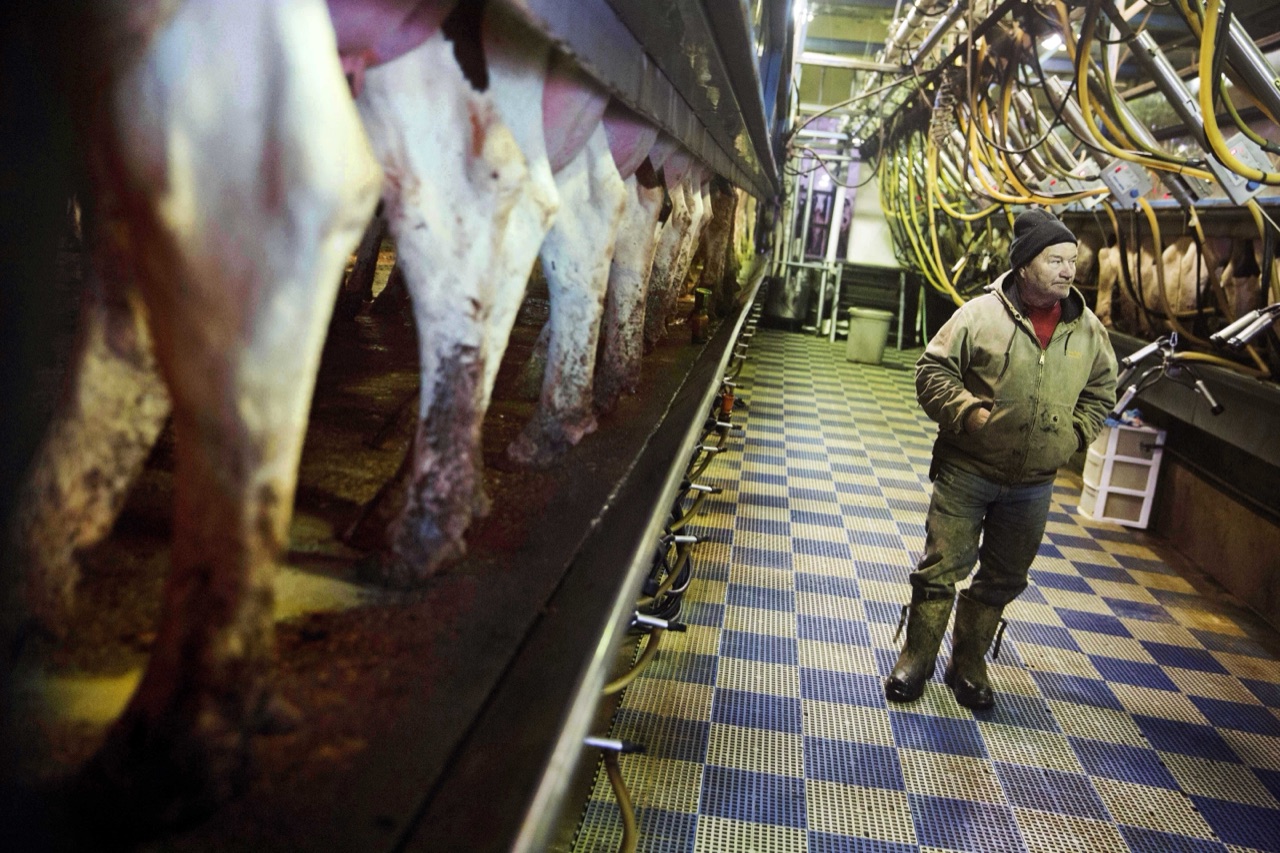
- James Nisly, who raises chicken, vegetables, and dairy south of Iowa City, said he lost 20% of his cashflow and many of his buyers when the school- and food-bank purchasing program was cut.
- Anna Pesek, who farms poultry, pigs, and flowers in eastern Iowa, estimated the cancellations cost her farm 10% of its income and nearly all of her large buyers.
- Carly McAndrews, a vegetable farmer in Iowa City, went to her local USDA office to apply for a new $1 billion assistance program for specialty-crop growers and found nobody there knew how to help her. "It was like a functionless program, in my experience," she said.
"I haven't seen any activity in the current administration that actually is beneficial for the small producer and the small-business entities," Nisly told the Guardian. "All of the policy activity that I've seen is hugely beneficial to the very large corporations, and detrimental to the small-business operators."
That's what's happening on the ground in her district. Now look at what Miller-Meeks has been doing in Washington.
She Joined the DOGE Caucus — and Bragged About the Cuts
The USDA killed that farmer-training grant using one word: "wasteful." That's not a coincidence of language. Slashing federal spending in the name of "waste" is exactly the project Mariannette Miller-Meeks signed up to join.
She joined the House DOGE Caucus — the group organized around Elon Musk's "Department of Government Efficiency" and its drive to gut the federal workforce and cancel federal programs. She didn't just go along with it quietly. She put out press releases touting her own hunt for what she calls "boondoggles" in federal spending.
So when the same "cut wasteful spending" machine she cheered on reached into her district and cancelled a program teaching new Iowans how to farm, she can't claim she didn't see it coming. This is the policy she asked for. The 20,000 USDA jobs, the frozen grants, the killed food programs — that's what "government efficiency" looks like when it hits a small farm instead of a spreadsheet.
Jason Grimm, who runs Iowa Valley RC&D, disputed the DEI label outright: "There was no requirement of a specific cultural or racial background to be able to participate in our programs." Last month a federal judge ordered the USDA to reinstate $127 million in grants to Iowa Valley RC&D and other organizations nationwide. But by then the damage was done. The fellowship was on hold. Rogers had already been laid off.
Tariffs and War Made Everything Cost More
The USDA cuts didn't happen in a vacuum. Trump promised on the campaign trail to be a champion for farmers. Instead, his own policies have squeezed them from every direction — and Miller-Meeks has stood by him the whole way.
Trump's tariffs prompted China to buy fewer American soybeans. Iowa is the second-largest soybean producer in the country, so prices fell and farmers scrambled to find buyers. Then Trump's war with Iran drove up the cost of fertilizer, gasoline, and especially diesel — the fuel that runs the tractors and trucks holding the whole farm economy together.
The strain is already showing. Eighteen Iowa farms declared bankruptcy in 2025 — a 220% jump from the year before, and one of the highest totals in the country, according to the American Farm Bureau Federation. Agriculture is a third of Iowa's economy and a fifth of its jobs. This is not a side issue in the 1st District. It's the whole ballgame.
And When Farmers Wanted to Talk, She Left
Here's how Miller-Meeks handles constituents who want answers. For most of 2025 she didn't hold an in-person town hall at all, telling local Republicans she'd do it "when hell freezes over."
When she finally held one in November, worried Iowans spent an hour booing, heckling, and shouting over her about Medicaid cuts, the economy, and immigration raids. After 50 minutes, she left the room to loud boos — and didn't come back for a planned meeting with the press.
It fits a pattern. She represents Iowa's 1st District, but in December 2025 — while running for reelection there — she changed her voter registration back to her Ottumwa home, which redistricting drew into a different district entirely. She won her last race by roughly 800 votes. She is now facing Democratic challenger Christina Bohannan for a third time.
Rogers, the laid-off farmer, put it plainly. "I have never had a decision on such a level impact my life literally overnight in such a drastic way," she said. "So, if that wasn't a rude awakening to pay more attention and, I don't know, maybe be more vocal or take more action, I don't know what could be."
That's the choice in front of Iowa's 1st District. The people growing its food are losing income and jobs to cuts their own representative signed up to champion — and when they show up to say so, she leaves the room.
Source
Chris Stein, "'A slap in the face': small farmers say Trump is turning his back on them," The Guardian, July 11, 2026. Photograph: Danny Wilcox Frazier / The Guardian.