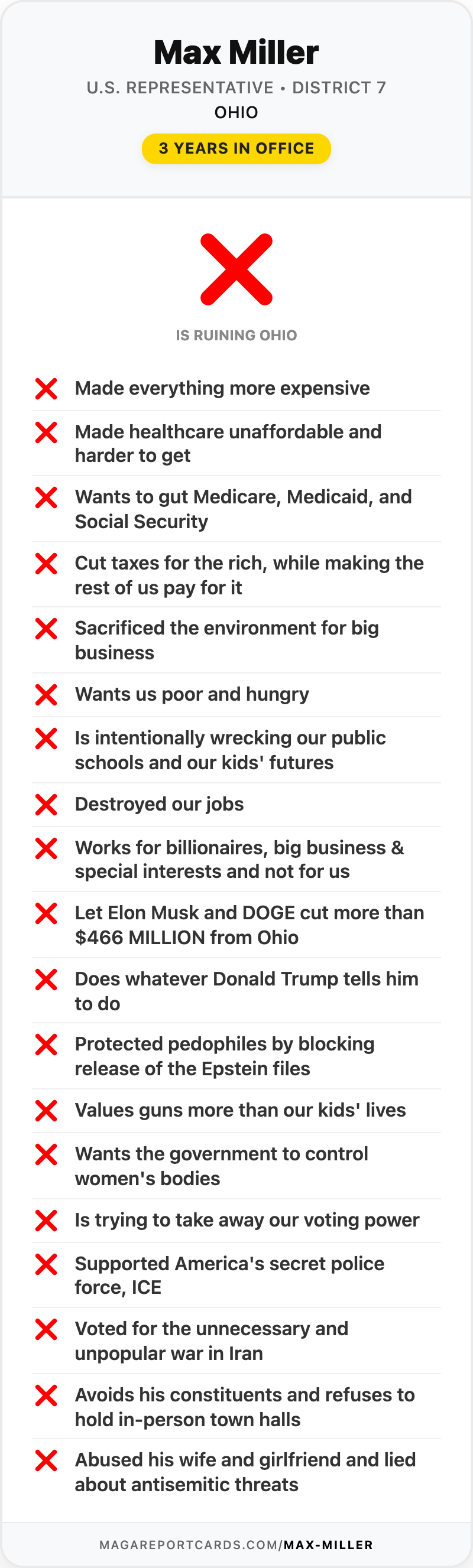
In a sworn statement filed on July 8, Ohio Congressman Max Miller told a court that unions are walking away from his campaign.
"A lobbyist for a trade union informed me by text message that the union was withdrawing its support for my campaign because of these allegations," he wrote. "Representatives of two other organizations that had supported my campaign likewise informed me or my campaign that their support was ending because of these allegations."
One union's national organization, he said, notified him in writing that it will endorse his opponent in November.
Miller put the cost at about $30,000 in lost organizational support, plus individual donors who told him they were done. He estimated his reelection would now cost $2.5 million to $3 million — up from $1.4 million before.
The filing is part of a defamation lawsuit Miller brought against his ex-wife, Emily Moreno, after a May report on allegations about his conduct toward her. Miller denies those allegations.
His explanation for the union exodus is that the allegations drove it.
There is a simpler explanation sitting in his voting record.
14 Percent
The national AFL-CIO, the largest federation of unions in the country, scores members of Congress on how they vote on issues affecting working people.
Through 2025, it scored Max Miller at 14 percent.
That is not a number a "friend of labor" posts. Fourteen percent means that on roughly six out of every seven votes the AFL-CIO tracked, Miller voted the other way.
Here is one of them.
The Vote on a Million Workers' Contracts
In March 2025, Trump signed an executive order stripping collective bargaining rights from federal employees. A second order in August 2025 widened it. Together they ended union contracts for more than a million federal workers — one out of every 14 workers in the whole country covered by a union contract.
On December 11, 2025, a bipartisan bill to give those workers their contracts back passed the House 231–195.
Miller voted no. He was one of the 195 Republicans who voted to keep the orders in place. The Senate has not touched the bill since.
Seven months later, he was telling Ohio radio audiences what kind of Republican he is.
"I've been a Davis-Bacon Republican since Day One."
That was Miller on July 13, referring to the 1931 law that guarantees construction workers on federal projects a decent wage.
"We are not a right-to-work state, ladies and gentlemen," he added. "And, you know, this is one of these things where hopefully this shows you and the rest of the district that I am representing the district as it is — I am not going to Washington, D.C. to represent my own wants, feelings, wishes and needs."
To be fair to his record: in June, Miller did break with Speaker Mike Johnson and vote for a bill making it easier for workers to unionize — after Democrats used a procedural maneuver to force it onto the floor. He has also collected some union endorsements, including from the Ohio Conference of Teamsters in early July and a local operating engineers union later that month.
But a 14 percent lifetime score is what the whole record adds up to. One good vote, forced to the floor by the other party, doesn't move it.
His Ex-Wife's Lawyer Made the Point Bluntly
Miller's affidavit came with no proof attached — no text message, no letter, no name of a union.
Moreno's attorney, Subodh Chandra, called the claim hearsay in a July 20 filing and offered an alternative reading.
"Nor is the reason self-evident," Chandra wrote. "Even if it's true, the union could have been walking away from Miller because he's a lousy candidate to champion its issues."
A Miller spokesperson did not respond to a request for comment.
The District Is Union Country
Miller represents Ohio's 7th District, in the Cleveland area. Ohio is more unionized than the country as a whole — 11.6 percent of wage and salary workers, per the Bureau of Labor Statistics.
His opponent is Brian Poindexter, a city councilman and a member of the local ironworkers union. Poindexter has built his campaign on workers' rights.
The endorsement math has moved with him. The Cleveland Building and Construction Trades Council endorsed Miller in 2024. This cycle, the Ohio State Building and Construction Trades Council — Cleveland is one of its 14 member councils — endorsed Poindexter. So did the Ohio AFL-CIO, which called him the "best and easy choice to elect someone who will spend every day fighting for us." So did the American and Ohio Federation of Teachers, the United Steelworkers, and the American Federation of Government Employees — the union whose members lost their contracts in the order Miller voted to preserve.
"Strengthening collective bargaining rights, allowing more and more people to join the union of their choice if they so choose — those are the types of things that I really want to fight for," Poindexter told Politico.
Recent polling shows Miller trailing in a district Trump carried by 11 points.
The Rest of the Ledger
The union story is one line in a long year for Miller. Two Ohio senators have told him to resign, while Kroger, Walmart and Nike are still on his donor list. He asked the House Ethics Committee to investigate him, and within hours it agreed. Two thousand pages of records have detailed further allegations, including a child abuse investigation. And when Republican senators called on him to quit, he answered by announcing a $1 million loan to his own campaign and staying on the ballot.
Through all of it, his message to Ohio's 7th District is that he's a union guy who got a raw deal.
The AFL-CIO put a number on the first half of that: 14.
Source
Riley Rogerson, "Max Miller insists he can win again — but warns in court filings he's bleeding union support and cash", Politico, August 19, 2026.