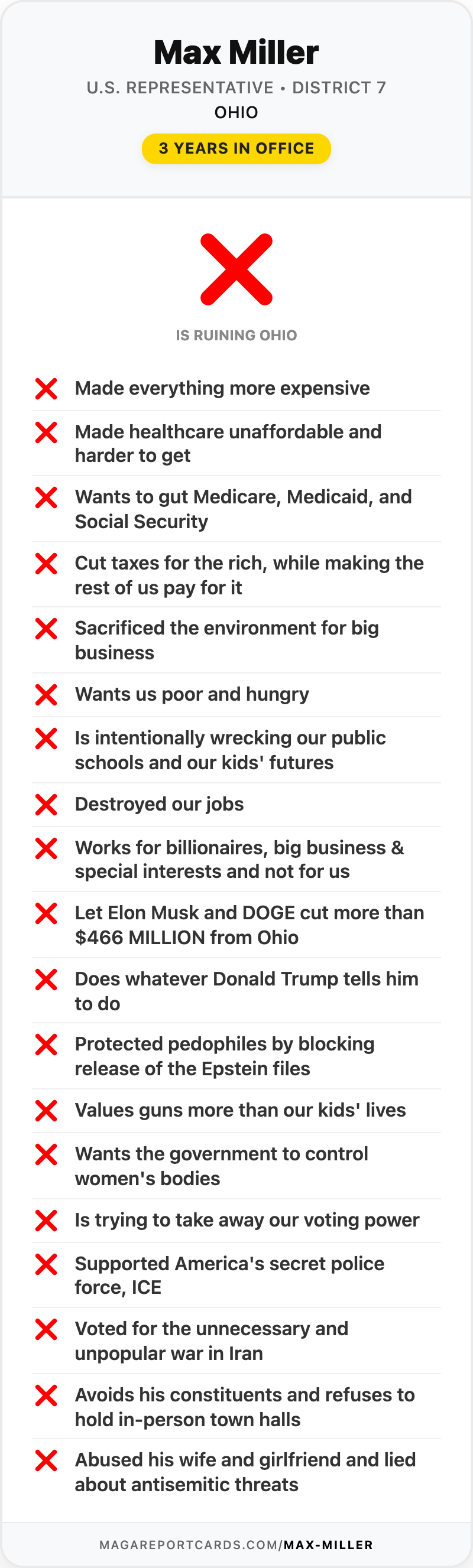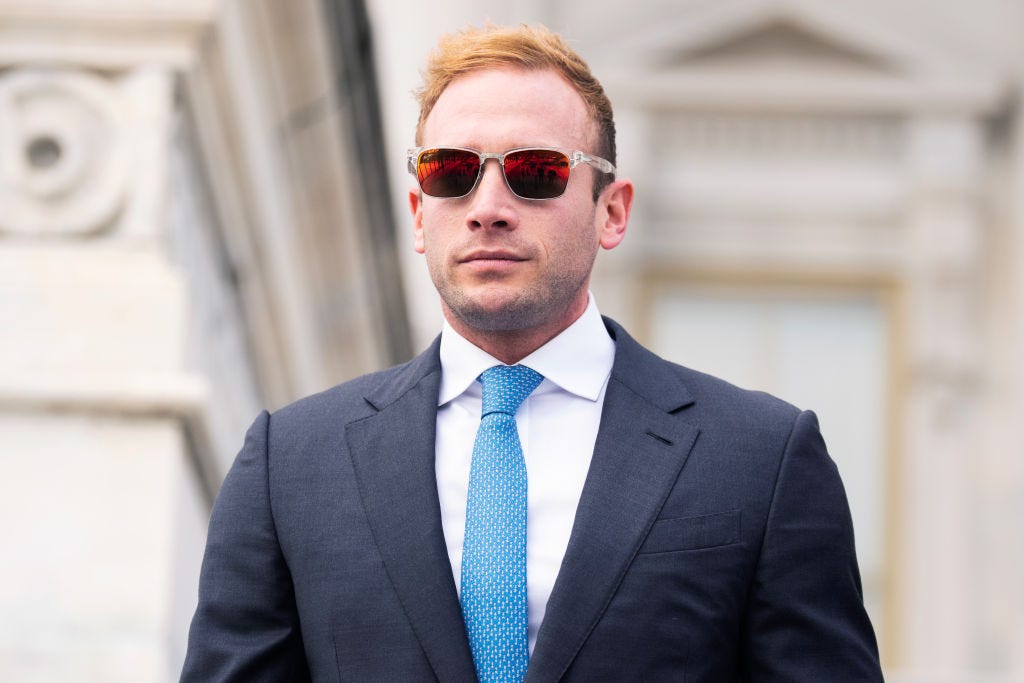
By now, almost every Republican who has to answer to Ohio voters has said something about Max Miller.
Sen. Bernie Moreno — Miller's former father-in-law — said in August that "if there are any basic standards of character required to hold elected office, Max Miller fails them." Ohio's other senator, Jon Husted, called on Miller to step down too. Montana's Tim Sheehy joined them, and Miller answered by loaning his own campaign $1 million and staying on the ballot.
But there is one group that has not said a word: the corporations writing him checks.
On Monday, Judd Legum at Popular Information published a list of the companies still funding Miller's re-election. We went and pulled the Federal Election Commission records for his campaign committee ourselves. Here is what corporate America has put behind him this election cycle.
The list
Every one of these is a corporate PAC — money the company's own political operation chose to send. The Daily Mail published the allegations on May 7, 2026, so the dates matter:
- Stanley Black & Decker — $10,000, in two $5,000 payments, both before May 7
- Elevance Health, the health insurance giant — $9,000, of which $1,000 came after
- Pfizer — $8,000, of which $2,500 came after
- Altria, the maker of Marlboro — $7,500, of which $2,500 came after
- John Deere — $5,000, of which $3,000 came after
- AT&T — $4,500, all before
- Kroger, the Cincinnati-based grocery chain — $3,500, both checks dated February 2025
- Citigroup — $3,000, the last of it three days before
- DraftKings — $2,500, before
- TD Bank — $2,000, all of it after
- Nike — $2,000, before
- Walmart — $2,000, before
That is what the public filings show through the July quarterly report, which covers April 16 to June 30, 2026 and was filed on July 15. Two of those entries did not arrive as direct checks to the campaign: Stanley Black & Decker's $10,000, and $3,000 of Pfizer's, came through the Max Miller Victory joint fundraising committee.
Popular Information lists Elevance, Altria, Pfizer, John Deere and TD Bank among the companies whose money "was received after the publication of the Daily Mail article." Kroger, Nike and Walmart are on its other list — corporations that "donated $2,000 or more this cycle."
Legum's team contacted all of Miller's corporate donors and asked a simple question: do you still support his candidacy?
Citi declined to comment. None of the others responded.
What the money is actually buying
It is worth being precise about who these donors are, because the list is not random.
Miller sits on the Ways and Means Committee — the committee that writes the federal tax code, sets tariff policy, and has jurisdiction over Medicare and health-plan rules.
Now look at the list again. A health insurer. A drugmaker. A tobacco company. A bank. Two of the country's biggest retailers. A farm-equipment manufacturer. These are companies with real money riding on what the Ways and Means Committee does, and five of their PACs sent checks to a member of that committee after the allegations against him became public.
Kroger's presence on the list stings the most for Ohioans. It is an Ohio company, headquartered in Cincinnati. Its two checks are dated February 2025, well before any of this became public — and like every other company here, it would not answer Popular Information's question about whether it still supports him.
This is who Miller works for
The corporate money is not an accident or an outlier. It is the whole structure of how Miller is funded.
Only 6% of the $6.8 million Miller has raised since 2020 came from small grassroots donors, and he ranks #256 out of 440 House members in grassroots funding — meaning most of the House is better funded by ordinary people than he is. AIPAC is by far his largest source of money this cycle — $201,302, more than five times the next-largest — and pro-Israel PACs have given him $366,455 across his career. People at KKR, the private equity firm whose tax treatment his own committee writes, have given him $35,143. (Who Bought My Rep tracks the grassroots numbers.)
Miller does not have a base of small donors who could pull their support and hurt him. He has institutions. And institutions, so far, have decided this is fine.
That is why the corporate silence matters. When a company gives to a candidate, it is a choice made by people in a room, renewed every quarter. Continuing to give after the allegations became public is also a choice — just a quieter one.
The pattern in Washington
Miller's protection has come from the top down, and it has been remarkably consistent.
President Trump, whom Miller served as an aide, called him "a very good person" and said, "I'm going to let the families figure that out." Speaker Mike Johnson said, "There's all sorts of domestic events going on with 435 members of Congress all the time, it's not my business to get engaged in it." Rep. Jim Jordan called the case a family matter — a standard he did not apply to a Democrat facing similar accusations a few weeks earlier.
Miller has denied the allegations and sued his ex-wife for defamation. In August he asked the House Ethics Committee to investigate him, saying he had "absolutely nothing to hide." The committee opened an investigation the same day — into domestic violence and illegal drug use.
Ohio's 7th District did not get a say in any of this. Miller has spent more than a year avoiding a real town hall — he scheduled one and canceled it, held a telephone town hall with pre-screened questions, and quietly announced a 60-person event in a small print newspaper with no open sign-up.
He will not take questions from the people he represents. His donors did not answer them either.
What you can do
The companies on this list sell you groceries, phone service, sneakers, insurance and prescriptions. Several of them spend heavily on advertising about their values. None of them answered a reporter's question about why they are funding Max Miller.
They will answer their customers faster than they answer a newsletter. Ask them.
Source
- These corporations are supporting an alleged domestic abuser for Congress — Popular Information, August 10, 2026. Photo: Tom Williams/CQ-Roll Call via Getty Images.