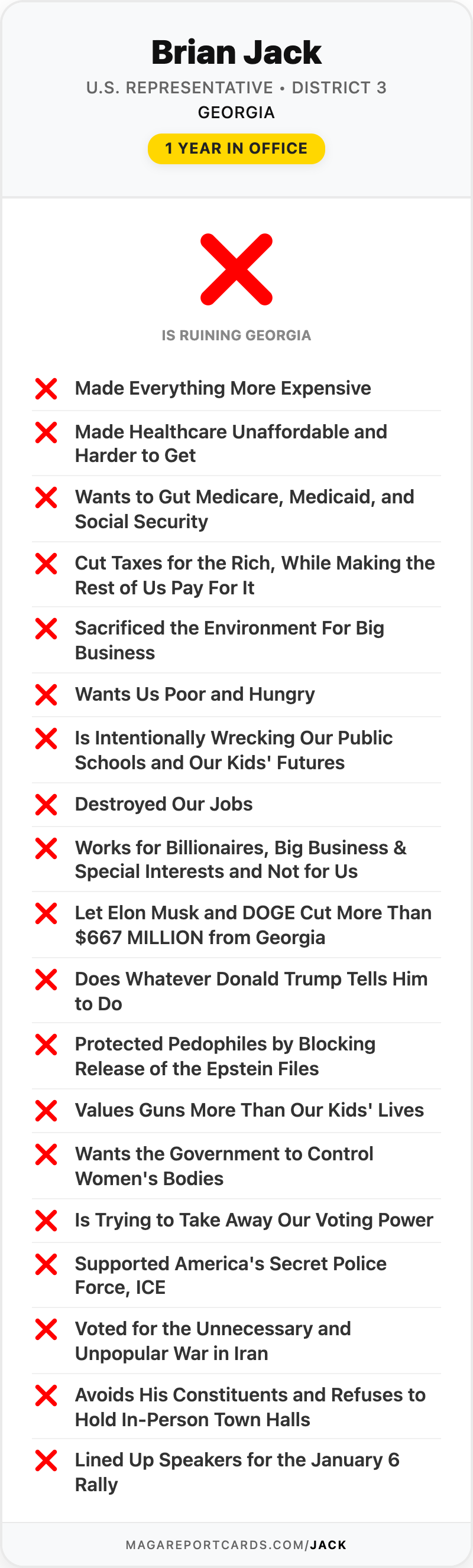
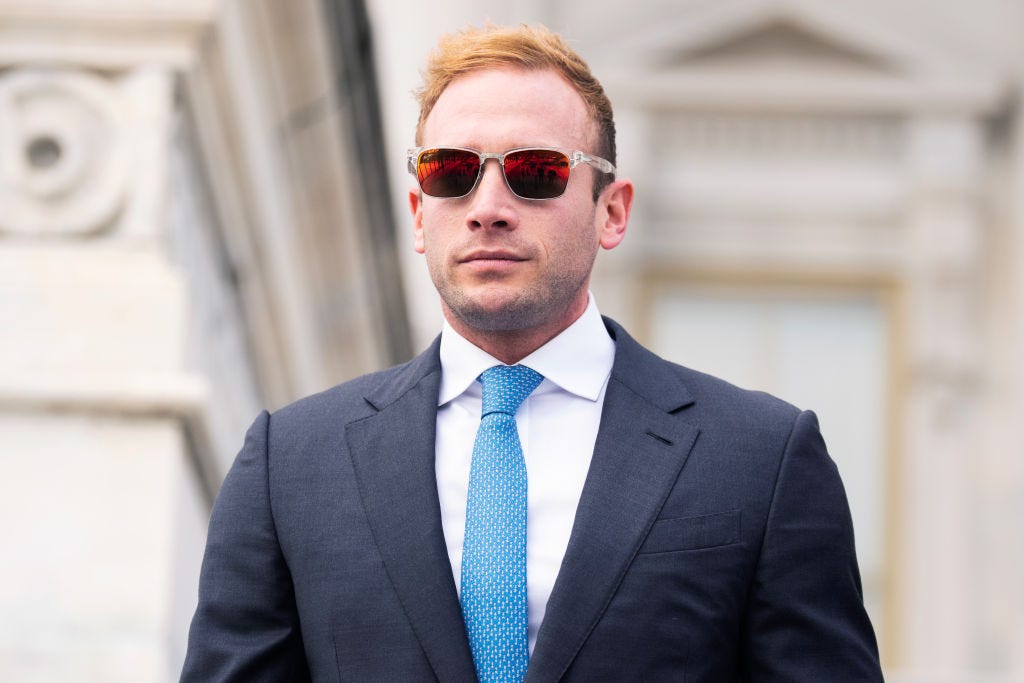
On March 24, 2026, the House passed Brian Jack's Muhammad Ali American Boxing Revival Act by voice vote — no roll call, forty minutes of debate, done.
Jack, a first-term Republican from Georgia's 3rd District, called it "landmark boxing legislation that will revive one of America's greatest sports in the name of one of America's greatest athletes." His office's summary of the bill includes this sentence:
"MAABRA preserves the 'Ali Act' that was codified in 2000."
A month later, Muhammad Ali's grandson sat in front of a Senate committee and said the opposite.
What Nico Ali Walsh told the Senate
Nico Ali Walsh — a professional middleweight and Ali's grandson — testified against the bill on April 22, 2026:
"The Ali Act was built on a simple principle. The people controlling fighters should not also control the entire marketplace those fighters depend on."
And:
"If this bill is passed in its current form, it should not have my grandfather's name on it, as it would betray the principles his Act was created to protect."
Oscar De La Hoya, the six-division champion who now runs Golden Boy Promotions, testified against it in the same hearing. He pointed at the company everyone in the room understood the bill was written for: "The UFC and its parent company agreed to a $375 million anti-trust settlement after fighters accused them of suppressing wages and restricting competition."
Testifying in favor: Nick Khan, the president of WWE — which, like the UFC, is owned by TKO Group Holdings.
What the bill actually does
Strip away the safety provisions and the bill has one structural idea in it: a new legal category called a unified boxing organization, or UBO.
The bill defines a UBO as an organization that signs boxers to contracts, matches them against each other under its own rules, and — this is the operative clause —
"without reliance on a sanctioning organization operating independently of such association, league, or centralized industry organization, implements a system for title belts and ranking for boxers under contract."
One company signs the fighters, promotes the fights, writes the rankings, and hands out the belts. That is the UFC model. It is also the exact arrangement the 1996 and 2000 boxing laws were written to break apart, on the theory that whoever pays a fighter shouldn't also be the one deciding whether he's ranked high enough to get a title shot.
Then comes the sentence that does the work:
"A unified boxing organization... shall be deemed to be in compliance with the requirements of this Act if the UBO meets the requirements of section 5 and the conditions of this section."
Deemed to be in compliance. Not "must comply." A UBO satisfies the checklist in the new section, and everything else in the statute is treated as satisfied.
So what's on the other side of "deemed"?
Two things worth knowing by name.
The 12-month rule. 15 U.S.C. 6307b, added by the Ali Act, makes a coercive contract provision unenforceable against a boxer when it runs "for a period greater than 12 months." That provision exists because promoters used to lock young fighters into long exclusive deals as the price of getting a fight at all.
Jack's bill puts a six-year ceiling on a UBO contract — "Such contract may not exceed 6 years" — and says nothing about coercive provisions at all. Section 24 never once cross-references the section of the Ali Act that makes them unenforceable.
The disclosure rule. 15 U.S.C. 6307e requires a promoter, before it can collect a dollar, to tell the boxer the amount of compensation the promoter contracted to receive from the match, and every fee, charge and expense being assessed against him. It's how a fighter finds out whether his cut of a night's revenue was 40% or 4%.
Read the UBO section of Jack's bill start to finish. It requires a second ambulance, a second ringside physician, chest X-rays for fighters 40 and older, an anti-doping program, a filing with the Federal Trade Commission listing the company's state of incorporation, business address and website. It does not require a UBO to tell a fighter what the fight grossed or what the company kept.
That is what the boxing lawyers have been saying since the bill dropped. Pat English, the attorney who helped draft the original 1996 and 2000 laws, told Congress in December 2025 that the Revival Act is "a betrayal of the current act," because fighters signed to a UBO would not get comparable protection against coercive contracts or the promoter disclosures every other promoter owes. Industry figures who spoke to Uncrowned in August 2025 — anonymously, because they still have to do business in this sport — put it less delicately. "This is a power grab," one said. Another: "UBO basically means they just get to be the UFC in boxing without having to abide by the Ali Act disclosures."
Who is standing at the door
TKO Group Holdings owns the UFC and WWE. In 2025 its UFC president, Dana White, launched Zuffa Boxing in partnership with Turki Alalshikh, the chairman of Saudi Arabia's General Entertainment Authority. Zuffa Boxing has been signing fighters ever since.
If the Revival Act becomes law, Zuffa Boxing is the entity in the sport ready to register as a UBO on day one. White's public answer to the criticism has been that "fighters are going to have more options. Why is that a bad thing?"
De La Hoya's answer, at the Senate hearing: "[By] creating the UBO, it's segregation, basically... we will not see the very best fighting the very best." Once each league owns its own belts, there is no mechanism to make the champion of one fight the champion of the other.
The fair version of Jack's argument
The bill is not all carve-out, and it deserves to be described accurately.
It sets the first national floor on fighter pay — $200 per round — which applies to conventional promoters too, not just UBOs. It sets a first-ever national minimum of $50,000 in medical coverage and $15,000 in accidental-death coverage for every professional bout, with the premium explicitly not the fighter's responsibility. It requires a second ringside doctor and a second ambulance at UBO events, a brain-health exam after any knockout before the fighter's next bout, and annual MRIs for fighters 40 and older. It bars a UBO from awarding more than one championship belt per weight class — a real fix for a sport that currently has four sanctioning bodies selling belts.
It is genuinely bipartisan. Rep. Sharice Davids, a Kansas Democrat and former MMA fighter, is the original cosponsor. The Education and Workforce Committee reported it 30–4. It was endorsed by the Association of Boxing Commissions, Mike Tyson, the Teamsters, and the operators of Madison Square Garden, MGM Resorts and State Farm Arena. The California State Athletic Commission backed it unanimously.
And Lonnie Ali, Muhammad Ali's widow and co-founder of the Muhammad Ali Center, supports it. Her statement on House passage is worth reading closely, because it is a supporter setting conditions: her backing "has been and will continue to be centered on ensuring fighters achieve real safety and health protections, are provided genuine economic protections and fair compensation," and she "look[s] forward to working with the Senate to ensure this bill becomes the very best bill possible for fighters."
The Ali family is split on this. The widow says fix it in the Senate. The grandson says take the name off.
The part Jack hasn't answered
A $200-per-round minimum is a floor for a four-round club fighter making $800 a night. It is not the issue in a sport where the money is in the top of the card, and it is not what the disclosure rule protects. Those are different problems, and the bill solves the small one while removing the tool that addresses the big one.
Jack's own summary says the bill "preserves the Ali Act." A fighter who signs with a UBO gets no legal right to be told what the promotion made off him — the disclosure every other promoter in America owes every other fighter, and the one the Ali Act's own draftsman says is missing here. The word "disclosure" does not appear anywhere in Jack's bill.
The bill is now sitting in the Senate Commerce Committee. Ted Cruz and Jacky Rosen introduced a Senate companion on July 30, 2026. Somebody there should read Section 24 next to 15 U.S.C. 6307e and ask Jack which of the two a fighter would rather be covered by.
We deserve better.
Source
Darshan Desai, "Muhammad Ali's grandson and Oscar De La Hoya condemn controversial Ali Act reforms in U.S. Senate hearing," Uncrowned via Yahoo Sports, April 22, 2026; Michael Rothstein, "Explaining what's behind the Muhammad Ali Boxing Revival Act," ESPN, March 24, 2026. Bill text from GovInfo; legislative history from Congress.gov. Photo: Uncrowned/Yahoo Sports.