Nicole Malliotakis introduced H.R. 1329 on February 13, 2025. It was a short bill with a simple job: let the Smithsonian American Women's History Museum be built on the National Mall.
It became a genuinely bipartisan bill. 231 members signed on as cosponsors — 127 Democrats and 104 Republicans, more Democrats than Republicans. Judy Chu and Nancy Pelosi were on it. So were Brian Fitzpatrick, Claudia Tenney and Mike Lawler. Malliotakis was vice chair of the bipartisan Problem Solvers Caucus, and this was the kind of bill that caucus exists for.
On May 21, 2026, the bill died on the House floor, 204 to 216. Not one Democrat voted for it. Six Republicans voted against it.
Malliotakis quit the Problem Solvers Caucus the next day and said bipartisanship had become "a one-way street."
Here's what actually happened to her bill.
The bill she wrote didn't say any of this
You can read the version Malliotakis introduced. It's about land. It lets the museum sit inside the National Mall's Reserve, sets up how federal agencies hand over the site, and tells the museum's advisory council to seek out a broad range of women's experiences.
The word "biological" does not appear in it. Not once.
Now read the version that went to the floor. A new section was bolted on:
"The Museum shall be dedicated to preserving, researching, and presenting the history, achievements, and lived experiences of biological women in the United States."
"Prohibition.—The Museum may not identify, present, describe, or otherwise depict any biological male as a female."
That language was added in the House Administration Committee on March 18, 2026. The committee's own report records that it "adopted an amendment in the nature of a substitute offered by Mrs. Miller by voice vote," then reported the bill out 7-4, straight down party lines. A competing amendment from Rep. Norma Torres failed 4-7.
Malliotakis knew exactly who wrote it, and defended it
She didn't just go along with the change. She put out a press release the same day naming the amendment's author and calling it reasonable:
"It's unfortunate that, despite having more than 230 bipartisan cosponsors and the support of President Trump, this legislation passed out of Committee (7-4) along party lines, with the Democrats opposing it, simply because language was added via amendment by Rep. Mary Miller to ensure the museum exhibits only biological women."
The word doing the work in that sentence is "simply."
Mary Miller is not a random colleague. Eleven weeks later she filed a resolution asking the House to formally stop recognizing Pride Month, on the grounds that Americans are "inundated with perverse Pride Month displays." That's the member whose amendment Malliotakis accepted onto her own bill and then defended as one of two "reasonable requests."
The rewritten bill also handed the President discretion to change the museum's location within 180 days — a provision Malliotakis listed alongside the trans ban in the same press release, as one of two pieces of "clarifying language."
What she said on the floor
Malliotakis' argument for the language, as she put it to the House: "I hate to alert my friends on the other side of the aisle, but a museum dedicated to women's history should have women in it."
That's a good line. It's also not what the amendment says. The amendment doesn't require that the museum include women — the museum was always going to be about women, that's the entire point of the building. It requires that the museum be prohibited from depicting a specific group of Americans. It writes a federal ban on who a Smithsonian curator is allowed to put on a wall.
Rep. Joe Morelle of Rochester answered the plain version on the floor: "I am saddened and disappointed that the Republican majority has needlessly politicized what has for years been a bipartisan priority." He called the added language "an ideological poison pill intended to dictate what the museum can and cannot say about women's history."
Six Republicans killed it too
The story Malliotakis told is that Democrats sank her bill. Democrats did all vote no. But so did six members of her own party — Andy Harris, Warren Davidson, Josh Brecheen, Tim Burchett, Keith Self and Michael Cloud — who, sources told Spectrum News, questioned whether the museum was necessary at all and worried it would divide Americans.
She had 231 cosponsors. She got 204 votes.
At least 127 members who had put their names on this bill voted against it in the end: 126 of the 127 Democratic cosponsors, plus Tim Burchett, a Republican who had cosponsored it. The one Democratic cosponsor missing from that column, Nikema Williams of Georgia, did not vote at all. That is not a Democratic problem. That is a bill that got changed after people signed it.
The part that's actually about Malliotakis
Nobody made her keep the language.
She is the sponsor. It was her bill, her name on it, her five-year project. When the amendment went in — on a voice vote, in a committee her party controls 8-4 — she had a choice: strip the trans ban and pass a women's history museum with 231 cosponsors behind it, or keep the ban and lose the museum.
She kept the ban. The museum lost. And then she resigned as vice chair of the bipartisan caucus, telling Spectrum News: "I've been a member of the Problem Solvers Caucus for five years. And it's clear that it's become a one-way street."
The one-way street runs the other direction here. A bipartisan bill was rewritten by one party, in one committee, and reported out on a party-line vote, to add a culture-war provision that had nothing to do with the bill's purpose — putting a building on the Mall. The sponsor accepted it. When the bill died, she blamed the people who had cosponsored it.
This is a pattern with her
Malliotakis has a long record of standing where the wind is. Running for mayor of New York City in 2017, she said she regretted her vote for Trump — she'd write in Marco Rubio if she had it back. Two and a half years later, running for Congress in the one part of the city Trump carried, she accepted his "Complete & Total Endorsement" and said the earlier remarks were taken out of context.
She did the same on abortion. In 2017 she told Gotham Gazette that it was "not something that I could do, but it's not to say that my views should be imposed on other women." In 2020, running in a redder seat, she told the Brooklyn Paper: "I would consider myself pro-life, my voting record is as such."
The museum bill is the same instinct with a building attached. When the choice came down to the thing she'd worked on for five years or a line that pleases the right flank of her conference, the building lost.
The bottom line
There is no Smithsonian American Women's History Museum on the National Mall. There was a bill with 231 cosponsors that could have started one. Nicole Malliotakis wrote it.
Then her party added a provision telling the museum which Americans it may not depict, she defended it as reasonable, the bill died, and she blamed everyone else and walked out of the bipartisanship caucus she was vice chair of.
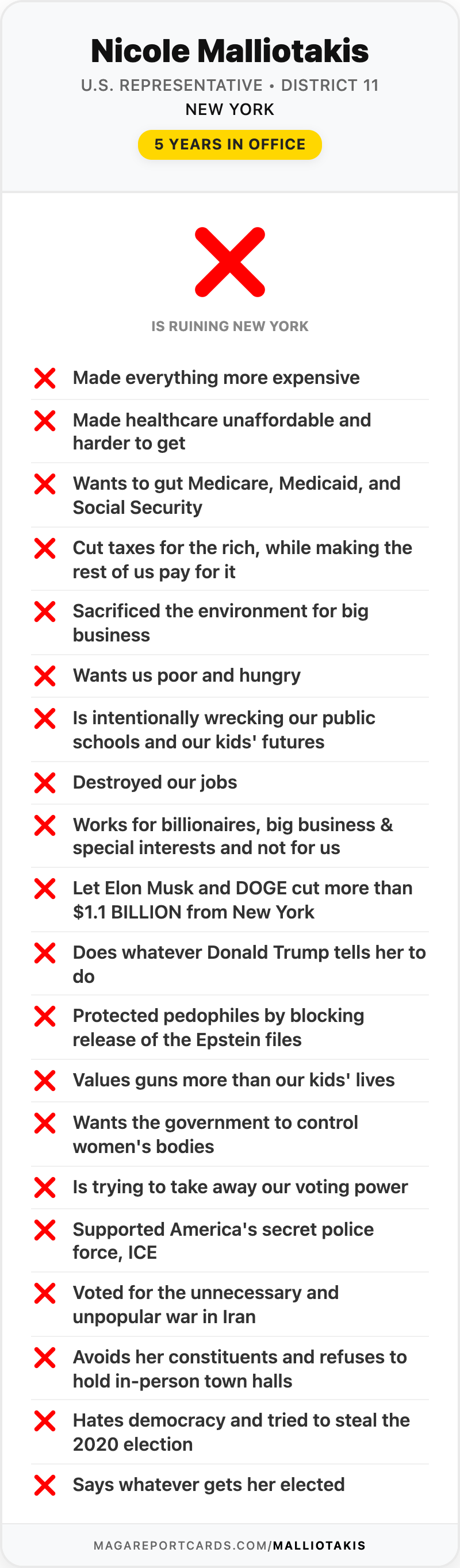
Staten Island and south Brooklyn have a member of Congress who still won't hold an in-person town hall while constituents rally outside her office every Monday. The museum vote is the same story in a different room: when it costs her something inside her own party, she folds.
Source
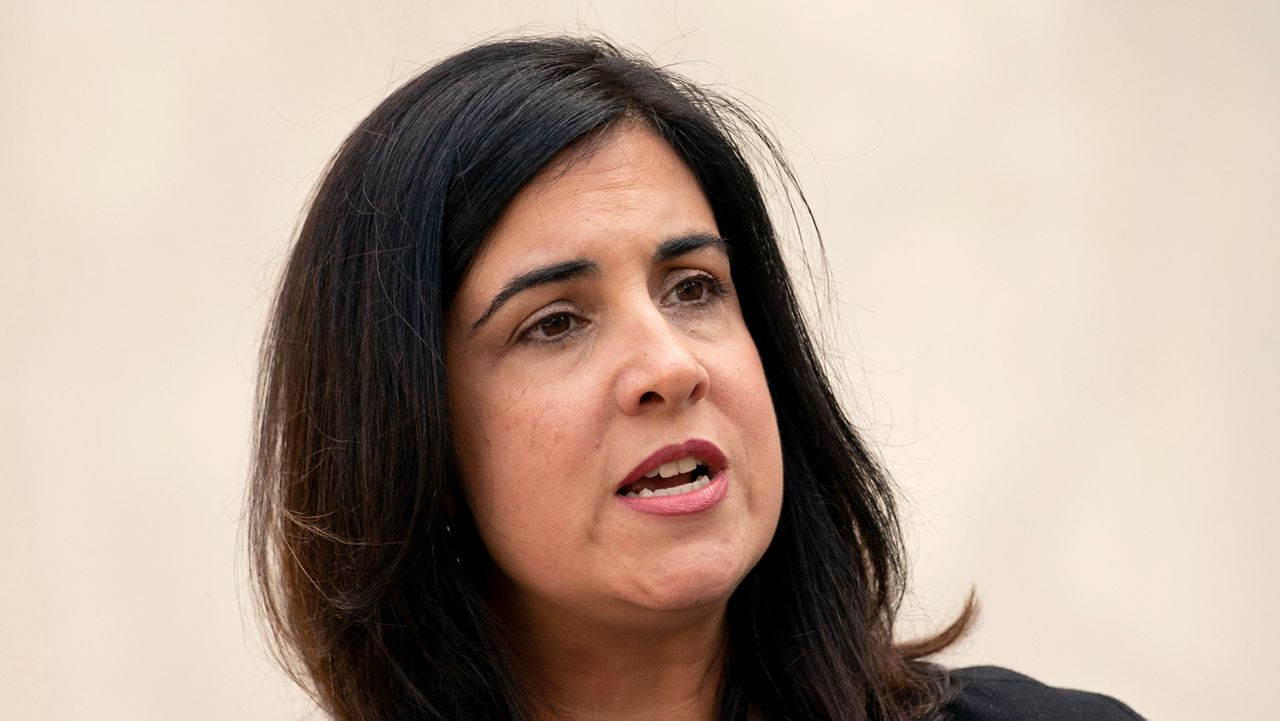
- Rep. Malliotakis leaves House caucus after failed museum vote — Spectrum News NY1, May 27, 2026. Photo: John Minchillo/AP.
- H.R. 1329 — Smithsonian American Women's History Museum Act — congress.gov