For more than half a century, the farm bill worked because of one deal.
Farm country needed crop insurance, price supports and disaster aid. Cities needed food stamps. Neither side had the votes alone. So Congress bundled them into a single bill, and rural Republicans and urban Democrats each voted for the other guy's half to get their own. That's not a theory about how the farm bill worked — that is how it worked, every five years, for fifty years.
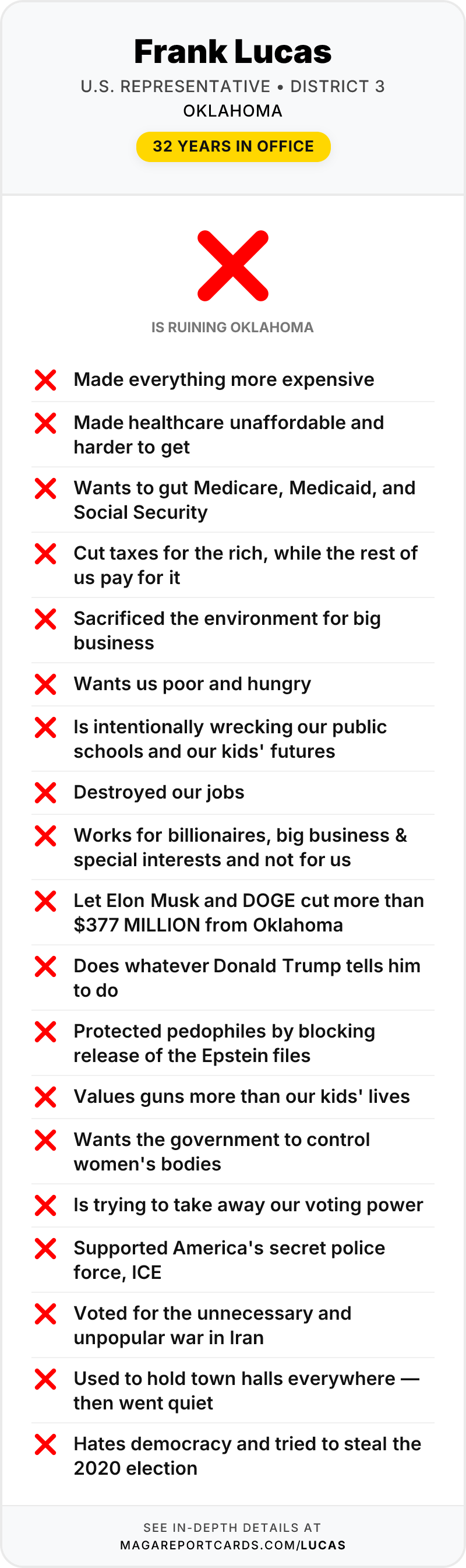
Frank Lucas has been in Congress for 32 years of it. He was first elected in 1994 and is now in his 17th term. Oklahoma Watch describes him as a longtime member of the House Agriculture Committee; he currently chairs its Subcommittee on Conservation, Research and Biotechnology. Few people in the House have spent more of a career inside that bargain than he has.
In a written statement quoted by Oklahoma Watch in January 2026, here is how he described where things stood:
"Fortunately, most of what typically gets passed in a Farm Bill was included in the recently enacted One Big Beautiful Bill, like updating the commodity support programs. This puts us in a much better position as we look towards passing what's left in a 'Skinny Farm Bill.'"
Fortunately.
What actually got split, and who got which half
Here's what the split did, laid out plainly.
The farm half — crop insurance, Price Loss Coverage and Agricultural Risk Coverage, disaster assistance, animal health money, trade support, and tax breaks for farm estates — went into Trump's budget bill, H.R. 1. Locked in over a ten-year window.
That bill did not go through the Agriculture Committee. It did not need 60 votes in the Senate. It moved through a special fast-track budget process called reconciliation, which lets a bill pass on a simple majority — so Republicans didn't need a single Democratic vote, and didn't get one.
The food half went in too. And it came out $187 billion smaller.
H.R. 1 rewrote SNAP: new cost-sharing rules that push bills onto states based on their payment error rates, more state responsibility for administrative costs, expanded work requirements, and changes to how benefits are calculated. The Food Research & Action Center calls the $187 billion figure the historic cut it is.
So the two halves of the old deal both moved — but only one of them got paid.
As Oklahoma Watch reported in the story where Lucas's "fortunately" line appears, that decision "effectively decoupled nutrition from agricultural policy." Analysts at the Oklahoma Policy Institute warned it weakens one of the few remaining bipartisan coalitions in Congress and puts new fiscal pressure on states.
We've written about what that cost-shift looks like on the ground: states now on the hook for billions in food stamp costs for the first time ever, and four million Americans already off the program while unemployment hasn't moved.
Then he voted for a farm bill that doesn't fix any of it
On April 30, 2026, the House passed the Farm, Food, and National Security Act of 2026 — the "skinny" farm bill — 224 to 200. Republicans voted 209 to 3 in favor. Lucas voted yes.
That bill had one obvious job available to it: put the food aid back.
It didn't. FRAC's read of the committee text was blunt — the mark "fails to include funding to restore the historic $187 billion in cuts to SNAP." It doesn't reverse the expanded time limits. It doesn't reverse the cost shift onto states. It doesn't restore benefits for the caregivers, veterans, older workers and homeless people who lost them.
What it does instead is extend SNAP's authorization through 2031 with every one of H.R. 1's cuts still in place. The smaller program is the one the next five years get built on.
45,277 households in his own district
This is not an abstraction in Oklahoma's 3rd District.
45,277 households there — about 15% of every household in the district — use SNAP to buy groceries. That includes 21,027 households with children and 14,920 with someone 60 or older in them, according to USDA's own data.
His district is rural and enormous — it stretches from the Panhandle to the western edge of the Tulsa suburbs. It is exactly the kind of place the old farm-bill bargain was built to cover on both ends at once: the people who grow the food and the people who can't afford it.
The farmers in that district got their ten-year certainty. Charlcey Plummer, an Oklahoma cotton grower quoted by Oklahoma Watch, described 2025 as the best cotton crop her family ever grew and the least money they ever made on one — "Every input on the farm is higher." She's right, and crop insurance and updated reference prices genuinely help her.
The grandmother two counties over who lost part of her food budget got nothing. There was no second bill for her. Lucas's word for that arrangement was fortunately.
The pattern in one bill
The same farm bill Lucas voted for on April 30 carries something else with his fingerprints on it: language that would permanently block the return of Fort Reno to the Cheyenne and Arapaho Tribes, by deleting the expiration date on an 18-year-old ban.
That's the through-line. When Frank Lucas has real power over a bill — and after 32 years, he has as much as anyone in that room — the things that get locked in permanently are the ones that take something away.
The bill is with the Senate now. The food aid can still go back in.
We deserve better.
Source
Oklahoma Farmers Face Uncertain Future as Comprehensive Farm Bill Splinters — Stephen Martin, Oklahoma Watch, January 30, 2026. Photo: Brent Fuchs/Oklahoma Watch.