There is a stretch of land west of Oklahoma City — about 6,700 acres of grass and hay bales and old brick buildings — that the Cheyenne and Arapaho Tribes have been trying to get back for more than 150 years.
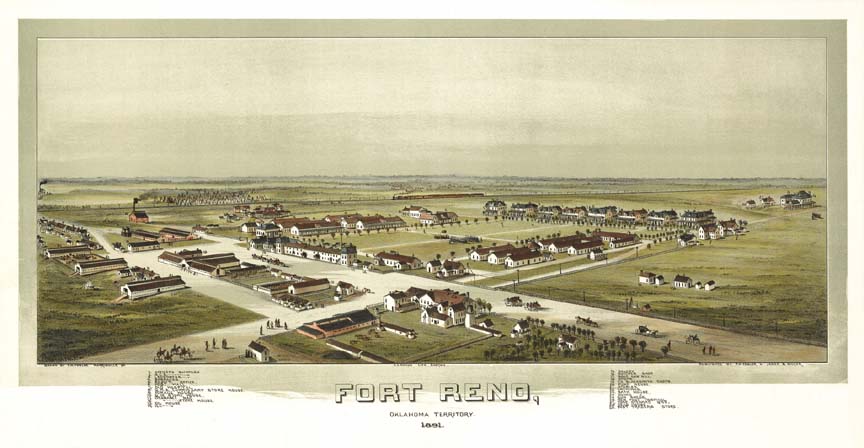
It was part of their reservation. In 1883, President Chester A. Arthur carved 9,493 acres out of that reservation and made it a military post called Fort Reno. The Army bred cavalry horses there, then mules for two world wars. When the Army was done with it in 1948, Congress didn't give it back. It handed the land to the U.S. Department of Agriculture, which turned it into a research station.
The tribes have never stopped asking for it. And for the last eighteen years, the thing standing in the way has been a single provision tucked inside the farm bill — the sprawling piece of farm and food legislation that Frank Lucas has led for years.
In February 2026, the House Agriculture Committee released its new farm bill. Buried inside the 800-plus pages was a change to that provision. Not a repeal. The opposite.
It deletes the expiration date.
What the provision actually does
Since the 2008 farm bill, federal law has barred the USDA from declaring the Fort Reno research facility "excess property" or transferring it to anyone else. Congress has renewed that ban over and over — through farm bills, through spending bills, through a disaster relief package.
Every one of those versions came with a sunset. An extension attached to the American Relief Act of 2025 ran the prohibition through September 30, 2025, and the November 2025 law that ended the government shutdown pushed it to September 30, 2026. That sunset is why the question kept coming back: every few years, Congress had to look at Fort Reno again and decide.
The Farm, Food, and National Security Act of 2026 removes the end date. If the language survives, the ban on transferring Fort Reno becomes a permanent feature of federal law — in place indefinitely unless some future Congress votes to take it out.
Lucas represents Oklahoma's 3rd District, which includes Fort Reno. He chairs the House Agriculture Subcommittee on Conservation, Research and Biotechnology. And as NonDoc reported, he has been the most visible federal lawmaker attached to this language for years.
His spokesman's answer is that prior federal settlements already resolved the tribes' claim, and that Congress needs to keep acting to protect the research at the site.
The committee approved the bill 34-17 in the early hours of March 4, after a markup that ran more than 20 hours. The full House passed it 224-200 on April 30.
"They say that we were paid for it. We haven't been paid for it."
That's Reggie Wassana, governor of the Cheyenne and Arapaho Tribes, in an interview with NonDoc.
The "we already paid you" argument is the whole federal case, and it rests on two payments. One came from treaty-era agreements over reservation land the tribes gave up in the late 1800s. The other came in 1965, when the government settled with the tribes for $15 million over lands ceded in 1891.
Here is the problem with using the 1965 settlement to close the book on Fort Reno. That settlement came through the Indian Claims Commission — and the Commission's authority only covered claims through 1946. Fort Reno wasn't transferred to the USDA until 1948.
The tribes aren't the only ones who noticed. The U.S. Department of the Interior looked at this and concluded the tribes hold a "credible, equitable claim" to land that wasn't included in the earlier settlements.
Wassana submitted written testimony to a House subcommittee in March 2026 — he was scheduled to appear in person but got caught by travel problems, so his statement went into the record instead. In it, he wrote that Fort Reno "sits on land taken from the Cheyenne and Arapaho by federal action," and that returning it would "acknowledge and remedy that dispossession."
"Returning Fort Reno to the Cheyenne and Arapaho Tribes is a concrete, lawful and moral step Congress can take to repair historical wrongs, restore tribal stewardship of ancestral lands and strengthen cultural and economic ties across Oklahoma," Wassana wrote.
This isn't a new idea, either. In 1949, Oklahoma Congressman Toby Morris introduced a bill to return roughly 6,900 acres to the tribes once the Army left. It passed the House in 1952 and died in the Senate. At the hearings, a 93-year-old Cheyenne man testified that tribal members had always believed the land would come back when the military no longer needed it.
That was 74 years ago. The land still hasn't come back.
Nobody is trying to take the research station away
The defense of the provision is that the science at the Oklahoma and Central Plains Agricultural Research Center is irreplaceable. A House Agriculture Committee aide said the center's work "cannot be replicated anywhere else in the world."
Maybe so. But that's an argument for keeping the research going — not for keeping the deed.
Wassana has said publicly that he's offered exactly that trade: the USDA keeps doing its research, the tribes get ownership, and the two work together — including on bison studies. In a September 2025 interview, he described the sticking point differently:
"We've offered everything and tried to do everything and bend as much as we can, but nothing is ever good enough for him to say, 'Yeah, let's work the deal together, we can be partners.'"
And this is the part that should bother anyone in Oklahoma's 3rd District, tribal member or not. As NonDoc laid out, there is no bill pending to transfer Fort Reno to the tribes. There is no legislation Lucas is defending the research station against. The only recurring legislative action on Fort Reno for eighteen years has run in one direction — inserting language to stop the USDA from ever letting the land go.
You don't need a permanent, no-expiration ban to stop something nobody has introduced.
What the tribes say it would be worth
Wassana has pointed to what the land could do if it ever came back. Leasing. Cattle. Crops. Energy development — there's oil and gas production in the surrounding area, and he told NonDoc it's "more than likely" there are reserves under Fort Reno, though he was careful to say that would need real evaluation before anyone counted on it.
Meanwhile, Lucas has been asking Washington to spend more on the facility. He requested $16.6 million from the House Appropriations Committee for renovations at the research center in 2025 — up from roughly $1.3 million in each of the two prior years. The tribes read that jump as one more way to lock the status quo in place.
"Keeping some type of research going, to me, it's more of a control issue than it is doing what's right for the general public," Wassana said.
Lucas's office did not respond to that reporter's requests for comment.
Thirty-two years, one answer
Lucas has been in Congress since 1994. He has led farm bills for years, and he sits on both the Agriculture Committee and the Financial Services Committee — the two committees whose industries make up most of his top PAC donors.
When a member of Congress's only recurring legislative business on Fort Reno is an eighteen-year-old provision keeping the Cheyenne and Arapaho Tribes' land out of reach, that's a choice he keeps making.
The 2026 farm bill now sits with the Senate. The Fort Reno language can still be pulled out. As NonDoc put it, what happens next is "less a single decision point than a recurring legislative loop" — and Lucas has controlled which way that loop turns for a very long time.
There's no town hall on the calendar to ask him about it, either. His congressional website's Town Halls page still tells visitors that "The 2024 Town Hall schedule will be posted after the New Year."
We deserve better.
Source
Farm bill draft would permanently block return of Fort Reno to Cheyenne and Arapaho Tribes — Stephen A. Martin, NonDoc, March 20, 2026. Photo: Fort Reno, Oklahoma, 1891, via Tribal Business News.