On June 29, 2024, Louisiana Congresswoman Julia Letlow signed a nondisclosure agreement with a company called Laidley LLC.
Laidley LLC is not really a company. It is a shell — the data center subsidiary of Meta, the corporation that owns Facebook and Instagram. Signing that paper gave Letlow access to confidential details about Meta's plans to build a $50 billion data center in Richland Parish, right in her own district.
Within months, she started buying stock in Meta. She also started buying stock in Nvidia — the company whose chips make Meta's data centers run.
Then she didn't tell anybody for more than a year.
That is the finding of a Gulf States Newsroom investigation by reporter Drew Hawkins, built on the NDA itself, which Louisiana Economic Development released in response to a public records request.
What the law says she was supposed to do
There is a federal law for exactly this situation. It is called the STOCK Act, and it does two simple things. It bars members of Congress from trading on nonpublic information they get through their job. And it gives them 45 days to report any trade they make.
Forty-five days. That's it. Tell the public what you bought and what you sold.
Letlow blew past that deadline by more than a year on the Meta and Nvidia trades.
Here is the timeline the records show:
- June 29, 2024 — Letlow signs the NDA with Meta's shell company.
- Six months later — she speaks at the public announcement of the data center, celebrating it.
- Jan. 31, 2025 — she sells part of her Nvidia holdings and buys between $1,001 and $15,000 more Meta stock.
- A week later — she sells part of her Meta holdings.
- July 2, 2025 — she sells the rest of her Meta shares.
- Aug. 11, 2025 — her broker notifies her. That is the notification date sitting beside all six Meta and Nvidia lines.
- Jan. 13, 2026 — she finally discloses them, in a periodic transaction report she signed that day. More than six months after the last sale, and more than a year after the first purchase.
At that public launch event, Letlow was delighted. "What a day for Richland Parish. I'm so honored to be here with all of you today," she said. "I was so excited about it, I even skipped a vote in Washington. Don't tell anybody, please."
She skipped a vote she was elected to cast, to appear at an event for a company whose stock she was buying. And she joked about it.
Her office says she didn't know
Letlow would not do an interview. Her spokesperson, Matt Smith, sent a written statement saying she had no role in directing any of her trades, including the Meta ones, and that the NDA had nothing to do with them because she was unaware the trades were even happening.
That is a familiar defense. Robert Hogan, a political science professor at Louisiana State University who studies elections, said members of Congress use it constantly — and that it's almost impossible to check.
"A lot of members make this argument," Hogan said. "Maybe that's the case. It's hard to tell."
There is a problem with the "it was limited in scope" part of the explanation, though. Smith said the NDA was narrow — just about "protecting preliminary business information."
The actual document is broader than that. Its definition of confidential information covers financial information, pricing, discounts and proposed terms. And it explicitly includes "the existence of this Agreement and the fact or nature of the discussions between the parties."
Read that again. The agreement barred Letlow from even admitting the agreement existed. A sitting member of Congress signed a contract with a private corporation that legally gagged her from telling her own constituents that she was talking to that corporation about a $50 billion project on their land.
Watchdogs say the whole thing is strange
The first thing that struck experts was not the stock. It was the NDA itself.
Kedric Payne is general counsel at the Campaign Legal Center and used to be deputy chief counsel at the House Office of Congressional Ethics. Meta's data center is a state economic development project, he pointed out — not a federal one. So why is a member of Congress involved deeply enough to need a secrecy agreement?
"That doesn't completely add up," Payne said.
Then there's the trading. Payne said this is a different and rarer category of problem than the usual congressional stock complaints.
"What we see here is that you have a lawmaker who appears to have access to non-public information and trades stock in a company related to that non-public information."
Nvidia wasn't a party to the NDA. Payne said that doesn't make those trades irrelevant. "You do not know what all was discussed with the NDA," he said, "but you can reasonably conclude that it would involve the business partners of Meta."
Hogan was careful not to overstate what a timeline alone can prove. "It's very hard to tell — did this motivate her purchase and sale? There are a lot of unknowns. But at the very least, it raises serious questions," he said.
The Meta trades were not a one-time slip
This is the part that should end any "honest mistake" reading.
In a report filed this January, Letlow disclosed 210 individual stock trades from the previous two years that she had failed to report on time. One hundred of them — including the Meta and Nvidia stock — were more than a year late.
Added up, those trades were worth somewhere between $225,000 and $3,185,000.
And the timing problem goes past Meta. On July 23, 2025, the House Appropriations Committee — which Letlow sits on — debated and approved budgets covering national security, the State Department and international lending institutions. Within two days, Letlow traded 16 stocks, including Boeing, Goldman Sachs, Taiwan Semiconductor and Visa. Combined value: between $16,000 and $240,000.
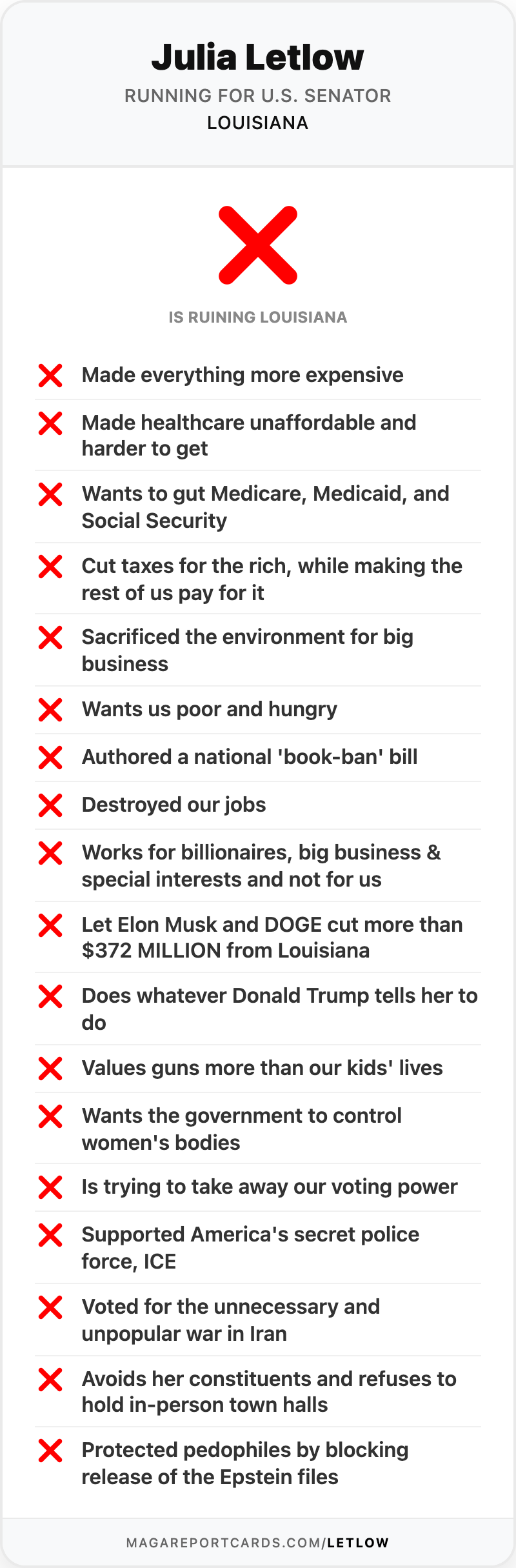
Letlow is not alone in ignoring this law. We found that 45 of the Republicans on this site broke the STOCK Act's disclosure rule — Letlow among them. The penalty is $200, and it is often waived. That is the entire consequence.
Payne's answer to anyone who wants to argue the sums are small:
"All trades are worth paying attention to. It's not about the value of the trade. It's about improper use of your official position, and about complying with the law."
Hogan put it in Louisiana terms. "Even on the low end of the range, $6,000 is a lot to the average Louisiana voter that she represents," he said. "It doesn't necessarily have to be a large sum in order for there to be nefarious possibilities there."
And she voted to ban the thing she was doing
Last month, the House passed the Stop Insider Trading Act, which would bar members of Congress from buying stocks and require them to give public notice before selling.
Letlow supported it.
She supported it while sitting on a pile of 210 late-disclosed trades, including stock in a company she had signed a secrecy agreement with.
Hogan named it plainly: "Perhaps there's some degree of irony here that she's busy trading stocks, not disclosing appropriately as she was required to by law and then voting for a law that clamps down on this behavior even more."
Payne was blunter about why that's not the contradiction it looks like. "There are many members of Congress who currently trade stocks and support banning the trade of such stocks," he said.
Voting for a rule is free. Following one is the hard part.
Who is actually going to look into this?
Here is the honest answer: probably nobody.
The House Ethics Committee has jurisdiction. It is controlled by Letlow's own party.
"If the potential investigators were Democrats, I think that things might look very different for her," Hogan said. "I think they may be less curious than Democrats would be."
That is the whole system in one sentence. The referee is on her team.
Why this matters for Louisiana
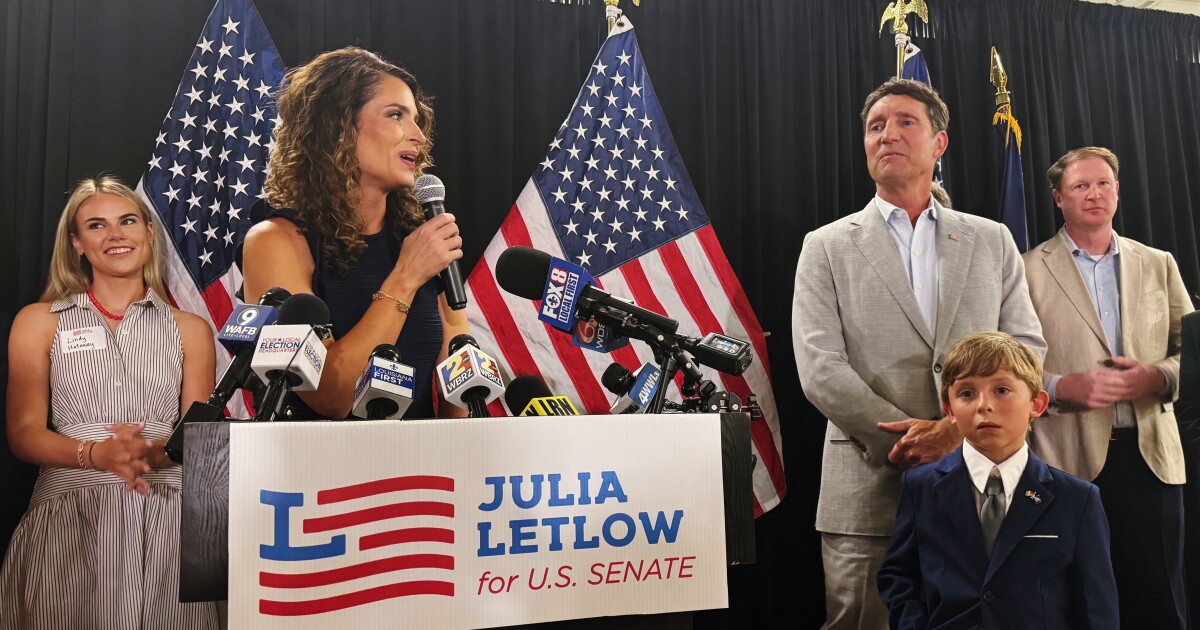
Letlow is not a backbencher. Since signing that NDA she got Trump's endorsement, beat incumbent Sen. Bill Cassidy and state Treasurer John Fleming in the Republican primary, and is now her party's nominee for the U.S. Senate. She faces Democrat James Davis in November.
We've written before about how she got there — she backed censuring Cassidy in 2021 for voting to convict Trump, and five years later she took his seat. And we've traced the $9.2 million super PAC that helped put her there, funded by LNG money, Occidental Petroleum, a stack of Louisiana LLCs and four corporations that don't disclose their donors.
Now add this: a secrecy contract with a corporation that spent more than $26 million lobbying the federal government in 2025.
Letlow's NDA wasn't unique in Louisiana. At least 54 elected officials in the state have signed similar agreements tied to big industrial projects since Gov. Jeff Landry took office, and Landry personally signed the same Meta agreement in April 2024 — two months before Letlow did. More than 100 Louisiana state employees have signed NDAs with Landry's office.
That's the culture. Deals about Louisiana's land, water and power get made behind a legal gag, and the people who live there find out when somebody decides to tell them.
Hogan's point is the one worth sitting with:
"Citizens should expect members of Congress to be able to tell them the truth straight up about what they know, and these kinds of agreements hamper that free flow of information."
You are supposed to be able to ask your representative what's happening in your parish. Letlow signed a contract that made answering that question a breach of agreement — and then traded the stock of the company she signed it with.
Source
Rep. Julia Letlow bought Meta stock after signing an NDA with the company, records show — Drew Hawkins, WWNO / Gulf States Newsroom, August 10, 2026. Photo: AP Photo/Jack Brook.