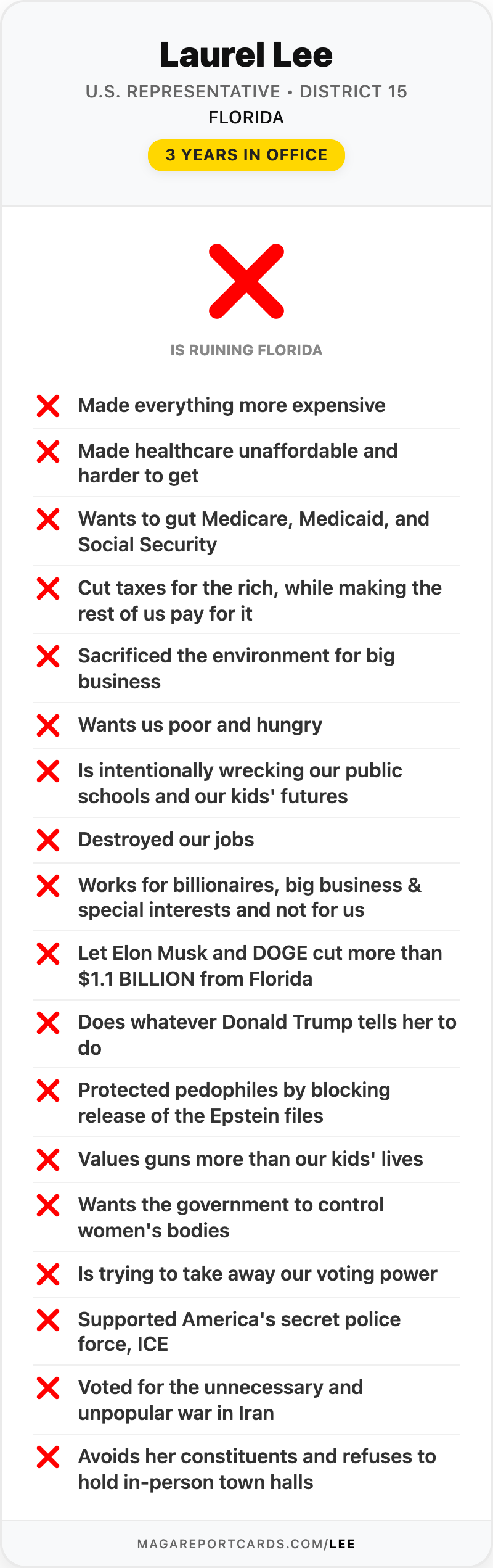
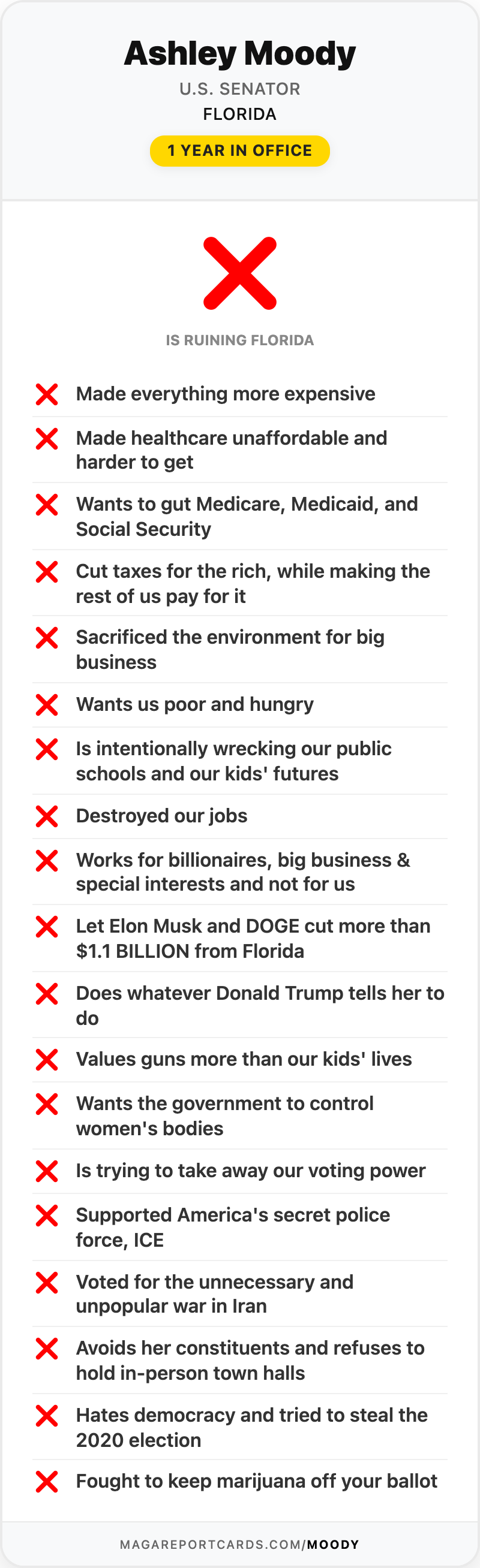
On September 3, 2026, Laurel Lee introduced the House version of a bill that would let the Postal Service decide whether your vote counts.
It is the companion to the Ballots by Election Day Act, which Ashley Moody introduced in the Senate on July 15, 2026. The bill amends the Help America Vote Act of 2002 to require that every ballot in a federal election — including absentee and mail-in ballots — be in the hands of an election official by the time polls close on Election Day. States would be barred from counting anything that arrives later. Ballots from military and overseas voters are exempt. It would take effect for federal elections in 2027 and after.
Read that again, because the mechanism is the whole story. The bill does not change who may vote by mail. It changes what happens to a ballot that a voter filled out correctly, signed correctly, and mailed on time — and that the Postal Service delivered a day late.
Under current law in a good part of the country, that ballot counts. Under this bill, it is thrown away.
Who actually loses a vote
The National Conference of State Legislatures keeps the list. Fifteen states, plus Washington, D.C., Guam, Puerto Rico and the Virgin Islands, will count a mailed ballot that arrives after Election Day as long as it was postmarked on or before it.
This is not a blue-state list. Mississippi is on it. So are Texas and West Virginia — three states with Republican legislatures that looked at the same question and decided a postmark should be enough.
The people who benefit from a postmark deadline are the ones with the least control over the mail: rural voters on long delivery routes, people who move late in the cycle, anyone whose ballot reached them close to the deadline because their county mailed late. None of them did anything wrong. The bill takes their votes anyway.
What Lee says, and what it leaves out
Lee's defense of the bill is that it isn't a restriction at all.
"One thing that's important to understand about this bill is that it doesn't limit voting by mail. It simply says that for state who allow mail voting, ballots must be received by Election Day."
That is true and beside the point. Nobody's right to request a mail ballot is being touched. What is being touched is whether the ballot gets counted, and the thing that decides it is not the voter's conduct. It is delivery time.
She also offered Florida as the model. "Florida is proof-positive that this works, that it does not deny any voter the right to vote," she said. The received-by-Election-Day rule, she told The Floridian, is "a really effective way of making sure that elections stay organized and that we have timely election results."
Timely results are the actual argument here, and it is worth saying plainly: the benefit on offer is that we learn the winner sooner. The cost is that some number of ballots cast on time are destroyed. That is the trade, and "organized" is doing a lot of work to obscure it.
Lee is not a bystander to how this works. She was Florida's Secretary of State — the official who ran the state's elections — before she ran for Congress. She knows exactly how much of a mail ballot's journey is out of the voter's hands.
The timing, and the Postal Service
This lands in a year when mail delivery is the whole fight.
The Trump administration has asked the Supreme Court to reinstate restrictions on vote-by-mail — a Postal Service plan, filed with the high court weeks before ballots go out, under which mailed ballots that do not meet new federal envelope and barcode standards can be returned to election officials. The judge who blocked it found those requirements could stop eligible voters from receiving their ballots at all. A receipt deadline is a much sharper instrument when the mail is that uncertain. Every ballot the Postal Service sends back or delivers late is an on-time voter who misses the cutoff.
It is also part of a longer push. Republicans in Congress and in the states have spent this cycle working the same seam — the SAVE America Act's documentary proof-of-citizenship requirement, state bills to end vote-by-mail outright, and litigation over which mail ballots a state may count. Each piece is defended as administrative housekeeping. Together they subtract voters.
The exemption gives the game away
The bill carves out military and overseas voters, who keep the ability to have a late-arriving ballot counted.
That exemption is an admission. Congress understands perfectly well that a ballot can be cast on time and arrive late through no fault of the voter — that is precisely why service members get protected from the rule. Lee and Moody are not confused about the problem. They have decided which voters deserve a remedy for it.
What the bill does
Ashley Moody's Ballots by Election Day Act, and the House companion Laurel Lee introduced on September 3, 2026, would forbid states from counting any federal-election ballot that reaches an election official after polls close, no matter how early it was postmarked. Fifteen states plus Washington, D.C. and three territories count those ballots today, including Republican-run Mississippi, Texas and West Virginia. Military and overseas voters are exempt from the deadline; everyone else is not. Lee, a former Florida Secretary of State, says the bill "doesn't limit voting by mail," which is true of the right to request one and false of whether it gets counted.
Source
Laurel Lee Introduces Companion Ballots by Election Day Act — Joseph Quesada, The Floridian, September 3, 2026.