Oregon has voted by mail for a quarter century. Voters chose it themselves. In November 1998, Ballot Measure 60 passed 757,204 to 334,021 — better than two to one — making Oregon the first state in the country to run all its elections by mail. By the 2000 presidential election, turnout hit 79 percent.
Christine Drazan wants to undo it.
In the 2025 legislative session, she was the lead sponsor of House Bill 3872. Her name is first on the bill: "Sponsored by Representatives DRAZAN, RESCHKE, HELFRICH, BOICE, YUNKER," followed by five more.
What the bill actually says
You don't have to take anyone's characterization of this. The Legislature publishes the bill's own digest. Here it is, in full:
"Makes in-person voting on the date of an election the standard method for conducting an election. Allows an elector to request a ballot that may be voted by mail if the elector is unable to vote in person on the date of the election. Retains vote by mail as the primary method for conducting elections for military and overseas electors and for electors who have a mailing address outside of Oregon. Requires electors to present valid government-issued identification when appearing in-person to vote or when requesting a ballot be sent by mail. Requires all ballots to be returned by the date of an election. Removes a requirement that the state pay postage for ballots returned by mail."
Break that into what it does to an actual Oregon voter:
- Mail voting stops being the default. If you want to vote by mail, you have to be "unable to vote in person on the date of the election" and request a ballot.
- You need a government-issued photo ID — not just to vote in person, but even to request a mail ballot.
- Ballots must be back by Election Day. Oregon currently counts ballots that arrive up to seven days late as long as they were postmarked on time. That grace period disappears.
- The state stops paying your return postage. Voting by mail would cost you a stamp again.
- It refers the whole thing to voters at the next general election.
Now here's how she describes it
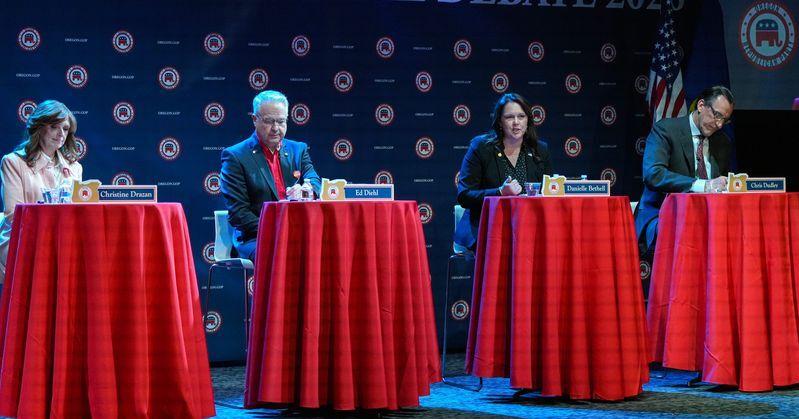
Asked about vote-by-mail by the Statesman Journal in May 2026, Drazan summarized her own bill this way:
"I had legislation that would have created an opportunity for in-person voting while protecting access to the absentee ballot."
Compare that sentence to the digest above.
"Created an opportunity for in-person voting" makes it sound like an addition. It isn't. What the bill changes is the default: in-person on Election Day becomes the standard method, and mail voting becomes the exception you have to qualify for.
"Protecting access to the absentee ballot" — the bill conditions that access on presenting a government-issued ID and on being unable to vote in person, then makes you pay the postage and get it back by Election Day or it doesn't count.
That's not protection. That's four new obstacles described as a courtesy.
She also told the paper that Oregon's system to determine voter eligibility needs improvement — the standard framing for a problem nobody has demonstrated.
Who each of those changes hits
Every item on that list falls hardest on a specific kind of Oregonian.
- The photo ID requirement is only an inconvenience if you have one. It's a barrier if you don't drive, don't travel, or let a license lapse.
- Election Day as the deadline matters most to whoever's mail runs slowest — which is not the people who live nearest the post office.
- Paying your own postage is a small amount of money. That's the point. Small costs are exactly the kind that change who bothers.
- In-person on a Tuesday as the default is easy if your schedule is your own. It isn't if you work a shift, need childcare, don't have a car, or are sick that day.
None of that requires a study. It's just reading the bill line by line and asking who each line makes it harder for.
Oregon already told the Legislature what it thought
Drazan's House bill wasn't the only measure of its kind that session. A similar Senate bill, SB 210, would have asked Oregon voters in November 2026 whether to make in-person voting at polling places the standard, with mandatory photo ID.
The public response was so large it crashed the Legislature's own website. More than 9,000 pieces of testimony were submitted and over 150 people signed up to speak. Sen. David Brock-Smith called it "the bill that broke OLIS."
House Speaker Julie Fahey's response was short: "Vote by mail is not going anywhere."
Neither bill advanced. But Drazan is now the Republican nominee for governor, and a governor doesn't need a bill to pass to shape elections policy — she signs and vetoes them, and she appoints and pressures.
What we already know about her and democracy
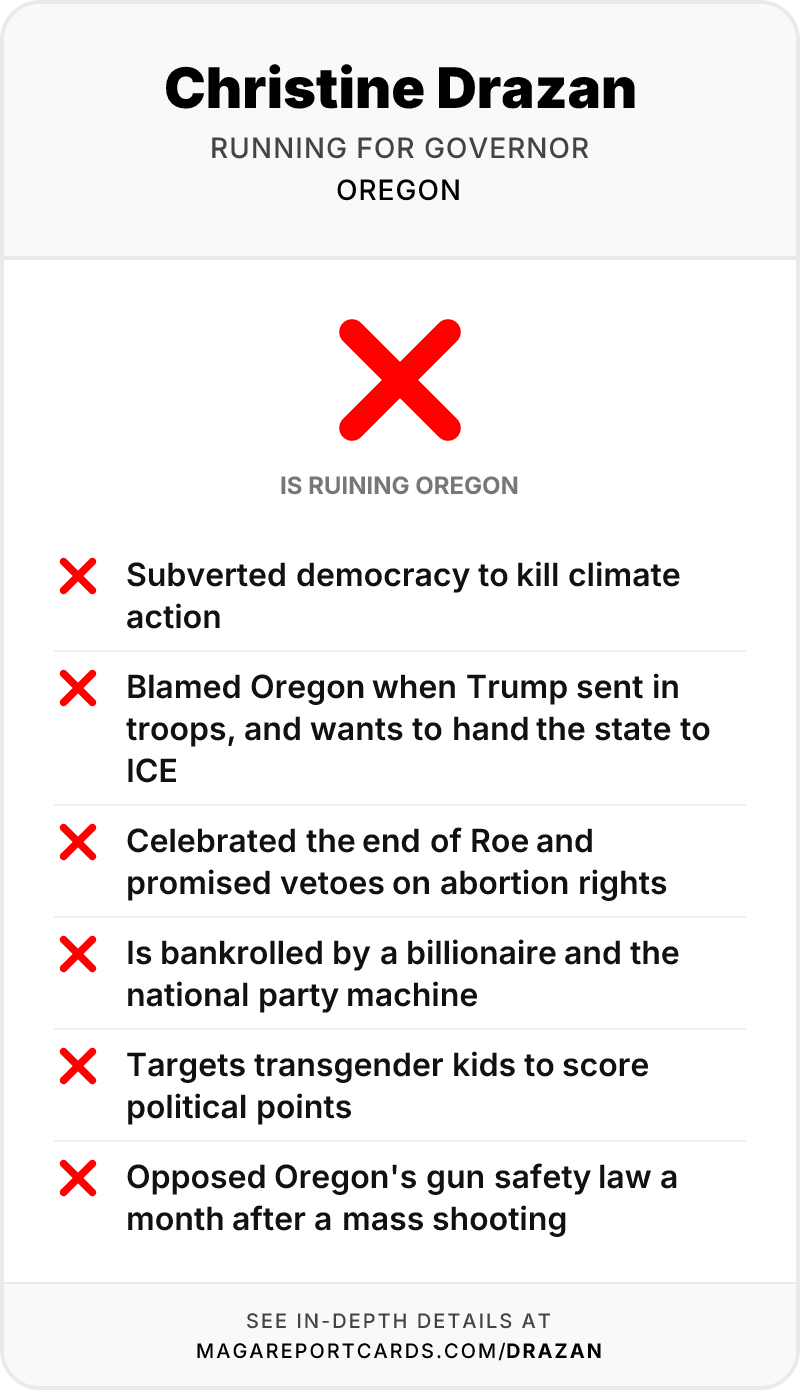
This isn't the first time Christine Drazan has decided that when the process isn't going her way, the process should stop. In February 2020, as House Republican Leader, she led her caucus out of the Capitol to deny the chamber the two-thirds quorum Oregon's constitution requires, killing a climate bill and taking bills on homelessness, wildfire preparedness and flood relief down with it. OPB reported the session ended "without a single meaningful bill reaching the governor's desk."
She couldn't win the vote, so she made sure nobody could vote.
Five years later, she put her name first on a bill to change how every Oregonian casts a ballot in the first place.
Oregonians voted for vote-by-mail two to one and have used it for 25 years. Christine Drazan wants to make it the exception instead of the rule, and she won't say so plainly. We deserve better.
Sources
- House Bill 3872 (2025 Regular Session) — Oregon Legislative Information System: sponsors and full bill digest
- What leading GOP candidates for Oregon governor say about vote-by-mail — Anastasia Mason, Salem Statesman Journal, May 11, 2026. Photo: Kevin Neri/Statesman Journal, via Central Oregon Daily.
- Bill to end vote-by-mail slows Oregon legislative website to a crawl — Dirk VanderHart, OPB, March 31, 2025